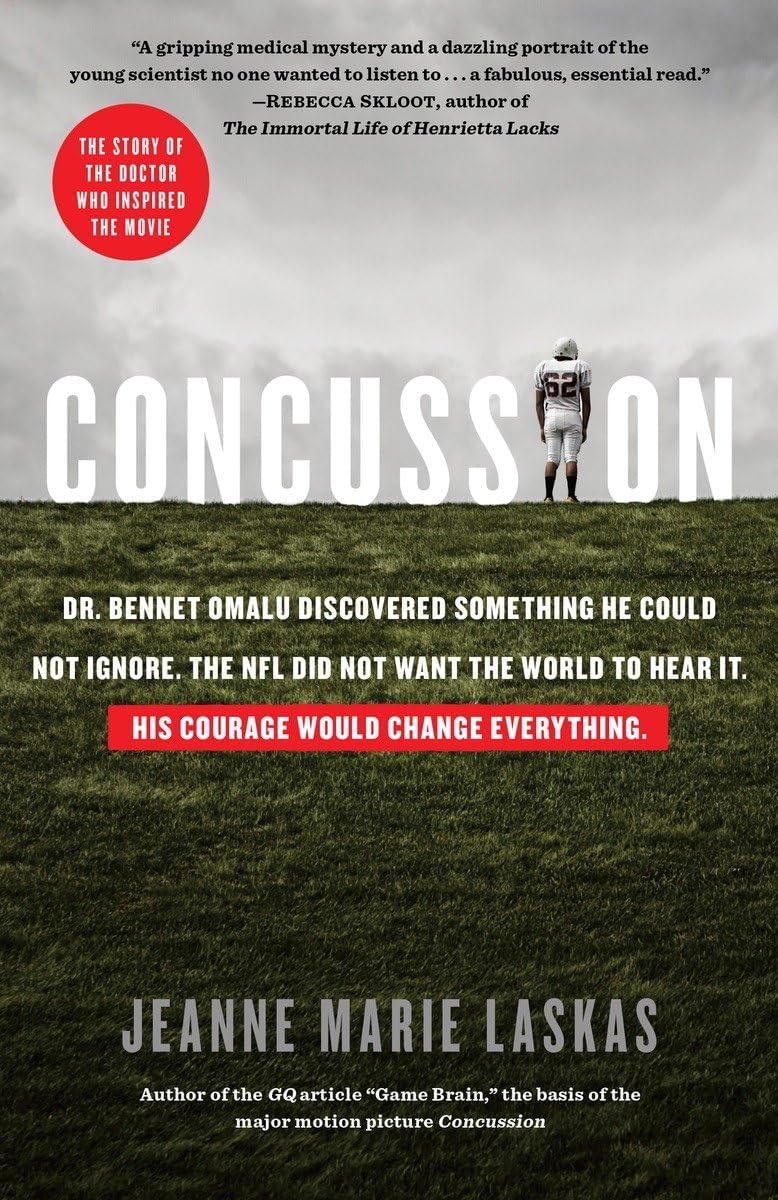
Concussion
Product ID: 20544826
Buy anything from 5,000+ international stores. One checkout price. No surprise fees. Join 2M+ shoppers on Desertcart.
Desertcart purchases this item on your behalf and handles shipping, customs, and support to Finland.
NEW YORK TIMES BESTSELLER • NOW A MAJOR MOTION PICTURE • Dr. Bennet Omalu discovered something he could not ignore. The NFL tried to silence him. His courage would change everything. “A gripping medical mystery and a dazzling portrait of the young scientist no one wanted to listen to . . . a fabulous, essential read.”—Rebecca Skloot, author of The Immortal Life of Henrietta Lacks Jeanne Marie Laskas first met the young forensic pathologist Dr. Bennet Omalu in 2009, while reporting a story for GQ that would go on to inspire the movie Concussion . Omalu told her about a day in September 2002, when, in a dingy morgue in downtown Pittsburgh, he picked up a scalpel and made a discovery that would rattle America in ways he’d never intended. Omalu was new to America, chasing the dream, a deeply spiritual man escaping the wounds of civil war in Nigeria. The body on the slab in front of him belonged to a fifty-year-old named Mike Webster, aka “Iron Mike,” a Hall of Fame center for the Pittsburgh Steelers, one of the greatest ever to play the game. After retiring in 1990, Webster had suffered a dizzyingly steep decline. Toward the end of his life, he was living out of his van, tasering himself to relieve his chronic pain, and fixing his rotting teeth with Super Glue. How did this happen?, Omalu asked himself. How did a young man like Mike Webster end up like this? The search for answers would change Omalu’s life forever and put him in the crosshairs of one of the most powerful corporations in America: the National Football League. What Omalu discovered in Webster’s brain—proof that Iron Mike’s mental deterioration was no accident but a disease caused by blows to the head that could affect everyone playing the game—was the one truth the NFL wanted to ignore. Taut, gripping, and gorgeously told, Concussion is the stirring story of one unlikely man’s decision to stand up to a multibillion-dollar colossus, and to tell the world the truth. Review: If you are interested in exploring the dark underbelly of that world Concussion is a must-read. - I have to admit from the start that I am far too close to the subject of concussions and CTE to write an objective review of Jeanne Marie Laskas’s outstanding best-selling book, Concussion. I can say, however, as someone who knows many of the book’s dramatis personae personally, who has witnessed first-hand what happens when as Laskas writes, “professional sports, Science, Medicine, Politics, Law, Families suffering, guys going crazy, beating up wives, guys killing themselves” and social media collide; who has seen what happens when those with money and power, big egos, and a firsthand WWE education for self-promotion, seize control of the concussion narrative from the scientists, that if you are interested in exploring the dark underbelly of that world Concussion is a must-read. Jeanne Marie Laskas is a brilliant writer and I found that I took my time to actually savour the book. I did not want it to end. I was like reading a real life mystery thriller. So many of the back stories that I had been wondering about were unfolding page by page. There was so much packed into this book that I believe most of the readers may not connect but, none-the less will grasp but will be looking for a sequel to fill in the questions many have after reading the book. But before you crack open the book, you need to understand one thing: it bears only a passing resemblance to the movie, and tells a very different story, one that needed to be told, but one that, even now, hasn’t been fully told. The book is not nearly so much about Dr. Omalu’s David and Goliath battle with the National Football League over telling the truth about chronic traumatic encephalopathy. It is not so much about how Dr. Omalu’s American dream was, as one movie reviewer put it, “waylaid by naysayers” (a familiar story for anyone who has read League of Denial or seen the Frontline documentary, but one which is re-told within the book’s pages) - although it is certainly worth reading to hear Dr. Omalu’s insider perspective on that battle. What sets the book apart, in my view, and where it breaks new ground only comes in the last 100 or so pages, which tells the story of how Dr. Omalu’s work was essentially co-opted by one man, Chris Nowinski from the Sports Legacy Institute (now renamed Concussion Legacy Foundation just weeks prior to the release of this book) , a man who was “neither a doctor nor a scientist … [but] a guy from Boston with his own very bad headache who had become a self-appointed brain advocate.” As someone who has spent the past 16 years in the cutthroat and competitive world of Concussion, Inc., and whose journey both intersects and parallels Dr. Omalu’s in so many respects, I know all too well why Dr. Omalu traces the beginning of his own “regrettable quagmire” in the “shady world of concussions in sports” to the day he received a phone call from Mr. Nowinski in November 2006. For it was that January 18, 2007 front page article in the Times that not only changed Dr. Omalu’s life forever, and thrust both Messrs. Alan Schwarz (NYT) and Nowinski into the concussion spotlight, but, as result of the unmatched power of the New York Times and SLI’s well-oiled publicity machine, allowed them to control and shape the media narrative about concussions and CTE, for better or in many cases, in my view, for worse, for the past decade. In the end, Concussion is an all-too-sad reminder that America is no longer a land where “people play [ ] fair. … [A] land where you d[o] honest work and work [ ] hard and harder still and because of your hard work you earn [ ] respect.” As both Dr. Omalu and I know all too well, it is instead a land filled with “jealousy, envy, rancor, [and] meanness.” And I am left with a haunting, unanswered question: Where would we be now if Dr. Omalu had been supported and encouraged to continue to study CTE, its causes, and potential remedies. . Review: An excellent scientific biography - Even if you're not much of a football fan, you may remember some controversy a few years back when the NFL, confronted with evidence that their players were in danger of permanent brain damage, established some new rules intended to tone down the worst of the inherent roughness of football and prevent players who had sustained a head injury from going back onto the field until fully recovered. A lot of fans thought that was sort of a sissy move: after all, the violence of huge, solidly-built men slamming into each other was part of the thrill of the game, and the risk of injury has always been part of any sport. In this case, however, the players really hadn't been in a position to make an informed decision about risks and rewards. Anecdotal evidence and independent studies of the effects of multiple concussions in rats had suggested for years that what happened on the football field couldn't possibly be good for the brain, but the NFL quickly arranged its own team of experts, and they insisted there was no danger. Then, one day in 2002, a young medical examiner in Pittsburgh, acting on a hunch, decided in the course of a routine autopsy to take a closer look at the brain of a pro football player. The brain belonged to Hall of Famer "Iron Mike" Webster, who had, in the final years of his life, become increasingly violent, irrational, and paranoid. The medical examiner, Bennet Omalu, was a Nigerian immigrant, driven and curious, protégé of the celebrated forensic pathologist Cyril Wecht. What he discovered in Webster's brain would set in motion a chain of events that would ruin careers, expose cover-ups, and very likely save lives. It's a true story that, even without embellishment, reads like the plot of a novel. Jeanne Marie Laskas has never written a novel, but she's well-known for her creative, intimate narrative nonfiction - and now she has turned the literary gifts that served her so well over the course of a trilogy of memoirs to this tale of sports and science. Readers interested exclusively in the medical and/or legal aspects of the NFL head-trauma controversy might well be advised to look elsewhere, as "Concussion" is first and foremost Dr. Omalu's story - but even they might find this lively little book a genial supplement to the more comprehensive or technical literature. Laskas's portrait of the quirky neuropathologist, though not always flattering (Omalu can be inconsistent and naive), is suffused with warmth and admiration. Although Omalu's work on chronic traumatic encephalopathy, what I'd picked up the book to read about in the first place, is barely alluded to in the first 85 pages, so engaging is Laskas's account of her subject's early life and education, and so quickly did the pages of smooth prose seem to turn themselves, that I hardly noticed the delay. "Concussion" would be worth reading for the inherent interest of the story alone, but Laskas's presentation is, for the most part, an asset. As her Acknowledgements make clear, she researched her story with the thoroughness of a journalist, but she relates it with the vividness and flow of that sometimes enigmatic subgenre, the nonfiction novel. Instead of dumping information on us, she often recreates events and conversations "as accurately as an informed imagination will allow." Unfortunately, I have a couple of minor quibbles with her style. Her alternating use of past and present tenses in different chapters or sections of the book didn't really work for me. Done right, a shift from past to present tense can add tension and immediacy to a narrative, but there didn't seem to be any rule governing Laskas's decision to use one or the other, and it felt a bit sloppy. I was also mildly confused by occasional passages printed in italics that seemed to be written in Dr. Omalu's own voice, unsure whether these were truly Omalu's own words or Laskas's creative reconstruction of his thought process. (It's the former, but that isn't made clear until the Acknowledgements.) I can't help wanting to call special attention to the wisdom and understanding Laskas brings to the parts of the book that describe Omalu's struggle with depression as a young adult. I don't know whether Laskas (or someone very close to her) has actually suffered from depression, or if she just listened to Omalu's own account with unusual empathy, but I can say for certain that she *gets* it. Seldom have I read before, even in books specifically about the subject of depression, anything like this: "Depression starts like a membrane, a shield you can't pierce, the internal world so vivid and nagging, the external world right *there*, right in front of you. He felt angry at the world for being so difficult to enter. . . . Depression is like a virus festering in your mind, and the discovery of it can cripple before it cures. . . . Depression isn't a thing that lifts or disappears just because of a change of scenery. The voice follows you no matter where you go, reminding you that you are worthless." That's some powerful stuff - and with black sufferers being less likely than whites, and men less likely than women, to seek treatment for depression, I can't thank Laskas and Omalu enough for giving the world the story of a Nigerian man who struggled in that black fog for years, then emerged to accomplish great things.
| Best Sellers Rank | #814,620 in Books ( See Top 100 in Books ) #281 in Football (Books) #361 in Football Biographies (Books) #440 in Scientist Biographies |
| Customer Reviews | 4.4 out of 5 stars 943 Reviews |
B**H
If you are interested in exploring the dark underbelly of that world Concussion is a must-read.
I have to admit from the start that I am far too close to the subject of concussions and CTE to write an objective review of Jeanne Marie Laskas’s outstanding best-selling book, Concussion. I can say, however, as someone who knows many of the book’s dramatis personae personally, who has witnessed first-hand what happens when as Laskas writes, “professional sports, Science, Medicine, Politics, Law, Families suffering, guys going crazy, beating up wives, guys killing themselves” and social media collide; who has seen what happens when those with money and power, big egos, and a firsthand WWE education for self-promotion, seize control of the concussion narrative from the scientists, that if you are interested in exploring the dark underbelly of that world Concussion is a must-read. Jeanne Marie Laskas is a brilliant writer and I found that I took my time to actually savour the book. I did not want it to end. I was like reading a real life mystery thriller. So many of the back stories that I had been wondering about were unfolding page by page. There was so much packed into this book that I believe most of the readers may not connect but, none-the less will grasp but will be looking for a sequel to fill in the questions many have after reading the book. But before you crack open the book, you need to understand one thing: it bears only a passing resemblance to the movie, and tells a very different story, one that needed to be told, but one that, even now, hasn’t been fully told. The book is not nearly so much about Dr. Omalu’s David and Goliath battle with the National Football League over telling the truth about chronic traumatic encephalopathy. It is not so much about how Dr. Omalu’s American dream was, as one movie reviewer put it, “waylaid by naysayers” (a familiar story for anyone who has read League of Denial or seen the Frontline documentary, but one which is re-told within the book’s pages) - although it is certainly worth reading to hear Dr. Omalu’s insider perspective on that battle. What sets the book apart, in my view, and where it breaks new ground only comes in the last 100 or so pages, which tells the story of how Dr. Omalu’s work was essentially co-opted by one man, Chris Nowinski from the Sports Legacy Institute (now renamed Concussion Legacy Foundation just weeks prior to the release of this book) , a man who was “neither a doctor nor a scientist … [but] a guy from Boston with his own very bad headache who had become a self-appointed brain advocate.” As someone who has spent the past 16 years in the cutthroat and competitive world of Concussion, Inc., and whose journey both intersects and parallels Dr. Omalu’s in so many respects, I know all too well why Dr. Omalu traces the beginning of his own “regrettable quagmire” in the “shady world of concussions in sports” to the day he received a phone call from Mr. Nowinski in November 2006. For it was that January 18, 2007 front page article in the Times that not only changed Dr. Omalu’s life forever, and thrust both Messrs. Alan Schwarz (NYT) and Nowinski into the concussion spotlight, but, as result of the unmatched power of the New York Times and SLI’s well-oiled publicity machine, allowed them to control and shape the media narrative about concussions and CTE, for better or in many cases, in my view, for worse, for the past decade. In the end, Concussion is an all-too-sad reminder that America is no longer a land where “people play [ ] fair. … [A] land where you d[o] honest work and work [ ] hard and harder still and because of your hard work you earn [ ] respect.” As both Dr. Omalu and I know all too well, it is instead a land filled with “jealousy, envy, rancor, [and] meanness.” And I am left with a haunting, unanswered question: Where would we be now if Dr. Omalu had been supported and encouraged to continue to study CTE, its causes, and potential remedies. .
R**S
An excellent scientific biography
Even if you're not much of a football fan, you may remember some controversy a few years back when the NFL, confronted with evidence that their players were in danger of permanent brain damage, established some new rules intended to tone down the worst of the inherent roughness of football and prevent players who had sustained a head injury from going back onto the field until fully recovered. A lot of fans thought that was sort of a sissy move: after all, the violence of huge, solidly-built men slamming into each other was part of the thrill of the game, and the risk of injury has always been part of any sport. In this case, however, the players really hadn't been in a position to make an informed decision about risks and rewards. Anecdotal evidence and independent studies of the effects of multiple concussions in rats had suggested for years that what happened on the football field couldn't possibly be good for the brain, but the NFL quickly arranged its own team of experts, and they insisted there was no danger. Then, one day in 2002, a young medical examiner in Pittsburgh, acting on a hunch, decided in the course of a routine autopsy to take a closer look at the brain of a pro football player. The brain belonged to Hall of Famer "Iron Mike" Webster, who had, in the final years of his life, become increasingly violent, irrational, and paranoid. The medical examiner, Bennet Omalu, was a Nigerian immigrant, driven and curious, protégé of the celebrated forensic pathologist Cyril Wecht. What he discovered in Webster's brain would set in motion a chain of events that would ruin careers, expose cover-ups, and very likely save lives. It's a true story that, even without embellishment, reads like the plot of a novel. Jeanne Marie Laskas has never written a novel, but she's well-known for her creative, intimate narrative nonfiction - and now she has turned the literary gifts that served her so well over the course of a trilogy of memoirs to this tale of sports and science. Readers interested exclusively in the medical and/or legal aspects of the NFL head-trauma controversy might well be advised to look elsewhere, as "Concussion" is first and foremost Dr. Omalu's story - but even they might find this lively little book a genial supplement to the more comprehensive or technical literature. Laskas's portrait of the quirky neuropathologist, though not always flattering (Omalu can be inconsistent and naive), is suffused with warmth and admiration. Although Omalu's work on chronic traumatic encephalopathy, what I'd picked up the book to read about in the first place, is barely alluded to in the first 85 pages, so engaging is Laskas's account of her subject's early life and education, and so quickly did the pages of smooth prose seem to turn themselves, that I hardly noticed the delay. "Concussion" would be worth reading for the inherent interest of the story alone, but Laskas's presentation is, for the most part, an asset. As her Acknowledgements make clear, she researched her story with the thoroughness of a journalist, but she relates it with the vividness and flow of that sometimes enigmatic subgenre, the nonfiction novel. Instead of dumping information on us, she often recreates events and conversations "as accurately as an informed imagination will allow." Unfortunately, I have a couple of minor quibbles with her style. Her alternating use of past and present tenses in different chapters or sections of the book didn't really work for me. Done right, a shift from past to present tense can add tension and immediacy to a narrative, but there didn't seem to be any rule governing Laskas's decision to use one or the other, and it felt a bit sloppy. I was also mildly confused by occasional passages printed in italics that seemed to be written in Dr. Omalu's own voice, unsure whether these were truly Omalu's own words or Laskas's creative reconstruction of his thought process. (It's the former, but that isn't made clear until the Acknowledgements.) I can't help wanting to call special attention to the wisdom and understanding Laskas brings to the parts of the book that describe Omalu's struggle with depression as a young adult. I don't know whether Laskas (or someone very close to her) has actually suffered from depression, or if she just listened to Omalu's own account with unusual empathy, but I can say for certain that she *gets* it. Seldom have I read before, even in books specifically about the subject of depression, anything like this: "Depression starts like a membrane, a shield you can't pierce, the internal world so vivid and nagging, the external world right *there*, right in front of you. He felt angry at the world for being so difficult to enter. . . . Depression is like a virus festering in your mind, and the discovery of it can cripple before it cures. . . . Depression isn't a thing that lifts or disappears just because of a change of scenery. The voice follows you no matter where you go, reminding you that you are worthless." That's some powerful stuff - and with black sufferers being less likely than whites, and men less likely than women, to seek treatment for depression, I can't thank Laskas and Omalu enough for giving the world the story of a Nigerian man who struggled in that black fog for years, then emerged to accomplish great things.
M**N
It's an "America's Favorite Pasttime" story - the NFL conflict hooks you in
There is sooo much going on in this book. This is not a book you read once and put aside. It's an "America's Favorite Pasttime" story - the NFL conflict hooks you in. Mike Webster, Terry Long, Andre Watts, all American heroes. What drove them mad? You want to know. It's an immigrant story - a young Nigerian determined to make the world a better place comes to the USA and makes good. But at what price? It's a big business story - As with the tobacco industry, there is no room in the NFL for anyone who questions the "integrity of the game" and the little guy (Omalu) gets squashed. It's a physician story - not unlike Oliver Sacks, Omalu is driven by his passion for the brain, to understand it. and contribute to science. And it's a parent story - a must read for everyone with children in contact sports of any sort. Lots to learn, lots to think about. Definitely an important book.
H**P
This is a MUST read for anyone who is interested in football
An ex-NFL player recommended this book to me. I could not believe what goes on behind the scenes of football. I just can't support the sport in any way after reading this book and talking to retired players. It is so eye-opening to see how poorly these players are treated and the little help they receive when they retire after making millions for the NFL. Shame on them! This book is based on a true story and the movie with Will Smith brings it to life. How can you in good conscience support football after knowing this?
D**G
Informative and Disturbing for Those Who Enjoy - and Play - Football
Informative and disturbing reading for anyone who enjoys American football, even worse for those who play, and their loved ones. Author Jeanne Marie Laskas also paints detailed and sympathetic biography of Dr. Bennet Omalu, the Nigerian-American pathologist who discovered and defined CTE – Chronic Traumatic Encephalopathy. Omalu first discovered what happens to brain tissue after repeated concussions sustained in the majority of football players, after analyzing the brain tissue of former Pittsburgh Steelers player Mike Webster, and other pro football players. More disturbing than what Omalu finds is the reaction of the National Football League, which tried for years to deny and dismiss Omalu's findings. Despite this, Dr. Omalu persisted and continued to do his research, publicizing his studies (which are ongoing). Repeated throughout this book is the fact that helmets - no matter how protective - do not protect the brain itself from being smashed up against the skull. The effects these injuries - some not detected for years - is often devastating. What the reader must decide is whether the game of football is worth watching, considering the implications to players, which are described in this book. Whatever justification one may use, the answers are covered in "Concussion". Like Gladiatorial Games in ancient Roman coliseums, one must look away to enjoy and engage. Further, this book should be required reading - sort of a "warning label" - for those who would participate in NFL football, or any other contact sport which involves repeated blows to the head - BEFORE they enter the arena.
K**N
Very good book about true events
Very good book about true events. I grew up in the Pittsburgh area and Cyril Wecht was an icon among pathologists. The events that transpired in this book in regards to the continuous denial by the NFL of the long term effects of concussion on memory and behavior is an egregious lack of ethics. Dr Omalu should be hailed by the medical community for his contributions and his discovery of the link to CTE. The hospital I work in located in Minneapolis has a traumatic brain injury unit and they are part of a coalition sponsoring a talk by Dr Omalu and a movement to ban football from schools
C**Y
Can Professional Sports Withstand Science and Headlines?
Concussion compares favorably with "League in Denial" and the PBS Special. Notable NFL players are surfacing every day with CTE and now Women's Soccer has joined those sports with too many Traumatic Brain Injuries. How long before the headlines bring the $10 billion dollar behemoth to heel?
P**S
NFL saving lives over profit.
Wonderful book. Well written and researched. Welcome to the land of milk and honey Dr. Omalua where you faced the meat grinder of corporate America who can not stand to hear the truth and loose revenue rather than trying to protect the very same people who made this money for them. Roger Goodell the commissioner of the NFL make upwards of $44 million per year and he and the NFL are not willing to part with their profits in order to set up a comprehensive and fair retirement and compensation program for these injured players. He would rather spend the profits to discredit Dr. Omalua and his co workers . Goodell stands by the primada spoiled children of football who discredit our military and country. Shameful. Wonder why the NFL is loosing ground?
A**O
Excelente
La historia, su desarrollo y la narración son de primera. Te quedas deseando más, y mejor final para Oba, pero en realidad logró lo que anhelaba y lo mejor, una familia buena y con amor. Además, la historia todavía se está escribiendo y aunque no supiéramos más de ella, el autor del libro deja ya con él una huella imborrable
P**O
Concussão Cerebral
Como sempre bem melhor a leitura em relação ao mesmo tema no cinema. A história desse fantástico médico e sua luta nos Estados Unidos para a descoberta e divulgação da doença que afeta milhões de atletas por todo o mundo. Recomendo para quem deseja saber os efeitos de esportes de alto impacto sobre os danos sobre o cerebro
D**D
Concussion
An excellent overview of he effects of head injuries in sports,a book that very parent, whose child is thinking of going into contact sports, should read!!! The book is a stern warning to all involved in a head injury,once is not too bad provided it is not too severe, but effects are cumulative. Further injuries will steadily increase damage with increasing side effects each time. The author of the book is a scientist who has carried out in depth research both in analysis of the physical damage to the brain, in terms of damage visible under the microscope and in terms of the external effects on behaviour. The effects described leave no doubt about the seriousness of the damage.
T**G
Das Buch VOR dem Film
Bücher zum Film mag ich nicht besonders, lieber sind mir die Bücher die vor dem Film geschrieben wurden. Und bei diesem Buch handelt es sich um so eines. Das Buch ist nicht von Herrn Bennet Omalu geschrieben sondern von Jeanne Marie Laskas aufgrund von Recherchen und Interviews mit Dr. Omalu. Da ich die im Buch genannten Artikel der medizinischen Fachzeitungen selber habe und kenne, ist das Buch mit den Artikeln von Dr. Omalu jedenfalls stimmig. Es ist viel mehr eine Zusammenfassung der traurig aber wohl wahren "Geschichte" um die Erkenntnisse von Dr. Omalu und dessen Team. An einigen Stellen hatte ich schon den Verdacht, dass man sich mit der NFL (National Football League) nicht all zu sehr anlegen will. Es wird aber aus meiner Sicht nichts schöngeredet. Dramatik liefern eigentlich die teils mittlerweile verstorbenen Footballspieler, die im Buch auch genannt wurden. Es reicht ein wenig Internetrecherche und man kann auch leicht selber nachvollziehen, was aus den genannten "Stars" wurde. Wie geschrieben: die Fachzeitungen bzw. Artikel die im Buch nur genannt werden gibt es wirklich. Alles in allem scheint der Inhalt für das Buch sehr gut recherchiert worden zu sein.
C**S
So far an excellent read.
After reading this book, is it any wonder the NFL was so reluctant to talk about concussions in their sport.
Trustpilot
2 days ago
2 months ago