
Desertcart purchases this item on your behalf and handles shipping, customs, and support to Finland.
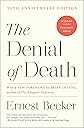
Winner of the Pulitzer prize in 1974 and the culmination of a life's work, The Denial of Death is Ernest Becker's brilliant and impassioned answer to the "why" of human existence. In bold contrast to the predominant Freudian school of thought, Becker tackles the problem of the vital lie -- man's refusal to acknowledge his own mortality. In doing so, he sheds new light on the nature of humanity and issues a call to life and its living that still resonates more than twenty years after its writing. Review: Nothing - A very well written critique of freudian philosophy and highly coherent with eastern philosophy. Review: Good 👍🏼 - Every should read books like this atleast once
| Best Sellers Rank | #2,848 in Books ( See Top 100 in Books ) #19 in Philosophy (Books) #25 in Psychology (Books) #64 in Health, Fitness & Nutrition |
| Customer Reviews | 4.4 out of 5 stars 3,258 Reviews |
K**R
Nothing
A very well written critique of freudian philosophy and highly coherent with eastern philosophy.
G**R
Good 👍🏼
Every should read books like this atleast once
M**A
Nice read so far
Been months now and yet I have not finished the book. However, what I have covered so far is a great addition to my knowledge
S**T
The meaning of life can be found in an onion !
The Denial of Death by Ernst Becker is a book I had wanted to read for quite some time, and it leaves a lasting impression. If someone truly wants to understand what life is about, this is a strong candidate. In the end, one realises that there is nothing at the core—like peeling an onion—but knowing this in depth changes a person far more than living without that awareness. Best for: Psychology / philosophy readers Those exploring meaning of life Not ideal for: Casual readers Those looking for practical solutions A few concepts that are interesting Human nature & heroism Narcissism + self-esteem create the desire to outlive oneself Sibling rivalry feels more real than cooperation Socialisation itself is painful Terror of death We admire those who face death; symbols and customs help us cope The modern lack of belief systems creates its own difficulty Morbidity may simply be reality realised too early Fear helps avoid death; repression helps us live Repression & maturity Repression is necessary and even creative Maturity is a form of accepting defeat (self-deception) Dual nature: to live vs to transcend Human condition “We are worms… but think like kings” The mind seeks transcendence while the body imposes limitation Man is an animal aspiring to become a “God” Child development The child tries to conquer death The mother is the first world, which the child later tries to control There is no perfect upbringing—only self-creation Character traits are “secret psychosis” Spectrum: Normal (controlled illusion) → Creative → Neurotic → Psychotic Philosophy integration Strong link between psychology, theology, and philosophy Freud aligns closely with this thinking Kierkegaard provides a powerful bridge Core paradox of humans Want peace vs want truth Want individuality vs want belonging Individuality within finitude Transference and characters Transference is a question of courage vs cowardice Humans try to belong to a larger system while still exceeding it The dual nature of human effort is clearly visible True transcendence is surrender (rare) Psychosis is the inability to deceive oneself What I did not like Religion analysis feels incomplete (especially from a Hinduism perspective) Over-focus on death → at times feels one-dimensional Question remains: can the mind stay focused on death continuously? Final takeaway Humans survive through illusions, repression, and meaning systems Truth is uncomfortable → life requires some level of denial Not about solving the paradox → but living within it
D**N
Classic, Thought Provoking
Not so much about death, rather about dysfunctions in life and reviewing the works of other great philosophers and psychologists of 19th & 20th century. It is an easy read, not necessarily easily digestable (or concievable). Its definitely not a self help book, instead it might just force you to rethink happiness, fear, arousal, hope, imagination, scizophrenia, homosexuality, perversions, etc. 👍🏼 Its a classic.
P**R
Best psychoanalytical book about human perception of reality
This book is amazing in the sense that it talks about how complex and insurmountable problem is life itself, it’s experience and the fear of it but it ends with no possible solution coz this is reality. It only needs to be interpreted in a meaningful and heroic way. Makes me both tread and uncomfortable about life. No balms and repressive techniques. Good to face reality some time out of our stupor and automaton state.
D**N
Worth reading
Once you read it, you cannot deny your death.
F**A
Superb, life changing book
It's worth its price in gold. Good quality for at this price range.
N**D
The book quality is good
My lowe starts is on the author not the sold product... Topic abit out dated
A**E
Really uplifting book
I am terrified of dying and I don't understand why no one else seems to think about it as much as I do. It's because they're all working on their, 'immortality projects' as Becker calls them. Like earning lots of money and having kids you feel more and more immortal. But you're not. You're just doing everything to try and ignore the fact that soon you will cease to exist and nothing you're doing now will mean anything to anyone!
O**.
Very academic tone
A little tough to get into but extremely insightful, and a valuable read. Well worth your time.
V**N
Timeless wisdom
The following sums up the central theme of this Pulitzer Prize-winner: "For now, it is enough to invoke Marcia Lee Anderson's complete scientific formula: `Stripped of subtle complications [i.e., of all the character defenses - repression, denial, misconceptions of reality], who could regard the sun except with fear?'"(p.66) Hereafter I'll quote extensively, as opposed to paraphrasing, in order to make it as beneficial for the interested individual as I can. Ernest chose a title that he knew would resonate with the public: The Denial of Death. But the book should have been called `The Denial of Life', because people not only repress their inevitable demise, but even more so their lives. The book is centered on the philosophy that every person starting in childhood creates an imaginary world where, to put it simply, everything is better and the people are nicer, so not to perceive the intricately problematic reality. Ernest aptly summarized prominent thinkers and students of human nature of the past 150 years, including Soren Kierkegaard, Otto Rank, Norman Brown, and Sigmund Freud. One might rightfully say that some of the latter men's conclusions were repudiated by modern thought. However, their fundamental findings - such as Freud's narcissist, Kierkegaard's `introvert', or Rank's artist - on characters of man are timeless. Details, tactics, and strategies of how to approach the very complex study of human nature change, but the nature itself doesn't. As much as I wish to discuss this book at length, I won't do it for lack of space. I'll succinctly outline the work of one philosopher, who is one of the most astute men in history, and briefly summarize two others, Sigmund Freud and Otto Rank. The 19th-century Danish philosopher Soren Kierkegaard analyzed man's inner characters. Even though more than 150 years have elapsed, his ingenuous analysis can readily be applied to our modern society. The immediate man - the modern inauthentic or insincere man - is someone who blindly follows the trends of society to the dot. Someone who unthinkingly implements what society says is "right." "He recognizes himself only by his dress,...he recognizes that he has a self only by externals." (p.74) He converts frivolous patterns to make them his identity. He often distorts his own personality in order to "fit into the group". His opinion means nothing even to himself, hence he imitates others to superficially look "normal." The introvert, the one "who tries to cultivate his interiority...he is a little more concerned with what it means to be a person", he who "enjoys solitude and withdraws periodically to reflect." (p.82) He enjoys reading and thinking about the deepness of life, human relations, and the universe in general. But Ernest wrote that introvert "is not an immediate man, but not a real man either, even though he gives the appearance of it." (p.83) And finally "the one who asserts himself out of defiance of his own weakness, who tries to be a god unto himself, the master of his fate, a self-created man." (p. 84) But "the ugly side of this Promethianism is that it, too, is thoughtless, and empty-headed immersion in the delight of technics with no thought to goals or meaning." (p.85) The aforementioned personalities are not what Ernest considered "real" men. Ernest, by interpreting Kierkegaard, regarded "the true individual, the self-realized soul, the 'real man,' is the one who has transcended himself." (p.86) (When he talks about self-transcendence throughout the book the text understandably becomes abstract.) He is the one who has admitted that his essential character has been a big lie, created to protect the self from the difficult reality of life. In order to psychologically survive such a realization one has to surrender oneself to the Ultimate Power of Creation, or so Ernest recommends. The book also talks at length about Freud, "perhaps the greatest psychologist who ever lived." (p.256), the man who was "like a Biblical prophet, who spoke a truth that no one wants to hear...whose pessimism [was] grounded in reality, in scientific truth." (p.94) He was a cynic who did not deceive himself about the man's "basic creatureliness," his inner animal. He was hated by many for unveiling that the fundamental nature of every man is weak and self-deceptive. He was the mentor of Otto Rank, who was a brilliant psychoanalyst. Eventually Freud severed his relationship with Rank due to irreconcilable disagreements. It seems that Becker worshipped Rank religiously. When Rank was 21, he impressed Freud so much with his intellect and insight that Freud made him a part of his inner-circle of confidants. Rank's most monumental work was his `Art and Artist'. In it Rank contemplated the creative type of man, who is the one whose "experience makes him take in the world as a problem...but when you no longer accept the collective solution to the problem of existence, then you must fashion your own...The work of art is...the ideal answer..." And now I'll briefly express my disagreement with Becker's ultimate cure for man's despondent predicament of "real" life. I certainly am not as knowledgeable as Becker and my opinion towards life will definitely change during the years, but now let's not be "the modern mechanical men in Russia, the near-billion sheeplike followers in China, and the brutalized and ignorant populations of almost every continent." (p.281) Even though Becker didn't advocate any particular religion, "finding god" unavoidably decays one's mind and leads him to Christianity, Islam, etc. The fact that can't be refuted is that religion in general, Christianity in particular, has been the most efficient and cruel oppressor of intellect for millennia. And, because it has also been the most potent restraint upon progress, one would only shrink and limit his horizons by adhering to it. And what I deem especially interesting about Ernest's prescription for a god is that it was a way to battle one's fear and dejection. Fear, that indelible and prevalent emotion of men in any culture was relied on by religion to compel men to follow man-made Biblical laws. I'm not an advocate of atheism. But I'm a proponent of full and interesting life, something that religion takes away by promising to arrange an eternal afterlife. Notwithstanding some of the Becker's conclusions that I don't agree with, this book is the best work on human nature that I know of; somewhat superior to `On Human Nature' by Edward Wilson. I must warn though that having read it thoroughly will not only alter your outlook on life and your relationships with your peers, but it will also make you sadder...but wiser.
C**D
Un'opera fondamentale di un grande antropologo
Un'opera fondamentale di un grande antropologo e, nel suo ambito, forse tra i libri di maggior rilievo della seconda metà del XX secolo. Sebbene le argomentazioni principali non siano del tutto nuove, scrittori “esistenzialisti” (un'etichetta terribile) come Kierkegaard e Heidegger hanno sempre sottolineato l'importanza di riconoscere, accettare e abbracciare la realtà della propria finitudine, Becker porta questo tema in profondo territorio psicologico (Sigmund Freund, Otto Rank, Norman O. Brown), presentandolo al contempo in un linguaggio molto accessibile: Più cerchiamo di esorcizzare la morte dai nostri pensieri coscienti, più essa torna a perseguitarci, sia come individui che come società, sotto forma di comportamenti dannosi, violenza, dipendenza e un senso generale di disperazione e vuoto.
Trustpilot
1 month ago
2 weeks ago
1 week ago
2 weeks ago