We remain fully operational. Our teams are working around the clock to ensure your deliveries continue safely.

DOWNLOAD THE APP


Customer Services
Copyright © 2025 Desertcart Holdings Limited
DOWNLOAD THE APP
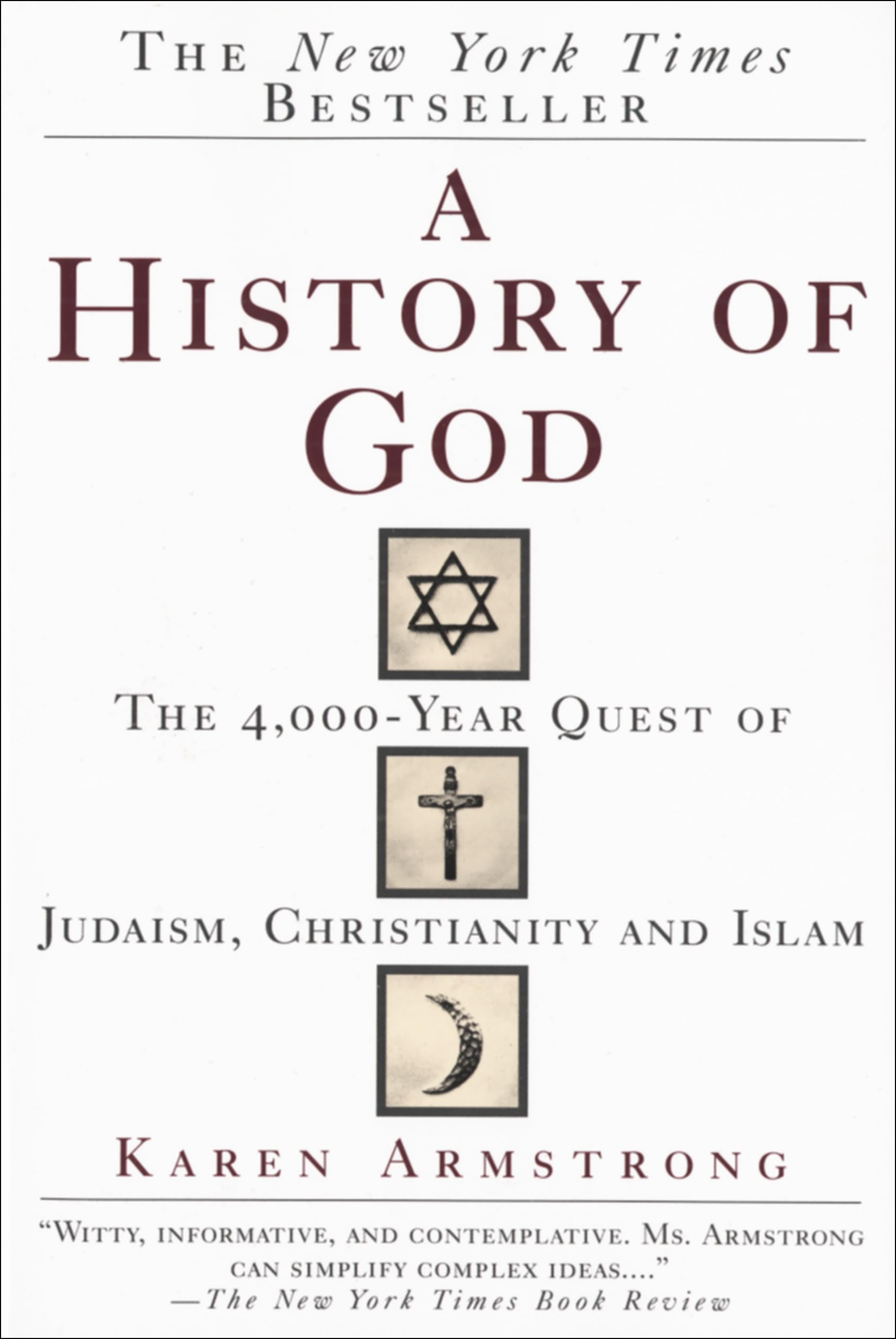
A History of God: The 4,000-Year Quest of Judaism, Christianity and Islam - Kindle edition by Armstrong, Karen. Download it once and read it on your Kindle device, PC, phones or tablets. Use features like bookmarks, note taking and highlighting while reading A History of God: The 4,000-Year Quest of Judaism, Christianity and Islam. Review: Unafraid, a Masterful Summation of Our One God Concept Throughout History - What a masterwork Karen Armstrong has achieved in "A History of God." As audacious a title as could be, Armstrong rises to the task and delivers an incredibly well researched, respectful, reflective, expounding, and even-handed survey of sacred topics. We journey with her through time chronologically, examining different eras in the God concept. We begin with the earliest Mesopotamian civilizations and their pagan rituals and see how similar the Babylonian creation myth is to that of Genesis. We continue with her in amazing depth and analysis through the emergence of YWH, the birth and life of Christ, the resulting debates on the nature of the trinity, and encounter the initial split that remains today between Eastern and Western Christianity. Then onto the Muhammad and the revelations of Islam, the philosophical interpretations of God through learned reasoning, the development of Mysticism as an ethos in monotheism, the reformers of the Middle Ages, and how the genius of the enlightenment changed the perspective of humanity toward God. The second to last chapter is entitled "The Death of God?" and in it we encounter the strongest late-millenial arguments for the utter non-existence of God. In the final chapter, "Does God Have a Future?", Armstrong shares her sentiment that although the specificity of the God concept has changed again and again, there is remarkable consistency in the ongoing quest to discover our spirit and its relation to something more. Even in an examined, profane world, hope in a greater mystery remains. She appropriately ends her dense, academic treatise with a poem. Thomas Hardy's "A Darkling Thrush" is a deeply touching four-stanza ode to a birdsong for the hope it brings to a man brought down by the cold, dark, grey world around him. What may sound heretical when here described does not feel that way through Armstrong's words. She addresses topics like a true scholar and attempts as best one could to synthesize complex theological issues so that they can be compared and contrasted. She returns to common themes, connecting them across the ages, and gives social and political context to powerful religious movements in history. This is one of the finest books I have read, it makes the most of the medium on several fronts. It is a must read for anyone interested in Theology. Review: Magnificent, magnificent - I sometimes wonder if the stage of our life when we first encounter a book affects our relationship to that book. I mean that had I encountered this book when I was much younger, I would not have been receptive to her arguments nor would I have been able to appreciate the depth of her scholarship. Make no mistake, this is a scholarly book that I enjoyed thoroughly. The title of this book is somewhat misleading: it is not a history of God, per se, but it is an erudite discussion of Woman and Man's relationship with God over the last 4000 years. Since I have been pursuing a similar quest over the last seven decades, Ms. Armstrong's magnificent manuscript has answered many of my questions and feelings about religion. It has enlightened me and cleared my head somewhat. It is not an easy book but will be worth the time and effort. Kudos to Ms. Armstrong.


| Best Sellers Rank | #84,416 in Kindle Store ( See Top 100 in Kindle Store ) #16 in Religious Studies - Comparative Religion #37 in Religious Studies - History #42 in Christian Faith (Kindle Store) |
M**)
Unafraid, a Masterful Summation of Our One God Concept Throughout History
What a masterwork Karen Armstrong has achieved in "A History of God." As audacious a title as could be, Armstrong rises to the task and delivers an incredibly well researched, respectful, reflective, expounding, and even-handed survey of sacred topics. We journey with her through time chronologically, examining different eras in the God concept. We begin with the earliest Mesopotamian civilizations and their pagan rituals and see how similar the Babylonian creation myth is to that of Genesis. We continue with her in amazing depth and analysis through the emergence of YWH, the birth and life of Christ, the resulting debates on the nature of the trinity, and encounter the initial split that remains today between Eastern and Western Christianity. Then onto the Muhammad and the revelations of Islam, the philosophical interpretations of God through learned reasoning, the development of Mysticism as an ethos in monotheism, the reformers of the Middle Ages, and how the genius of the enlightenment changed the perspective of humanity toward God. The second to last chapter is entitled "The Death of God?" and in it we encounter the strongest late-millenial arguments for the utter non-existence of God. In the final chapter, "Does God Have a Future?", Armstrong shares her sentiment that although the specificity of the God concept has changed again and again, there is remarkable consistency in the ongoing quest to discover our spirit and its relation to something more. Even in an examined, profane world, hope in a greater mystery remains. She appropriately ends her dense, academic treatise with a poem. Thomas Hardy's "A Darkling Thrush" is a deeply touching four-stanza ode to a birdsong for the hope it brings to a man brought down by the cold, dark, grey world around him. What may sound heretical when here described does not feel that way through Armstrong's words. She addresses topics like a true scholar and attempts as best one could to synthesize complex theological issues so that they can be compared and contrasted. She returns to common themes, connecting them across the ages, and gives social and political context to powerful religious movements in history. This is one of the finest books I have read, it makes the most of the medium on several fronts. It is a must read for anyone interested in Theology.
C**R
Magnificent, magnificent
I sometimes wonder if the stage of our life when we first encounter a book affects our relationship to that book. I mean that had I encountered this book when I was much younger, I would not have been receptive to her arguments nor would I have been able to appreciate the depth of her scholarship. Make no mistake, this is a scholarly book that I enjoyed thoroughly. The title of this book is somewhat misleading: it is not a history of God, per se, but it is an erudite discussion of Woman and Man's relationship with God over the last 4000 years. Since I have been pursuing a similar quest over the last seven decades, Ms. Armstrong's magnificent manuscript has answered many of my questions and feelings about religion. It has enlightened me and cleared my head somewhat. It is not an easy book but will be worth the time and effort. Kudos to Ms. Armstrong.
M**N
A Very Enjoyable Read!
The book is separated by 11 chapters. ~ Chapters 1-2 (In The Beginning, One God). The author begins by exploring the most primitive conceptions of the divine. She delves into the Axial Age (800 - 200 BCE) and explains the Aristotelian god, Buddhism conceptions (Nirvana, Atman, Brahman), the old polytheistic pagan religions, and the important revelations and that have become expedient in the doctrines and worship of the major religions of the world today (Moses, Abraham, etc). Also - and perhaps most importantly - the author explains how monotheism and the praising of one god came about. ~ Chapters 3-5 (A Light to the Gentiles, Trinity: The Christian God, Unity: The God of Islam) As you can probably expect, these chapters explore the roots of the major Abrahamic religions. It is interesting to see the trials and tribulations each one endured. You can expect to read about the evolution of ideas between the religions, how they relate to each other, and their ever-evolving conceptions of outsiders. ~ Chapters 6-8 (The God of the Philosophers, The God of the Mystics, A God for Reformers) Perhaps the most interesting sections of the text. In these chapters, history is amalgamated with philosophy: the author explores the 3 major conceptions of God, with how they came about, and then ties them to their implications, doctrines, and perceptions. To explain each briefly: The God of the philosophers came about when God got caught up in the mix of philosophy. As civilizations started to advance, philosophers took it upon themselves to look at and try to prove the existence of God rationally. The philosopher's God was one that can be proven through inquiry and rational thought, and one that should be liable to discourse. For some time many religious sects adopted this game plan for God, for example, the Faylasufs. The God of the Mystics was an alternative: it can not be proven through rational thought because it lay beyond experiment and observation. The God of the Mystics was one that could be felt deep inside us, and in nature, even though it's essence itself was impenetrable. The God for Reformers is a more contemporary, personal, and rule imposing entity. This God was used to reform certain societies and their norms; it was the centerpiece for theocratic empires. ~ Chapters 9-11 (Enlightenment, The Death of God?, Does God Have a Future?) If there's history in any sense in these chapters, it is not the main goal of them. These chapters talk about the enlightenment era with its advent of science and technology. This was the time in history where discoveries were made that shattered preconceived conceptions of the physical world, the solar system, and most importantly our place in it. This was the time where we really started to discover that perhaps life does not have any divine meaning, and by observing natural phenomenon we come to see that there is also no purpose. For the first time, it was possible to become an Atheist. Many prominent intellectuals came to abhor the idea of a creator, or master engineer, that that twists and turns the knobs of life and discriminately favors some while punishing others. Much of the general public had severe reservations of how personal God was, and can be, just like the Mystics and the Buddhists. Is God dead? The New Right Christian movement of the late 20th century doesn't seem to portend to any fatality of superstition. Does God Have a Future? Who knows. Apparently the author believes that the God of the Mystics does, which I discuss below. I must concede that what is so prolific about the book is the author's candor. In her sentiment you can detect of a whiff of fate, and thus reckon her intrapersonal disappointment in her tone, but she nevertheless casts her emotions aside to justly display the truth. Much sections of the book reads as if it was written by an atheist. But this doesn't mean that she didn't purvey her opinions. Often you can extrapolate her convictions on matters by the way she alludes to it and by what (I almost said 'who', but that would have been incorrect) she chooses to quote. I'm not an expert on religious matters, but she seemed to be objective - atleast in motivation - for the most part when explicating and trying to explain God's history. I believe that for the most part, such a goal (i.e. objectivity) is not feasible. In the history of divinity and religion; with it's prophets and revelations; there are too many uncertainties to be able to explain these topics without a substantial amount of subjectivity. The whole religious enterprise seems to be subjective. This isn't an existential rejoinder, but an observational truth. It's possible for such experiences to be "real", in the non-materialist and neuron-void sense, but it is not plausible. There is admittedly not a complete material understanding of consciousness and the brain, but there is a fairly adequate scientific understanding of it that takes dominion over the archaic notions of Dualism and non-material "magic" that so many intellectuals have resorted (or succumbed) to in the past when explaining subjective experience and the human mind. It seems that the author, Karen Armstrong, doesn't seem to understand this and I think the contemplative reader is ultimately left in the midst when trying to string together her "God", the one that would purportedly work in the future. She rejects a personal God, and denotes such an idea as unjustifiable, dangerous, and detrimental to religion. So then wouldn't she be a deist? She speaks a lot about deism but doesn't seem to allude to being a deist, per se. She seems to be enthralled by the God of the mystics; the one that lacks shape or form, that can't be anthropomorphized, and is all around us; and that's attainable through introspective practices. She doesn't mention it, but if she doesn't believe that this God created the universe, and is knowledgeable incorporeal entity, than what is the point of God? She seems to insinuate that you need such belief or faith because it attenuates the inner conflict of struggle and inevitable death, but this conclusion is parochial in nature and it does not deserve any kind of fidelity. I would also like to mention, as other reviewers did before me, that she seems to paint Islam in good light. She is in no way a Muslim, but perhaps she felt propelled to be a little persuasive in tonality when speaking on behalf of Islamic religion and Koranic scripture because of prevailing vitriol and inflicted cultural subjectivity in the Western portrait of Islam. This of course was around the time the book was published (1991), and i'm sure although Islam deserves much of it, many academics nevertheless go overboard; that is, doing it fallaciously; in demonizing it. The problem is that Armstrong's fervor shows in this aspect, and often seems to undermine and juxtapose the other major monotheistic religions which seems like an effort to bring them down just to enhance the comparative look of Islam. At one point she seems to blame the downfall of what used to be an open-minded and rationally motivated religion (i.e. Islam) on the Westernization of Islamic territory through Colonialism. This seems like a feeble attempt to deposit blame on other things while simply ignoring requisite facts of an (or at least what came to be an) inherently destructive religion. Maybe some positive light needed to be shedded, because anything that is entirely bad doesn't last long. Even though Islam may have, or have had, some good tenets, I still remain a little skeptical of its exegesis in this text. Note that when I say "seems that the author, Karen Armstrong, doesn't seem to understand this...", i'm coming from my pre-conceived conviction in the fidelity of Materialism (which is what I meant by "this"). In other words, I'm assuming it to be the truth, which many people - especially readers of this book - wouldn't adhere to. Even though I don't necessarily agree with everything the author has to say, the text itself was engaging and I sincerely enjoyed reading it. There is a lot of information to be gleaned and I do recommend it. It deserves a high rating. 4.4/5
R**L
A seminal work that must be read
I bought this book when I heard a famous Brazilian historian speak very highly of it. I myself am an avid reader of History of Religions in general as I acknowledge that religions have shaped our world, so it is impossible to even begin to understand the world without spending a lot of time on the history of religions. This book is a survey of the concept and shapes of God and a very good one at that. The author’s arguments are very thought-provoking and interesting, and anyone who wants to understand the world a little better, with or without any faith, would certainly profit from this reading. I highly recommend it.
M**Y
A useful survey -- with some serious omissions
It's easy to understand why many people find this book helpful. It represents a vast amount of research. Armstrong is a learned woman. The breadth of her knowledge is very impressive. She is also a good writer. She has a friendly style. And almost everyone will find something here of interest. I especially liked the section about Mohammed, as I know very little about Islam. Armstrong is at her best when she elucidates various issues (such as the feminine/goddess) that continue to be embarrassing to orthodox Christianity. But a book that calls itself a History of God must be held to a high standard. Armstrong's discussions of a number of important issues are inadequate -- about what one would expect of an overview. Her book, then, is a useful survey. It takes the reader competently across a vast amount of material. But the author keeps presenting more of the same, and fails to take the reader any deeper. By the 7th chapter I found myself slogging along, and losing interest. Armstrong's treatment of the Old Testament is in general competently done. Yet there are omissions. The author never mentions the Ras Shamra tablets found on the coast of Lebanon in the late 1920s, despite their extreme importance. She has imbibed, however, the correct conclusions about Judaism's great debt to Canaanite religion. Her discussion of the Book of Job (pp 65-66) fails to recognize that the ending part of Job was an afterthought, added by a later scribe, rather than original to the text. Indeed, the whole discussion of Job is inadequate. Armstrong seems unaware that most of the Wisdom Literature and the Gnostic Demi-urge followed and flowed directly from Job, which is arguably the most controversial book in the Old Testament. She fails to illuminate its meaning and true significance, which is vital to understand the role of Jesus as reformer. Armstrong's handling of the New Testament is less skillful. She allocates only four pages to Gnostic-Christianity, a woeful amount, and never even mentions the Nag Hammadi or the Gospel of Thomas. She recognizes the common ground between Christianity and Hinduism/Buddhism, but never follows up on this vitally important area with any analysis. There is no discussion of Jewish-Christianity, an issue about which orthodox Christians tread with extreme care--no mention of the Ebionites (the poor), for example, which is egregious given the reference "Blesed are the poor" in the first Beatitude of Jesus. (But then, Armstrong is not alone in this omission. I know of no other Christian scholars who have made the connection.) Armstrong also uncritically accepts the wrong judgment of orthodoxy that Jesus' dying words "Eli Eli" refer to the Father when in fact they refer to Elijah (p. 77). Her discussion of the Arian controversy in chapter 4 mentions the new doctrine of creation from nothing (ex nihilo), but the author neglects to mention the most important (and appalling) implication: the fact that orthodoxy in the process also rejected the immortality of the soul. Nor is there a discussion of the grave consequences for Christianity of this error. The author correctly mentions that Christians "were confused about the Holy Spirit" (p 115) but she fails to follow up this lead in with any clarification of this most important subject.
I**Y
How men created "God"
Of all the books about religion that I've read--and I've read a good many over many years--this is the best and most concise recounting of the beginnings and development of the three monotheistic faiths. The precis of the book's central theme is very clearly and more than adequately expressed in the Amazon description of the book. Religious historian Karen Armstrong's discussion and in-depth study of the invention of "God" is thorough and deep: her remarks and history are supported by many, many, many primary sources. She makes no judgment on the believability of any tenet; her focus here is how people's need for explanations of the unexplainable produced a supreme being, and how those beliefs change over time to accommodate changing politics, economic conditions, and emerging knowledge. The one finding that stood out for me was the incontrovertible fact that each set of beliefs was ALWAYS preceded by the acknowledgment that "God" was unknowable and unfathomable, and THEN followed by the assertion that the set of beliefs had found THE one and only way to know "God." And each such unshakeable rightness/correctness led to a backlash of another set of beliefs, whose authors declared that THIS set alone would lead to knowing all about the unknowable "God." Be forewarned: this book is not going to help you find answers and reassurances that any one faith is the one and only road to knowing "God." But, if you persevere, this book gives a very clear, precise history of how men created "God"--and are still doing so today.
K**E
Armstrong is magical
My copy of this book is full of highlights, annotations, exclamation marks, and dog-eared pages. For anyone who is interested in the idea of God, Western religion tradition, and the history of how we got to where we're at now and where it all came from... well, there could not be a better book for it!!!! Full of facts and sources, writing and literature, and crammed with history and information, this book is THE source for the history of the monotheist God. From pre-Judaic concepts of God in Babylon to the formation of the nation of Israel and Abraham, through the Jewish periods (Mosaic, Temple Judaism, Prophets, etc) and into Jesus of Nazareth.. then early Christianity, the formation of the Catholic church as we recognize today, and into Muhammad and the start of Islam. It gets better: Armstrong continues into depth with the God of the philosophers, the mystics and their divine wisdom, and then into the death of God and the future of God. I bought this book for a college course titled "The Idea of God" and we used the text as a reference for our study, as it took us gently through the history of this monotheist idea of God. One thing worth noting: It is recommended to have a search engine on hand, as Armstrong tends to assume that readers are already on top of this kind of knowledge. Sometimes it can be a little dense in the beginning, but once you get into it you may find yourself reading it for pure enjoyment and knowledge, as well as wisdom. There is much to gain in this book and I recommend it for anyone who is Jewish, Christian, Islam, any other religion, or considers themselves spiritual. If you're looking for the stuff you don't learn in church, Armstrong has it all. Prepare to be amazed at all the things you never knew and have your idea of God change, for the better.
D**E
a truely exciting experience
Karen Armstrong's "A History of God" is an expansive and exciting work. In it, she attempts a broad sketch of the evolution of the concept of God in three major monotheistic faiths: Christianity, Islam, and Judiasm. I enjoyed this book a great deal, both for its introduction (to me) of new conceptions of God, and more importantly, in its demonstration that God, as conceived of by man, has never been a static or unchanging entity. Indeed, the main strength of "A History of God" is its illustration of how dynamic and mutable conceptions of God really are. For this book, it is important to focus on what it is not, as much as what it is. It is not an effort to justify or to prove the existence, or to demonstrate the correctness of any one religious view. While Armstrong does question the development of certain religious practices, in particular those of Christianity, her questions are important ones, and do not seem malicious or destructive in intent. Instead, her goal is one of the mapmaker. She does not say what the land is or whether it is good or evil; she merely charts it as she goes, and primarily leaves the duty of determining the value of the land surveyed to the reader. In doing so, she provides the reader with a chance to examine the cultural evolution of so many of the ideas that we currently hold as universal and immutable. While her challenge is not a direct one, any serious reader must question their own beliefs in the face of a clear demonstration that God is in many ways a man-made entity, and that God, as a concept, has developed as man has developed, to fill his needs and desires. I did have some complaints about this book. As others have said, the book feels heavily weighted towards Islam, at times to the exclusion of the other two faiths it aims to cover. However, it is important to recognize that a topic of this magnitude is going to have to make ommissions, and for western readers, a greater focus on Islam is at times sorely needed. Additionally, she also at times seems somewhat hostile towards Christianity. Again though, her complaints are most often valid ones that should be addressed or at least considered. At times a difficult book to get through, due to its depth, but in all an excellent and enlightening read. I highly recommend it.
Trustpilot
1 day ago
1 month ago