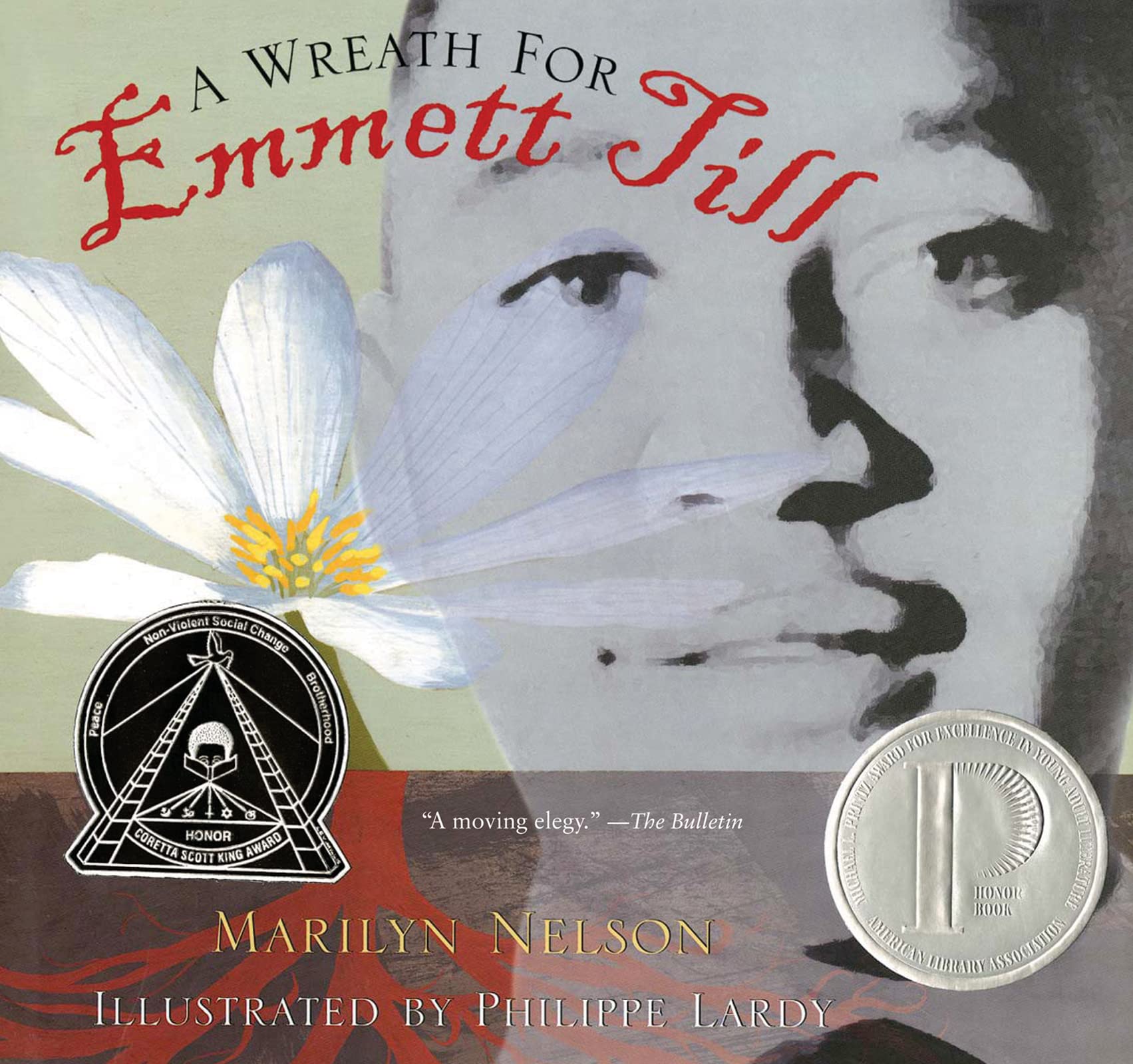
desertcart.com: A Wreath for Emmett Till: A Printz Award Winner: 9780547076362: Nelson, Marilyn, Lardy, Philippe: Books Review: Exquisitely, tenderly wrought and incredibly important - A beautiful literary tribute to a boy who deserved to live the life that was cut short by one of the most horrific acts of violent racism imaginable. This book, however, presents the kind of beauty that can only come from a combination of sensitivity and talent. Author and illustrator, working together to tell an unbearable story, honor Emmett Till's memory with the unlikely pairing of wrenching truth and exquisite beauty. In author Marilyn Nelson's foreword, one feels the tenderness with which her work was wrought. She concludes her explanation of form (the book is written as a sonnet) and intent by saying, "I wrote this poem with my heart in my mouth and tears in my eyes, breathless with anticipation and surprise." As such, the work has a life of its own as she and illustrator Philippe Lardy let live what was taken. This is a soulful, wrenching, illuminating, important read. Deserves to be in the "required reading" category of high school curriculums. A stunning historical and literary achievement. Rest in peace, Emmett. Review: Richie's Picks: A WREATH FOR EMMETT TILL - I cannot recall if back in 1968 my eighth-grade American history teacher Mrs. Auryansen taught us about the death of Emmett Till. But one of the things I loved most about that year of studying with an enthusiastic teacher who often made American history come alive for me was the series of quarterly independent projects we had to plan and complete. Each marking period we would have to do an American history-related visual piece as well as a written piece and an oral piece. "BY the flow of the inland river, Whence the fleets of iron have fled, Where the blades of the grave-grass quiver, Asleep are the ranks of the dead: Under the sod and the dew, Waiting the judgment-day; Under the one, the Blue, Under the other, the Gray." Whence the fleets of iron have fled, Where the blades of the grave-grass quiver, Asleep are the ranks of the dead: Under the sod and the dew, Waiting the judgment-day; Under the one, the Blue, Under the other, the Gray." That's the first of the seven verses of "The Blue and The Gray" by Francis Miles Finch (1827-1907). I memorized and proudly recited those seven verses to my American history class, and that memory has stuck with me. Having just celebrated my personal half-century mark, I'm all for turning around and returning to eighth-grade. And if I could do so, this is what I would memorize this time around for one of my oral pieces: "Pierced by the screams of a shortened childhood, my heartwood has been scarred for fifty years by what I heard, with hundreds of green ears. That jackal laughter. Two hundred years I stood listening to small struggles to find food, to the songs of creature life, which disappears and comes again, to the music of the spheres. Two hundred years of deaths I understood. Then slaughter axed one quiet summer night, shivering the deep silence of the stars. A running boy, five men in close pursuit. One dark, five pale faces in the moonlight. Noise, silence, back-slaps. One match, five cigars. Emmett Till's name still catches in the throat." That is one of the fifteen sonnets that comprises A WREATH FOR EMMETT TILL by Marilyn Nelson. After reading the book to myself and then reading it aloud to Shari, my thoughts kept wandering off yesterday to brainstorming how I might somehow set up an event down in the City on Sunday, August 28th--fifty years to the day since Emmett was kidnapped--in which someone who would both have known the Civil Rights movement and whose presence could attract a major audience (a Danny Glover or a Bill Russell or someone else of that stature) would read this powerful series of poems aloud to a crowd to commemorate the anniversary of the brutal death of Emmett Till, a death which horrified the world and made clear what had gone on for so long. I can imagine having a choir and soloist perform at such an event, but definitely not a bunch of droning speakers whose verbosity might take away from the carefully chosen words of Marilyn Nelson's heroic crown of sonnets about Emmett Till. As Marilyn explains in her preface (HOW I CAME TO WRITE THIS POEM): "A crown of sonnets is a sequence of interlinked sonnets in which the last line of one becomes the first line, sometimes slightly altered, of the next. A heroic crown of sonnets is a sequence of fifteen interlocking sonnets, in which the last one is made up of the first lines of the preceeding fourteen." Thus, it's like a literary crossword puzzle. Get one word wrong and it simply doesn't fit together. Get all the words exactly right and you've got something worthy of public performances by famous personalities and recitations by today's and tomorrow's American history students. Marilyn Nelson got it right.


| Best Sellers Rank | #62,332 in Books ( See Top 100 in Books ) #11 in Poetry for Teens & Young Adults #46 in Teen & Young Adult Fiction on Prejudice & Racism #68 in Teen & Young Adult Fiction about Death & Dying |
| Customer Reviews | 4.6 out of 5 stars 189 Reviews |
M**B
Exquisitely, tenderly wrought and incredibly important
A beautiful literary tribute to a boy who deserved to live the life that was cut short by one of the most horrific acts of violent racism imaginable. This book, however, presents the kind of beauty that can only come from a combination of sensitivity and talent. Author and illustrator, working together to tell an unbearable story, honor Emmett Till's memory with the unlikely pairing of wrenching truth and exquisite beauty. In author Marilyn Nelson's foreword, one feels the tenderness with which her work was wrought. She concludes her explanation of form (the book is written as a sonnet) and intent by saying, "I wrote this poem with my heart in my mouth and tears in my eyes, breathless with anticipation and surprise." As such, the work has a life of its own as she and illustrator Philippe Lardy let live what was taken. This is a soulful, wrenching, illuminating, important read. Deserves to be in the "required reading" category of high school curriculums. A stunning historical and literary achievement. Rest in peace, Emmett.
N**.
Richie's Picks: A WREATH FOR EMMETT TILL
I cannot recall if back in 1968 my eighth-grade American history teacher Mrs. Auryansen taught us about the death of Emmett Till. But one of the things I loved most about that year of studying with an enthusiastic teacher who often made American history come alive for me was the series of quarterly independent projects we had to plan and complete. Each marking period we would have to do an American history-related visual piece as well as a written piece and an oral piece. "BY the flow of the inland river, Whence the fleets of iron have fled, Where the blades of the grave-grass quiver, Asleep are the ranks of the dead: Under the sod and the dew, Waiting the judgment-day; Under the one, the Blue, Under the other, the Gray." Whence the fleets of iron have fled, Where the blades of the grave-grass quiver, Asleep are the ranks of the dead: Under the sod and the dew, Waiting the judgment-day; Under the one, the Blue, Under the other, the Gray." That's the first of the seven verses of "The Blue and The Gray" by Francis Miles Finch (1827-1907). I memorized and proudly recited those seven verses to my American history class, and that memory has stuck with me. Having just celebrated my personal half-century mark, I'm all for turning around and returning to eighth-grade. And if I could do so, this is what I would memorize this time around for one of my oral pieces: "Pierced by the screams of a shortened childhood, my heartwood has been scarred for fifty years by what I heard, with hundreds of green ears. That jackal laughter. Two hundred years I stood listening to small struggles to find food, to the songs of creature life, which disappears and comes again, to the music of the spheres. Two hundred years of deaths I understood. Then slaughter axed one quiet summer night, shivering the deep silence of the stars. A running boy, five men in close pursuit. One dark, five pale faces in the moonlight. Noise, silence, back-slaps. One match, five cigars. Emmett Till's name still catches in the throat." That is one of the fifteen sonnets that comprises A WREATH FOR EMMETT TILL by Marilyn Nelson. After reading the book to myself and then reading it aloud to Shari, my thoughts kept wandering off yesterday to brainstorming how I might somehow set up an event down in the City on Sunday, August 28th--fifty years to the day since Emmett was kidnapped--in which someone who would both have known the Civil Rights movement and whose presence could attract a major audience (a Danny Glover or a Bill Russell or someone else of that stature) would read this powerful series of poems aloud to a crowd to commemorate the anniversary of the brutal death of Emmett Till, a death which horrified the world and made clear what had gone on for so long. I can imagine having a choir and soloist perform at such an event, but definitely not a bunch of droning speakers whose verbosity might take away from the carefully chosen words of Marilyn Nelson's heroic crown of sonnets about Emmett Till. As Marilyn explains in her preface (HOW I CAME TO WRITE THIS POEM): "A crown of sonnets is a sequence of interlinked sonnets in which the last line of one becomes the first line, sometimes slightly altered, of the next. A heroic crown of sonnets is a sequence of fifteen interlocking sonnets, in which the last one is made up of the first lines of the preceeding fourteen." Thus, it's like a literary crossword puzzle. Get one word wrong and it simply doesn't fit together. Get all the words exactly right and you've got something worthy of public performances by famous personalities and recitations by today's and tomorrow's American history students. Marilyn Nelson got it right.
A**P
Skillful and impressive writing
Nelson is a master of formal poetry and it shows in the crafting of this sonnet sequence and with such a fitting subject matter.
M**K
A must have for the classroom!
Heart-wrenching but truly beautiful book!
B**K
Brilliantly constructed. No, it is not an easy read.
This book is not of the whimsical, happy-go-lucky poetry most Americans (especially public school students) have become accustomed to. I believe 1 of the reviewers misses the point. In particular when she states that Emmett's murder is "loosely" tied to the 9/11 event by the author. Well, some of us Americans, do in fact, equate the many acts of violence perpetrated against Blacks, from slavery to Jim Crow and on, as some of the first acts of terrorism committed on American soil, so I beg to differ. Being an American of African descent, I do understand the connection. The sonnets are presented as a journey deep into the atrocities and the realities often hidden by the U.S. educational agenda-- is this perhaps the reason why some seem a bit threatened by their content? It is a critical history but also a presentation of hope for us all. As other reviewers have, I recommend it to be used in school curriculum (public, private etc.) and dissected - word by word if necessary. The truth of American history, the good with the bad, must be peeled back, layer by layer and examined WITH A CRITICAL EYE, if we are truly ever going to learn to live and work together with respect, honor and appreciation of our differences.
S**L
Remember Where We Came From
I had this book in my third grade class and would use it every year yo talk about history. I lost my book when I moved and bought another one because I want to share it with my grandson when he is older.
S**A
A beautifully heartbreaking poem that must be read aloud!
This bracing work of art, complete with illustrations depicting just enough of the story to know that it was true, will haunt me always. Written in iambic pentameter, a form familiar to students of Shakespeare, with allusions to crimes both historical and current, it teaches without preaching, making it an excellent resource and starting point for a discussion on civil rights.
K**R
Wonderful to read out loud
Carefully crafted and moving poem about an American tragedy and terrible crime, the murder of Emmett Till. The sonnet sequence was lovingly wrought. The illustrations added depth to the experience of reading this elegy. I highly recommend.
Trustpilot
2 weeks ago
1 day ago