

Desert Online General Trading LLC
Dubai, United Arab Emirates
Desert Online General Trading LLC
Dubai, United Arab Emirates

Full description not available
T**S
She is serving all the victims with this book...
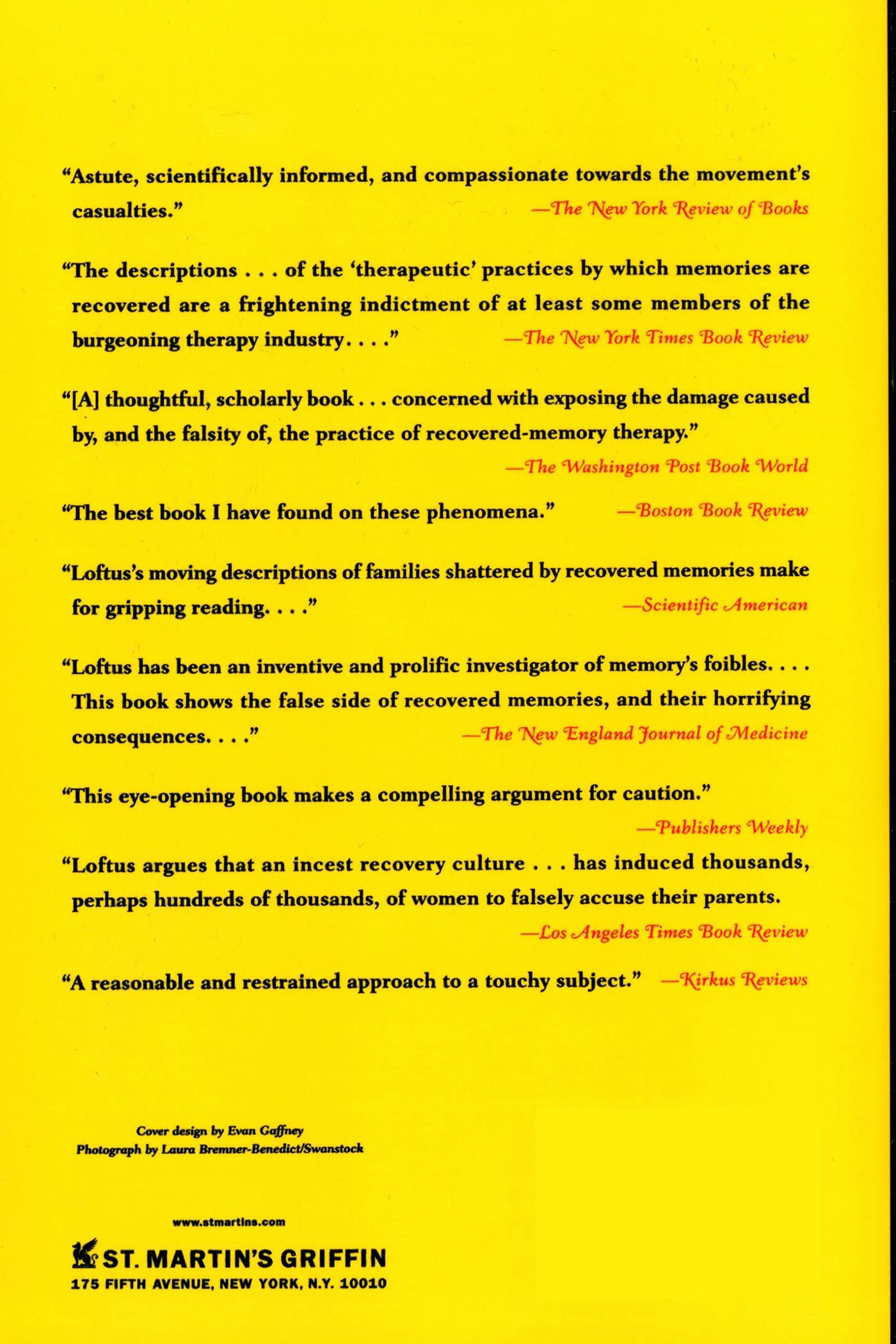
The primary author Dr. Elizabeth Loftus is an internationally known scientist published in professional journals and principal investigator of numerous highly acclaimed peer reviewed experiments on memory. Dr. Loftus is often called as the memory expert in high stakes court cases due to her experience and expertise. Katherine Ketcham has a degree in psychology and has both popular writing experience and clinical counseling experience. Legal (both criminal and civil cases) and personal attacks have not been successful against either author over the decades. Dr. Loftus has also endured protests, public attacks on her character and death threats by those who disagree with her evidence, analysis and conclusions. This book focuses on an emotionally riveting topic and these authors display a rare courage and integrity whether one agrees or does not agree with the thesis of the book. She addresses the harassment, threats and violence perpetrated by "believers" against "deniers" (and against other researchers like her) in Chapter 2 "A Strange Time" (pg 3-7)This book is an amazing diverse collection of stories, personal experiences, research, interviews and facts all focused on carefully examining the assertion that "repressed memories" are historically accurate accounts of past experiences. In many accounts the "Repressed Memories" are used, as stand alone evidence to accuse, isolate, sue, prosecute, jail and imprison innocent people (some for more than a decade). This book carefully and gently leads the reader to the conclusion, based on the accounts and interviews, that "repressed memory" can not possibly provide anyone with reliable accounts of the highly emotional traumatic recollections years or decades later as claimed. In fact the events may never have taken place historically and may be the result of confabulations, distortions, assumptions, suggestive therapy, coercive questioning or source confusion among other factors (or any combinations of these possibilities).She examines the historical roots of how Sigmund Freud initially viewed "repressed memories". Freud initially thought the memories were actual historical recollections but he quickly came to the conclusion that the stories were actually fantasies. Freud's initial errant insight that these fantasies were factual memories (pg 49-50) has been lifted for use by clinicians and writers who came to see "repressed memory" as the explanation for a wide variety of maladies. This notion has fueled book sales, personal therapies and group therapy sessions (pg 50-59).The book carefully documents how suggestive and/or coercive comments, inquiries, influences and therapies through counselors, friends, relatives and interrogators can help create imagined events which are then labeled "repressed memories." Some of the stories are personal accounts. Dr. Loftus relates that she had a detailed memory develop when told that as a child. that she had found her mother drowned in a pool. In fact she had not (pg 39-40). Throughout the book story after story details how accusers in court cases influenced by friends, police and therapists find "repressed memories" that describe in amazing detail horrid behavior including incest, physical abuse, murder and satanic rituals. Even cursory investigation along with an obvious lack of physical evidence often causes very reasoned doubts that the memories are genuine historical events even if they appeal to our strong natural emotional urge to protect children.I found the most interesting part of the book to be Chapter 11 "Sticks and Stones". In this chapter Dr. Loftus reveals personal meetings and exchanges she has had with famous proponents from the "recovered memory" movement. It is amazing how gracious and amiable she managed to be with those who have publicly disparaged her and her positions. Toward the end of the Chapter 11 Dr. Loftus shares with a recovered memory therapist (Barbara) how she was sexually abused when she was 6 years old by a 15 year old male babysitter (pg 225-226) named Howard. Dr. Loftus states "In his mind, I suspect, he (Howard) was taking a minor risk, experimenting with someone 'safe'. A little girl who wouldn't reject him or tattle on him....He wasn't cruel he just didn't think...But I never forgot this memory, nor did I repress it" (pg 226). Dr. Loftus shares that when she and the recovered therapist "parted later that night we hugged" (pg 226). A week later she received a paper with a drawing in the shape of a body labeled "HOWARD". It had pins in the chest and where sexual organs would be. The pins tips were colored bright red. Barbara had sent this to Dr. Loftus (pg 226). This is the point in the book that solidified (for me) how repressed memory zealots manage emotional issues (using symbols). Those like Dr. Loftus manage the emotional trauma differently. I will leave it at that.I have read all the one star ratings of this book. None of them display the evidence of having read the book but here I address some of the errant assertions:(1) The book is referenced with 15 pages of citations to a wide variety of literature both in scientific journals and popular reading materials. Most impressive is the careful reading of "recovered memory" books that she cites in her book (something the recovered memory books do not do of her writings!)(2) She is an abuse victim herself and her book reflects great care for those who genuinely are victims (she is even gentle with those who sincerely think they are abused because of memories nurtured by poor therapy). I was genuinely touched.(3) She clearly distinguishes between the DSM description on dissociate amnesia and "repressed memory" which is NOT in the DSM. In fact this book does the best job in contrasting these two very different concepts better than any other book I have read.(4) She does not deny the Holocaust because none of the validated recollections of the Holocaust were ever claimed to have been "repressed." These memories were recorded and cataloged at the time and the victims have remembered all along what happened to them (this has been well documented in multiple studies).(5) Dr. Loftus has never been found to have a secret pact or relationship with any known satanic or right wing conspiracy leaders since the writing of the book more than 20 years ago.(6) She never lumps the incest survivor stories using "repressed memories" with repressed memories of space alien abductions or repressed memories of previous lives as roman soldiers or repressed memories of satanic rituals involving dark lit areas with large altars and screaming victims. She could have but she does not.I think EVERY aspiring therapist should read this book. Every parent (or family member) who is being falsely accused should read this book. It will allow you to see more clearly how your accuser is truly a victim. Not because of you but because of a cultural myth called "repressed memory".
W**H
Science versus Salem
In "The Myth of Repressed Memory," Elizabeth Loftus makes a compelling case for the argument that there is, indeed, no such thing as repressed memory. Using science to challenge the common (mis)understanding of repressed memory, she brings us through a few horrifying cases of people who have been, it seems, wrongly accused of sexual abuse as the result of vulnerable "victims" being coaxed and prodded by zealous law enforcement officials and counselors to see abuse where there has been none. While in no way demeaning the very real experiences of real sexual abuse survivors, Loftus takes us through the ins and outs of memory and the workings of the brain, and demonstrates pretty convincingly that there is no "there" there.I was interested in this subject because it always seemed to me strange that (particularly in the day care abuse cases of the past few decades) children would come up with the most fantastic stories about hidden tunnels and clowns and ritual murder but there was never, ever any evidence uncovered to that effect. I often thought well, if these satanists are murdering scores of babies in their rituals, why aren't we hearing about the strange disappearance of infants from their cribs? It never made sense to me. It still makes no sense that people hold on to these explanations when, as Loftus points out, all the evidence (and plain common sense) points to the fact that they never happened, that memory is not an object existing in time, but a construct, the product of imagery and suggestion and fear and vulnerability.Loftus demonstrates, through descriptions of her own scientific studies, just how it easy it is to create a memory of an event that never happened and how, once this memory is implanted, the person having the "memory" will defend it as being absolutely real. It's important that we know this.Loftus uses the Salem witch trials and more specifically, Arthur Miller's play, "The Crucible" as a literary touchstone for this conversation. It is extraordinary, the parallels between what Miller wrote and what Loftus describes. We are programmed to see monsters under the bed, it seems and Loftus describes this neurological programming with clear and compelling detail.This book is a description of science and of a sociological/psychological phenomenon, but it reads like a detective novel--a real "can't put it down" piece of writing.
R**E
Supurb reading, especially for those confronted with false memories
Elizabeth Loftus casts a brilliant light on the witchcraft of the dark art of "recovering" memories.The techniques used to generate memories of events that never happened are deceptively simple and easy to implement. By understanding current memory research the reader can better understand the limitations of their own memories as well as the source of memories in others of events that never occurred.Armed with knowledge on limitations of memory a person can better resist the corruption of their own memories, as well as better defend themselves against charges based on the corrupted memories of others (whether the charges are legal or social).Given the emotional attachment we all have for our memories, and the profit motive (both financial, for unscrupulous therapists, and emotional, for those who enjoy being a victim), it is no wonder there are many who are are vehement in their objections to what Dr. Loftus has to say.
C**C
Made things clearer
Great read, makes the whole repressed memory issue clearer and illustrates the need for more research into trauma and how it is stored and retrieved in the brain.I still can't see how it would serve us as humans to forget that people have harmed us? I have worked with people who have been abused and have clear memories and feelings about it and in my experience they struggle to forget or let go of it.Very interesting read for anyone wanting to understand more about how memory can be easily manipulated or influenced by lines of questioning.It has fueled my interest in learning more about trauma and its effects.
Trustpilot
1 day ago
1 week ago