
DOWNLOAD THE APP


Customer Services
Copyright © 2025 Desertcart Holdings Limited
DOWNLOAD THE APP
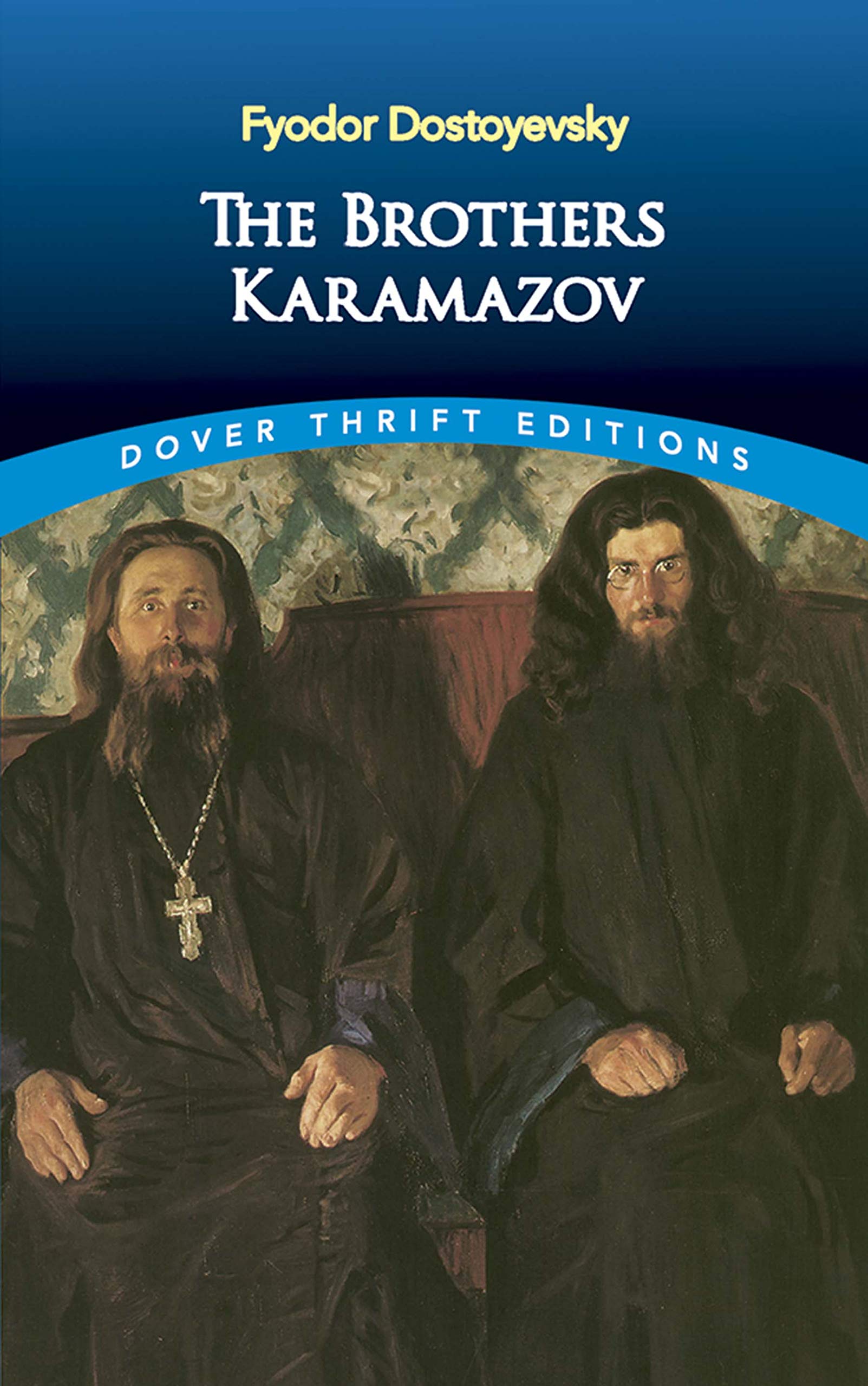
The Brothers Karamazov (Dover Thrift Editions: Classic Novels) [Fyodor Dostoyevsky, Constance Garnett] on desertcart.com. *FREE* shipping on qualifying offers. The Brothers Karamazov (Dover Thrift Editions: Classic Novels) Review: Great in two respects - One hardly needs to praise this acclaimed novel. But after my third reading I am in awe. The novel works in two entirely different ways, which are nevertheless intertwined. On one hand it is a great story. On the other hand it is a profound meditation. (Interestingly I recently watched two film versions -- the American/Hollywood (1958) and the Russian (1969) -- that divide on just this point. Both are excellent movies, I feel, but the American one works strictly as a great romance and crime drama, while the Russian one is truer to the philosophical concerns.) The reason Dostoevsky had for writing this novel, besides his continual need to support himself and his family, and his passion for writing, was to convey the idea that (what he considered) the innate faith of the Russian people in God, immortality, and Christ is essential to living morally. (In “real life” Dostoevsky was fanatical about this, to the point of viewing Russian Orthodoxy – the tsar included -- as key to the salvation of the whole world. He might very well have been a Putin supporter, despite his otherwise agapic and socialist leanings.) This idea is embodied by Alyosha Karamazov, one of the brothers and a Christ-like figure of universal loving, and also his spiritual mentor, Father Zosima. The idea is also embodied in the brother Ivan (and his own acolyte, the brother Smerdyakov), albeit in its negative manifestation, since he accepts the implication – that without God, everything is permissible, including crime – but, opposite to Alyosha, rejects God. The fourth brother, Dmitri, embodies the idea as well, but in his case – perhaps the most typically human -- God “wins” but always with a struggle. With Alyosha godliness is simply natural. Ivan also struggles, but in him God’s victory is only intermittent because Ivan’s reason and compassion find the evil in the world to be in absolute conflict with the conception of a good and all-powerful God. (Smerdyakov is the extreme God-rejector, Alyosha’s pure opposite.) Thus faith alone (and even contrary to reason), as Alyosha possesses with passion (but also Dmitri, if only by Russian instinct), could give God a clear victory. Dostoevsky does not shy away from this implication. That is one thing that makes this novel great: It challenges the believer so effectively that many readers will side with Ivan’s impassioned argument for atheism. And also for this reason, the story (and character) aspect of the novel is crucial; indeed, Dostoevsky believed that it was the answer to Ivan’s argument, which otherwise could not be defeated by rational argument. The reader will have to judge how successfully the events and characters of the novel refute atheism. I myself think that Dostoevsky’s position doesn’t make sense even in its own terms. Consider that for everything to be “permitted,” there would still need to be an authority that permits; but if God does not exist, who would there be to permit anything? So crime would not be permitted, no more than it would be prohibited if there were no God (according to the theodic logic). Be that as it may, the story and characters stand on their own merits, it seems to me. And here again the novel is a great one. As an aspiring novelist myself, I am in awe of the many amazing personalities and ingenious intricacies of plot that Dostoevsky introduces in this mammoth book. How he was able to maintain the cohesion despite facing publishing deadlines for installments, usual for his day, is beyond my comprehension. (He failed to do this in previous novels. This one was his greatest and final triumph. He died shortly after completion … with a second volume tantalizingly forming in his mind.) Review: Great immagination - Great story! But the emotions of the characters were greatly exaggerated. Just the romance style. But great intellect. Great morals.






| ASIN | 0486437914 |
| Best Sellers Rank | #25,470 in Books ( See Top 100 in Books ) #213 in Classic Literature & Fiction #421 in Psychological Fiction (Books) #788 in Literary Fiction (Books) |
| Customer Reviews | 4.5 4.5 out of 5 stars (2,669) |
| Dimensions | 5.24 x 1.69 x 8.27 inches |
| Edition | Unabridged |
| ISBN-10 | 9780486437910 |
| ISBN-13 | 978-0486437910 |
| Item Weight | 2.31 pounds |
| Language | English |
| Print length | 736 pages |
| Publication date | August 23, 2005 |
| Publisher | Dover Publications |
J**S
Great in two respects
One hardly needs to praise this acclaimed novel. But after my third reading I am in awe. The novel works in two entirely different ways, which are nevertheless intertwined. On one hand it is a great story. On the other hand it is a profound meditation. (Interestingly I recently watched two film versions -- the American/Hollywood (1958) and the Russian (1969) -- that divide on just this point. Both are excellent movies, I feel, but the American one works strictly as a great romance and crime drama, while the Russian one is truer to the philosophical concerns.) The reason Dostoevsky had for writing this novel, besides his continual need to support himself and his family, and his passion for writing, was to convey the idea that (what he considered) the innate faith of the Russian people in God, immortality, and Christ is essential to living morally. (In “real life” Dostoevsky was fanatical about this, to the point of viewing Russian Orthodoxy – the tsar included -- as key to the salvation of the whole world. He might very well have been a Putin supporter, despite his otherwise agapic and socialist leanings.) This idea is embodied by Alyosha Karamazov, one of the brothers and a Christ-like figure of universal loving, and also his spiritual mentor, Father Zosima. The idea is also embodied in the brother Ivan (and his own acolyte, the brother Smerdyakov), albeit in its negative manifestation, since he accepts the implication – that without God, everything is permissible, including crime – but, opposite to Alyosha, rejects God. The fourth brother, Dmitri, embodies the idea as well, but in his case – perhaps the most typically human -- God “wins” but always with a struggle. With Alyosha godliness is simply natural. Ivan also struggles, but in him God’s victory is only intermittent because Ivan’s reason and compassion find the evil in the world to be in absolute conflict with the conception of a good and all-powerful God. (Smerdyakov is the extreme God-rejector, Alyosha’s pure opposite.) Thus faith alone (and even contrary to reason), as Alyosha possesses with passion (but also Dmitri, if only by Russian instinct), could give God a clear victory. Dostoevsky does not shy away from this implication. That is one thing that makes this novel great: It challenges the believer so effectively that many readers will side with Ivan’s impassioned argument for atheism. And also for this reason, the story (and character) aspect of the novel is crucial; indeed, Dostoevsky believed that it was the answer to Ivan’s argument, which otherwise could not be defeated by rational argument. The reader will have to judge how successfully the events and characters of the novel refute atheism. I myself think that Dostoevsky’s position doesn’t make sense even in its own terms. Consider that for everything to be “permitted,” there would still need to be an authority that permits; but if God does not exist, who would there be to permit anything? So crime would not be permitted, no more than it would be prohibited if there were no God (according to the theodic logic). Be that as it may, the story and characters stand on their own merits, it seems to me. And here again the novel is a great one. As an aspiring novelist myself, I am in awe of the many amazing personalities and ingenious intricacies of plot that Dostoevsky introduces in this mammoth book. How he was able to maintain the cohesion despite facing publishing deadlines for installments, usual for his day, is beyond my comprehension. (He failed to do this in previous novels. This one was his greatest and final triumph. He died shortly after completion … with a second volume tantalizingly forming in his mind.)
W**S
Great immagination
Great story! But the emotions of the characters were greatly exaggerated. Just the romance style. But great intellect. Great morals.
J**M
Interesting
This book, of course, is a classic. It poses questions for people of all eras, but through the lens of nineteenth century Russia. One sees typical Dostoyevsky themes, that is characters who are bound by their society and the sociology of that group. He gives you Christlike goodness stacked against criminal activity. Both, in their own way, throw over the traces of their society, and that society hardly knows what to do about them. Also those characters that are not hysterical most of the time are schizoid in personality, swinging back and forth between anger and happiness. It is a read for patient people.
T**N
Genius
There is a God. There is good in the world. And oddly enough it is found in this exceptional novel. The author of this story never fails to tell a compelling story. The complexities of the characters personalities and the Russian backdrop make for a great read.
C**P
Best Ebook Version of My Favorite Novel
I have several editions/translations of this book, and this Kindle edition -- while it contains a few errors of the kind that are typical to ebook conversion -- is very good. The biography portion of the ebook is especially fraught with spelling/grammar errors, but that seems to be because of translation problems, not automatic conversion issues. To me it seems like a novice translator did the work on the biography information, and there are some problems with phrases and spelling. Still, not a huge deal at all. If you've never Dostoevsky, this Kindle version is a great place to start. The annotations are helpful and the Kindle dictionaries are handy for looking up arcane words and information about Russian cities. Like Crime and Punishment and The Idiot, The Brothers Karamazov is a mesmerizing read. There's a wealth of weighty issues covered here -- topics from family, Christian faith, free will, and accountability, to the rise of socialism, nihilism, and atheism, all movements that were exploding in Russia at the time Dostoevsky wrote Brothers. You get a real sense of the social landscape in Russia at the time; you can feel the early winds of the Russian Revolution starting to blow, although it was still more than 30 years away. If you're worried about the subject matter, the length of the book, or the translation, allow me to offer this: jump into this novel feet first. It'll take you a while to finish the book and you'll probably have to work a little harder than you have on most anything else you've read. But it's worth the effort. Dostoevsky was a brilliant storyteller and this is his greatest story. I honestly consider my life to be richer for having read this novel.
J**E
Brothers Karamazov is a huge challenge if you don't have a good grasp of the language. This version makes it possible to get a lot more from the work than you would simply by reading it in English. There are quite a few slips. Also, it can be hard to keep track of who is speaking in conversations, because of the differing punctuation systems between the two languages. Having said that, I got to the end, on the strength of evening class Russian and a fair bit of general reading after that. The sort of thing that gets lost in translation is the distinction between ты and вы, which is especially important in the section where different classes of visitors consult Zosima for spiritual advice.
M**O
As overrated as the book is built up to be, it is still a masterpiece and there are parts in the novel that'll shock and shake your values at your core
L**A
A true bargain for this masterpiece. Brand new book delivered in a couple of days, I warmly recommend the seller!
B**L
Awesome book. Go for it.
K**A
Me encantó la historia. Los rusos tienen otra forma de escribir
Trustpilot
1 month ago
4 days ago