Some deliveries may take a little longer than usual due to regional shipping conditions.

DOWNLOAD THE APP


Customer Services
Copyright © 2025 Desertcart Holdings Limited
DOWNLOAD THE APP
Full description not available
C**D
The Great Trains...Once More
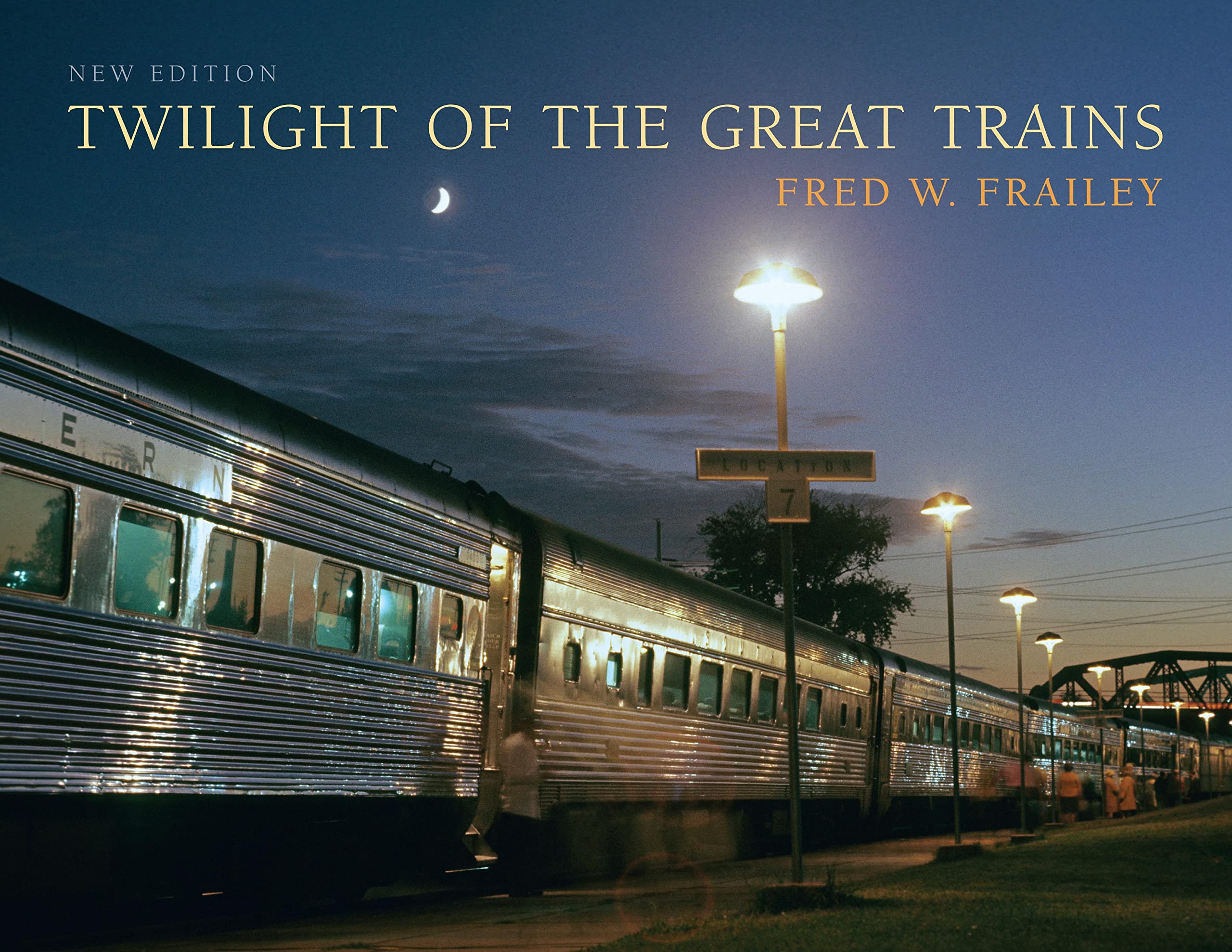
Amazon just delivered the "Expanded Edition" (2010) of Fred Frailey's original book, "Twilight of the Great Trains," published in 1998 by Kalmbach. This new edition is printed by Indiana University Press. Both books cost the same: $50 (interesting...no price inflation over 12 years; you can't say that about much else today, and the new book is 20 pages bigger!). Amazon sold it to me for $33.In my opinion, the original book is the best treatment ever written about the final decade of passenger train operation in America. Fred's writing is detailed, comprehensive, and easy to understand. The passenger line diagrams of where the trains went, and their consists, is outstanding in understanding, even in the twilight of privately-operated passenger trains, just how fine tuned the system was. It's about as close to Trains editor David P Morgan's writing style as you'll find, and each chapter contains a wealth of knowledge written in a friendly "let me tell you about this" manner.The new edition keeps all the text of the older one, and has added one entirely new chapter focused on the Illinois Central: "America's Main Street." It comprises 17 pages, 10 pictures, and a superb chapter closing tabular entry by Steve Parsons of Sparta, Illinois, which documents by motive power and individual passenger car names/numbers 17 trains and 352 cars that passed through Carbondale, Illinois, on December 21, 1963. Fascinating insight into a way of traveling in terms of numbers of trains and traffic density that has all but disappeared from America outside the Northeast Corridor, particularly on the former IC routes.Ten different photos in the new book replace other images in the original version. One image, B&O's "Capitol Limited" leaving Baltimore in July 1965 has the identical caption as the 1998 version, but a different Herbert H. Harwood Jr. photograph. New to the book are a classic Richard Steinheimer view of the eastbound "City of San Francisco" in full cry leaving Oakland behind four PAs (Steinheimer always photographed PAs like they were steam locomotives, and it shows!) and a beautiful consist only shot of C&O's eastbound "George Washington" easing to a stop in the Alexandria, Virginia, depot in April 1968.The original book used glossy paper; the IU edition uses more of a matte finish paper. Its images are sometimes a bit darker than the Kalmbach print, but in many respects I found the "almost sepia tone" to be more pleasant visually. Kalmbach's was printed in Hong Kong; IU's in China.I'm glad I purchased the new edition. The fly leaf says the expanded edition "brings the story up to date." I don't think it does that, as the final chapter in both books is identical and there is no new forward in the 2010 edition. But the IC material is brand new, and I liked the printing of the 2010 version better than its 1998 predecessor. If you do not have the 1998 version, I can unequivocally recommend this book if you're interested in passenger trains on 12 great railroads in the last decade of their existence.
A**3
Not quite the story expected.
Timely arrival, well packaged, no issues.Not quite the detailed history I expected, this is more a rambling series of conjectures, weaving together the personalities that defined the era with the structural forces that led to end of passenger service (as we knew it). Generally well written and researched, spare use of imagery a little disappointing. Chapters focus on individual lines, so chapter by chapter you get inundated with redundant material (eg the forces working in concert to undo passenger service), but when all is said and done when finished you have a pretty good idea of what happened, and why. Curious choice of narrative style, but it works.
J**Y
The best book of its kind
Twilight of the Great Trains gave me a much better understanding of the downfall of the American passenger railroads and the creation of Amtrak. The chapter on Union Pacific was a bit of a disappointment, as it was mostly a chronology of events. But subsequent chapters got inside the heads of railroad executives and the different approaches they took to a common problem. Some couldn't wait to get rid of their passenger trains, while others held onto them as long as they possibly could. Sprinkled throughout are several interesting personal stories.Missing from the narrative is a detailed discussion of government funding policies which heavily favored air and auto travel while excluding trains entirely. This was a major factor in the loss of passenger rail service in this country, for the trains were essentially trying to compete against government-built highways and airports.
D**N
Railroads' approaches to declining passenger business
An outstanding history of the decline and eventual end of private-sector rail passenger service in the United States. Veteran railroad author and Trains magazine correspondent Fred Frailey details the varying approaches taken by different railroads to the pressures of competition from the highways and airlines and of regulation by state and federal agencies, all of them ultimately ending with the creation of Amtrak. Well illustrated with black and white and some color photographs, along with detailed diagrams illustrating routes and consists of major trains, this is a well-written look at the passenger rail industry of the 1960s.
P**T
A poignant story
This is a great book about the end of privately operated passenger train travel in the United States, between the end of World War II and the start of Amtrak. It's a story of big dreams and dashed hopes told in an engaging style. Case in point: Frailey relates how a trip on the once-posh Texas Special went from crisp sheets and fluffy towels in the Pullmans and crystal-and-silver in the dining car to "a night spent in a Maytag dryer." Some railroad kept trying to the bitter end, others just gave up. Poignant and engaging, an excellent read.
R**N
Four Stars
Well done book, but heavier on equipment stats than what made the name trains special in the first plac.e
E**E
good stuff
It is a pretty comprehensive history of the demise of passenger trains in North Amarica. I'd recommend it for anyone with a desire to read an authoritative account of how this sad event in railroad history came about. If your interest is casual and you open the book with no knowledge of railroad langauge, it becomes a hard read. I would have liked consistant good maps of the routes of these trains, but otherwise the photos are quite good and carefully selected.
A**W
Great book for persons wanting to know more about passenger trains
I chose a five star rating because this book has a lot of valuable information on passenger trains and their respective consists. It is a really good source for those wanting to know about the history of passenger trains of various railroads. These passenger trains are mostly from as they ran in the 1960s, which were the final years of passenger service before the takeover of Amtrak in 1971.
T**S
Five Stars
a really interesting story well written
Trustpilot
2 days ago
5 days ago