
DOWNLOAD THE APP


Customer Services
Copyright © 2025 Desertcart Holdings Limited
DOWNLOAD THE APP
Full description not available
M**Y
Excellent reference for Holocaust students and teachers.
Excellent reference for Holocaust students and teachers.
A**N
"There, but for the grace of God go I." by Anda Meisels Rosen, author of a memoir :"Middle Andzia"
While historians are lecturing from their ivory towers, politicians make speeches, and as the likes of Hitler are arising anew and are even given a platform at the UN, and as new kinds of genocide are being perpetrated, a French Catholic priest, Father Patrick Desbois, an extraordinary human being, humbly walks on the Ukrainian soil touching with his own hands the scars etched in it by the "Holocaust by bullets",and listening to the echoes of the victims cries. The countryside mud, so thoroughly soaked with the blood of the Jews murdered there 70 years ago, sticks to the soles of his very own boots as he confronts the evidence of a gruesome history that others chose to deny, ignore or forget.He went there to witness with his own eyes and ears the mass graves of at least 1.5 million Jews who were brutally murdered there with bullets, some buried still alive. He went there to find the few Ukrainian witnesses who are still alive.He talks to them in person, looking them in the eyes, searching their facial expressions, never missing the telling inflections in their voices, reading every nuance of their emotions as they describe what they have seen with their own eyes and heard with their own ears as children. Somehow they trust him and finally want to talk, to get something very heavy off their hearts before they die.And thus, he also becomes a witness; he listens and observes, while hiding his own emotions, lest they might intimidate a witness, lest the accounts would stop. More often than not, listening to the accounts, he had to suppress his own tears, shock and nausea.Father Desbois is a devout Catholic priest talking to fellow Christians about murders committed close to their doorsteps by others who considered themselves also Christians even though they were Nazis. But Father Desbois does not judge- he leaves that to God. And so the old Ukrainian men and women talk to him, they trust him. Yet he still needs a bodyguard, because there are still some around who would rather hide the true and gruesome history of these God forsaken places.Father Desbois does not delegate this difficult task to a graduate student at a university, or a student at a seminary or a professional journalist. Seeing the bones, he doesn't think of them as historic, statistical data. He thinks of the names they might have had. To him these were mothers, children, men, parents, grandparents, teachers, rabbis, doctors, people young and old, once rich or poor; to him each bundle of bones is a lost human life, a life created by God who, one by one, bullet by bullet, was destroyed by other humans committing the sin of murder.Father Desbois is a humble and righteous man. He should be awarded the Nobel Prize for his work, this book, this testament to the evil of antisemitism, blind hatered and fratricide, because his is an inspiring story. He is a man who stands head and shoulders above many a recent recipient of that prize.To you, Father Patrick Desbois, as one who once was also there, a Jewish child who somehow escaped, but whose family is buried in one of those hellish pits, I bow with great respect, gratitude and love. Choosing to become a witness to this brutal truth you personify the words "Tikun Olam" in the deepest sense. (In Hebrew Tikun Olam means the task of repairing the world.) Only through confronting the truth, no matter how painful, can the healing begin.
Z**N
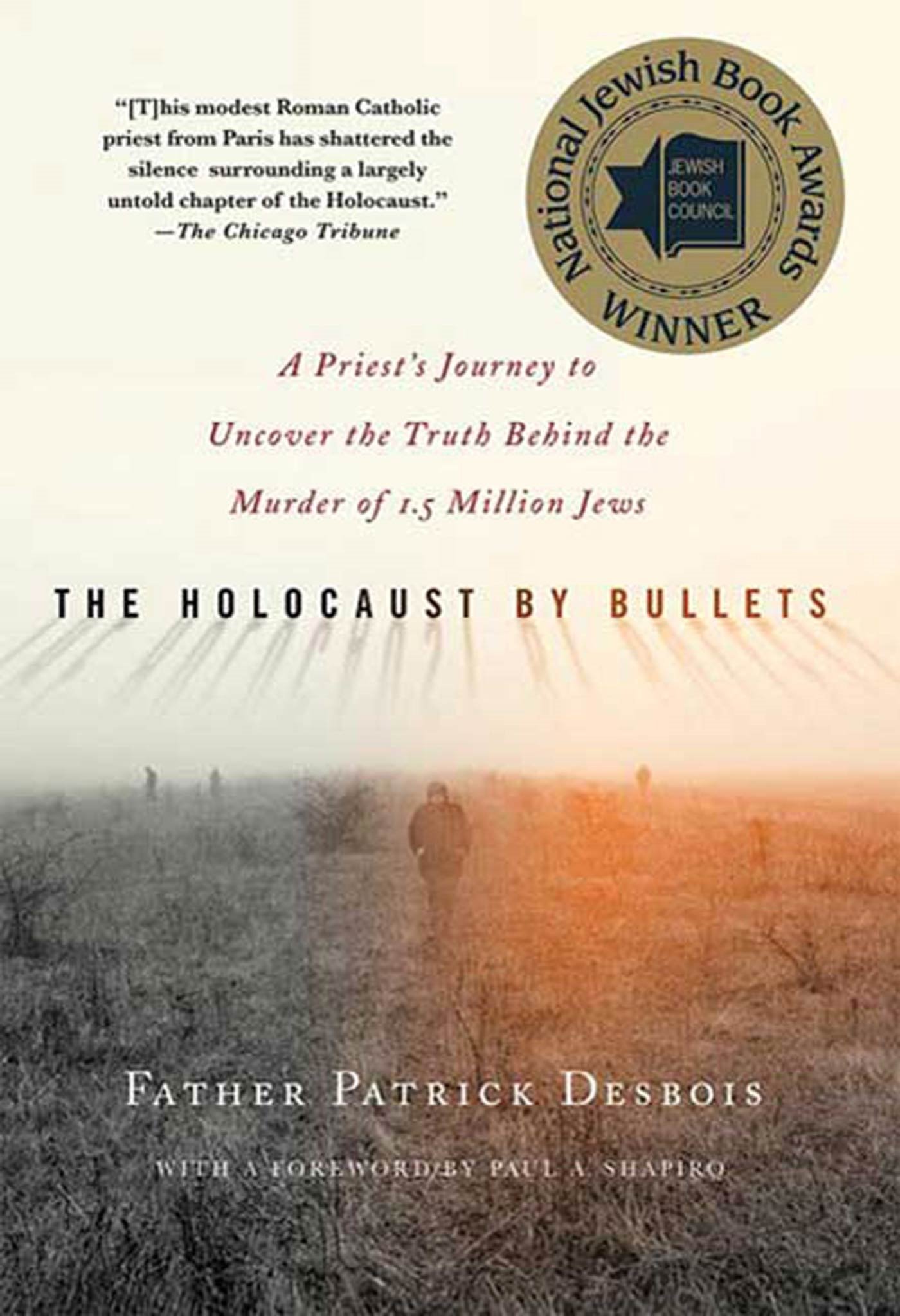
The Holocaust By Bullets - In Broad Daylight
Review of The Holocaust by Bullets, by Father Patrick DesboisReviewed by Zev Stern In my 67 years as the son of a Holocaust survivor I must have read tens, if not hundreds, of works in this genre, survivors’ memoirs, accounts by professional historians and other third parties, historical novels. I watched many films on the subject, popular and academic. But this book and a later one by the same author, In Broad Daylight, were special. Do not stop taking your antidepressants before you read one or both books. Have some tissues handy, even if you are a grown man. These books are different because they lay bare a dimension of the Holocaust that most of us in the second generation and after are unaware of or have pushed aside, as if to a back burner of consciousness. When most of us think of the Holocaust, we have a mental image of people being crowded like livestock into boxcars, without food, water or sanitary facilities, and taken to a death camp such as Auschwitz, where most would be gassed on arrival and those deemed fit for slave labor would be held under unspeakable conditions of starvation and inhuman treatment. Needless to say, any inmate who became too ill to work was immediately shipped to the gas chambers. The reality was different in what is now Ukraine, Belarus and western Russia. In 1941 Nazi Germany executed a lightning campaign (blitzkrieg) that conquered most of what was then the Western Soviet Union. The area contained millions of Jews in numerous small communities that had been there for centuries. As soon as a town was captured Nazi mobile killing squads, or Einsatzgruppen, set about shooting every Jewish man, woman and child they could find, into mass graves. Those graves were dug by the victims themselves, or by “requisitioned” locals, Soviet citizens. The ditches by themselves drew little attention since the villages were mostly agricultural, and farmers in the area had long made use of ditches for storing produce and other purposes. But the people who dug them knew what they were for, and the next day everybody in the village would know. The author’s grandfather, a Frenchman, not a Jew, was a prisoner of war and was shipped by the Nazis for forced labor in Rawa-Ruska, a little village in what is now Western Ukraine. He returned to France after the war and told the author about what happened to him and other POWs, but was very reticent about the fate of “the others,” whom he did not identify but whose fate was much worse. When he grew older, the author decided to find out who “the others” were and what happened to them. By then the world knew about the Einsatzgruppen in broad outline, but Father Desbois set out to uncover details that would prove embarrassing to the local non-Jewish population as well as to this son of a survivor, albeit an unusual kind of survivor. My late Viennese father saw the writing on the wall, left Austria before the Anschluss, and fought the Nazis first in the French and later in the American army. The author rips aside a veil of secrecy and shows us the bureaucratic machinery of death, operated by the Nazi murderers themselves and their more-or-less eager Ukrainian and Russian collaborators, the handymen (and women) of death who kept the well-oiled machinery of genocide running smoothly. He might well have named his book “A Report on the Banality of Evil” had not Hannah Arendt already used the title for her seminal work on the trial of Adolf Eichmann. Few monuments mark the mass graves that exist in almost every hamlet where Jews lived, so the author and his teammates used new technology that measures the consistency of the earth below and identifies anomalies consistent with decomposing human remains. Elderly persons were interviewed by an assistant who spoke Ukrainian and, the Soviet Union having fallen, these witnesses gave details about the crimes that otherwise would have been lost to history. Schoolchildren and their teachers looked out the windows of their schools, saw their neighbors being mur-dered and were not unduly traumatized. Jewish victims would stand at the edge of the pit, their friends and relatives already dead inside, while the German murderers enjoyed lunch with their weapons stacked somewhere. The Jews waited patiently to be killed and did not lift a finger in their own defense. Babies and children who could not stand were simply tossed alive into the pits; why waste a bullet? Wounded but not dead, still-moving Jews were not given a coup de grace before the ditch was covered with earth or lime. Those live Jews could be heard screaming from the pit, evoking God’s rebuke to Cain: Your brother’s blood screams to Me from the ground. Accounts of the witnesses all state that “the earth moved for three days,” as if testifying to the desecration wrought on it. Blood and body fluids would leach from the pits and seep into town, and peasants were ordered to bring ashes from their hearths to dry it up, recalling the phrase in one of the prayers for the Holocaust victims: Earth, cover not their blood. The events described so poignantly in these two books leave a gaping wound in my heart that will probably never heal. The crimes were committed “in broad daylight,” yet the Christian Poles, Ukrainians and Russians did absolutely nothing, if they didn’t eagerly collaborate with their German oppressors and divide among themselves the clothing and property of their slaughtered neighbors. Worse still, the Jews themselves did not actively resist. Though victory in the usual sense was impossible (once the forces of evil capture the machinery of a modern industrial state it’s too late), they could at least have salvaged some honor for our people, as the Warsaw ghetto fighters and the Jewish partisans in the forests did. The author writes that thinking and writing are his acts of resistance. Visiting New York’s Holocaust museum and reading, with the traditional cantillation notes, from the Torah scrolls in display cases, is mine. Those scrolls were supposed to be gawked at in a “museum of an extinct race” to be built in Prague. I am there not dressed for synagogue but in my summer running clothes, glistening with sweat and showing off my muscular Jewish physique, built by lifting weights, often to the powerful and strident music of Richard Wagner, once idolized by the Nazis. Extinct race, huh? I once came up on a young German runner in a hot and hilly race in New York’s Central Park. When he complained about the heat, I threw back at him the immortal words of Nietzsche, a philosopher dear to the Nazis: What doesn’t kill me makes me stronger. I left the German in the dust and completed the race high on life and Jewish joy - another act of resistance. I have only one major criticism of these two books. The author often refers to the acts of genocide as “assassination” and “execution.” Assassination requires a motive, usually political or religious. President Kennedy and England’s King Charles I were assassinated. Execution requires a crime, a trial, or at least a sham trial, and a finding of guilt. Millions of Eastern European Jews did not commit capital crimes. Their only crime was being who they were. They were not assassinated or executed. They were murdered. And their voices still scream to us across the years and across the ocean. The only way to give meaning to their suffering and death is to stand up for our civilization and not stand by while others commit genocide against another people or peoples. “Never again” must mean exactly that, not to us and not to anyone else.
J**N
Apowerful narrative give voice to forgotten victims
"The Holocaust by Bullets: A Priest's Journey to Uncover the Truth Behind the Murder of 1.5 Million Jews" by Father Patrick Desbois is an illuminating and deeply moving account that brings to light a tragically overlooked chapter of the Holocaust. Father Desbois' relentless quest for truth and justice uncovers the horrific mass shootings of Jews in Eastern Europe, a stark contrast to the more widely known atrocities of the concentration camps. His meticulous research and powerful narrative give voice to the victims and witnesses, shedding new light on the extent of Nazi and local collaborator brutality. This book is an essential read, offering a poignant reminder of the horrors of the Holocaust and the importance of remembering every aspect of this dark period in history.
C**N
La verdad del Holocausto por Balas debe ser más reconocida por historiadores y la sociedad en general.
Muchos conocemos los campos de exterminio, pero …. lo sucedido en la Europa del este, antes y durante los asesinatos mediante las cámaras de gas, es también de una atrocidad inimaginable y poco conocida. El Holocausto por Balas es la fase anterior a las cámaras de gas. El Holocausto por Balas dio paso a las cámaras de gas, porque los ejecutores (alemanes y colaboradores) padecieron el impacto emocional y estrés traumático de asesinar, cara a cara, a unos 2 millones de judíos, hombres, mujeres, niños y ancianos, de los 6 que se reconocen oficialmente.Este libro presenta la evolución del sacerdote católico francés Patrick Desbois y su equipo de investigación, dentro de la asociación Yahad-In Unum, en el descubrimiento de las fosas comunes de judíos y gitanos en los países del este de Europa. No solo recoge los estudios de campo en sus visitas por cientos de localidades, mediante entrevistas a testigos directos de las matanzas, sino que usan archivos oficiales alemanes y soviéticos para completar , ampliar y contrastar sus investigaciones a pie de calle y casa. Esta combinación de elementos en el estudio del Holocausto por Balas le confiere de una solidez y rigor histórico notable. Pero hay que destacar y valorar el esfuerzo del Padre Desbois por presentar este estudio histórico bajo un prisma de humanidad admirable y difícil de conseguir. El tacto con el que presenta a los testigos directos y el respeto a las víctimas del Holocausto por Balas es sorprendente. Aunque es un libro duro de leer, considero acertado enfrentarse a la verdad del Holocausto por Balas del Padre Patrick Desbois.Nota adicional: Existe un segundo libro por el mismo autor, y para completar un cuadro más amplio y global, recomiendo el impactante libro de Klee, Dressen y Riess: “The Good Old Days” (una aproximación sorprendente desde los perpetradores nazis sobre el Holocausto).He leído unos 35 libros relacionados con el Holocausto y he de admitir que el “Holocausto por Balas” y “The Good Old Days” han sido los más difíciles de digerir.
A**R
Would recommend any books by this author
Passionately and sensitively written narrative of the author and his helpers, journey to discover killing sites throughout Ukraine. Would recommend any books by this author. Gripping.
A**R
A harrowing but necessary read. Very well compiled
Harrowing to read, not for the faint-hearted. . But after all I’ve researched on the holocaust this showed a very different light. The complicity of Eastern European’s and learning that the firing squad killings took 3 days for all the people to die in the graves, mostly from suffocation not bullets!! Well researched.
D**A
Worth reading
This book offers another perspective of the Holocaust and delivers an understanding that the terror faced by Jewish people was not limited to the concentration camps. In their villages, surrounded by their neighbours and family they were killed for no other reason than being Jewish. Holocaust by Bullets is what the title states. It is a very moving and raw account.
Trustpilot
2 weeks ago
5 days ago