🎶 Elevate Your Sound, Elevate Your Life!
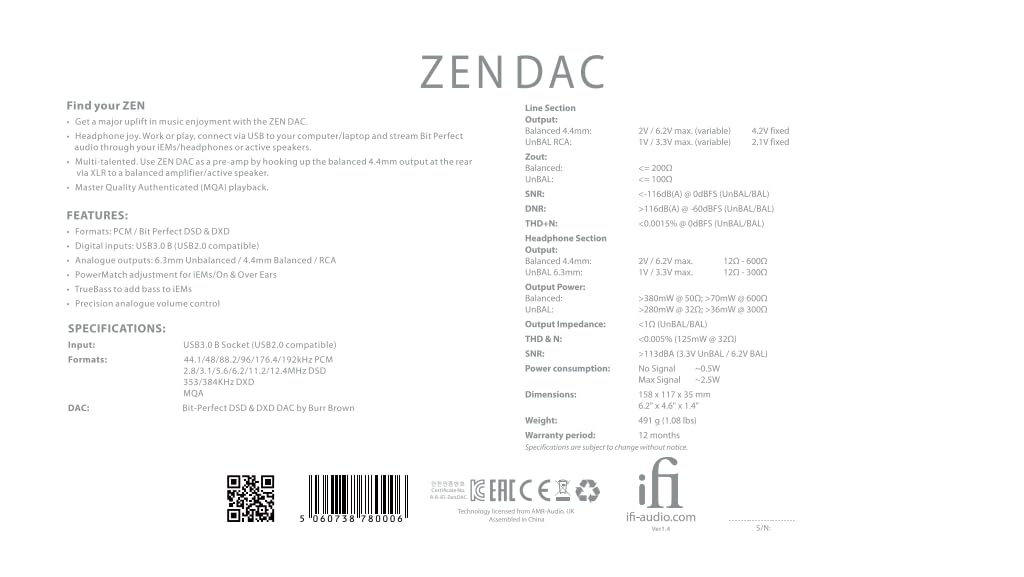
The iFi ZEN DAC is a compact Digital Analog Converter designed to enhance your audio experience at home or on the go. With high-resolution audio capabilities, seamless USB connectivity, and a stylish aluminum design, it’s the perfect upgrade for audiophiles and casual listeners alike.


| Manufacturer | Abbingdon Music Research |
| Part number | ZenDACrm |
| Item Weight | 491 g |
| Product Dimensions | 27.69 x 15.75 x 6.1 cm; 491 Grams |
| Item model number | ZEN-DAC |
| Size | Unit only |
| Item Package Quantity | 1 |
| Plug profile | Plug Mount,Tabletop |
| Batteries included? | No |
| Batteries Required? | No |
R**Y
iFantastic!
I’m a self-confessed iFi fan. So please pardon the stream-of-consciousness review.Also, I live in South Africa - and this unit was purchased via Amazon in the UK and swiftly delivered to me in Johannesburg in the new year, well before the world started locking-down due to the Coronavirus.So, first some context. The love-affair with iFi started last year as I started to emerge from the false-premise that all digital music could not live up to the mesmerising sounds that I used to get from my vinyl & CD days. This was before I even knew such a thing as a dac or headphone amp existed. I’m 47 years old, and now I feel like a kid in a candy shop as I’m re-living and re-loving my music collection all over again.It started with a birthday gift to myself last year. I splurged out on my first hi-end pair of headphones in almost 2 decades - the Beyerdynamic DT770 Pro 80 Ohm, which I bought from a South African distributor. This was huge for me, as they were not cheap for me, and they were the most ‘fancy’ set of cans I’ve had since I wore out my pair of Sennheiser HD 497s well over 10 years ago. The Sennheisers were eventually replaced by the Klipsch Image One, and then the Grado SR80e headphones - which were good, but I wasn’t in love.Then one day, a colleague of mine, who happens to be quite the established audiophile, saw my disillusionment as I plugged my DT770s into my headphone jack socket on my MacBook Pro and was underwhelmed by what I was hearing. He suggested two things: “Try a headphone amp or dac, and stop using iTunes.” So I stopped using iTunes and upgraded to Amarra Luxe Pro (which is phenomenal, but buggy as hell). And then he said he would loan me his dac to try out. The next day he presented me with his iFi Nano iDSD dac (which I believe has been discontinued - please correct me if I am wrong people from iFi).After connecting it to my MacBook and listening to Miles Davis's & Cannonball Adderley's "Autumn Leaves", my ears melted into audio heaven. I couldn't believe it! It certainly made the music sound awesome like I'd never heard it before, but still struggled to drive my DT770s to a loud enough volume. Even my Grados took on a new lease on life through that little iFi. I begrudgingly had to return the Nano iDSD a few days later, and longed to return to that sound. But I couldn't just go out and purchase a dac - as I am a budget audiophile virgin, and I have a family to feed. So I waited some time before I could splurge again. I then got an impressive little Sabaj PHA3 tube headphone amplifier, which definitely improved the volume of my DT770s, but yet still something was missing. And then iFi released their Zen Dac. And, it seemed like a gigantic upgrade on the Nano iDSD for less money, and I bit the bait.So, I've been living with the iFi Zen Dac for almost 5 months now, and I can honestly say that it has been one of my best friends during lockdown.It's permanently plugged into my MacBook Pro's USB socket, which is great as it doesn't need external power - although it comes equipped with a 5 volt DC power input, but alas no power adapter. This may be a dealbreaker for some, but I plugged in my Sabaj power adapter into the unit and heard no noticeable difference in sound quality as opposed to using just the USB connection. Which is fine for me as my wall-socket already looks likes Medusa's hairdo with all the wires and things. I have connected the iFi's RCA outputs to the Sabaj amp (where the iFi becomes a pure dac), and sometimes switch between the plugging my headphones into the iFi or Sabaj just to hear the sound differences. Not too sure why, but my Hifiman HE4XX planar magnetic headphones sound a little better powered through the Sabaj, but for everything else the iFi is unbeatable. I have not tried any of my headphones on the balance output that the iFi Zen Dac comes standard with, opting to use the 6.3mm unbalanced port with a quarter-inch adapter that most headphones include as an accessory. Some say that the balanced output might be better for the planar magnetic headphones, but alas I will have to wait till I get a 4.4mm pentaconn adapter to verify this.I'm not going to get into any of the fancy technical details of the iFi Zen Dac, mainly because I do not understand most of it. But it seems to be extremely high-specced and hi-tech for a dac costing under £130, and the build quality is truly astounding. Most other dac/amps in this price-range are made of plastic, but this is solid metal, and a nice hefty metal at that. They say it's military-grade aluminium - and it feels like it's built like a tank. I also love the retro look of the design - it's got soul.I guess I should get into how the iFi Zen Dac sounds. Well, to my ears, utterly magical. I can only imagine how iFi's more expensive dacs sound if this little wonder already makes my ears joyous. Some say it has to do with iFi's love-affair with using the Burr-Brown Dac chip in their circuitry. And I love the TrueBass function, which really rounds of the bass nicely. If you're a reggae and dub lover, then you need the TrueBass button in your life. But it's not just the bass that is buttery, so too are the mids and highs. And as an amp it gets loud. My DT770s are already extremely loud at the 1 'o clock position on the volume knob (and what a lovely knob it is).Currently I'm mostly streaming music from Deezer HiFi and Spotify Premium on my MacBook Pro, played through the Zen Dac, and I'm loving my music all over again. It really is that good. I'd love to get a second one so I can have one at home and one at the office, but my wife might divorce me if I buy any more audio toys LOL.
G**
Turned my IPad into a Hi-Res audio player for my Hi-Fi
Music streaming services such as Tidal are now offering “Masters” quality Hi-Res versions of albums. The tracks on these albums have been digitally sampled at 24-bit/96kHz which promises to offer a superior audio experience to CD versions of the album which are always digitally sampled at a lower 16-bit/44kHz frequency. The great news is that “Masters” albums are not just limited to recent releases by the likes of Ed Sheeran, Stormzy, Justin Bieber and Drake. The entire back catalogue of musical icons such as the Beatles, Bowie and Led Zeppelin have been resampled at this higher bit rate and frequency from the original Master tapes.I initially expected that it would be relatively easy to enjoy the full Hi-Res audio experience from MQA (Masters Quality Authenticated) files played from the Tidal app on my iOS devices. After a little bit of research I soon learned that MQA files require two stages of unpackaging and processing to unlock the Hi-Res sound. The first stage of the unpackaging is done by the Tidal App on your iOS device. The data is then passed on to the DAC (Digital to Audio Convertor), which is responsible for completing the final unpack and processing of the MQA audio file.The removal of the 3.5 mm headphone jack from recent iOS devices resulted in the loss of the onboard DAC. You are therefore left with one of three choices to transfer your music from your iOS device. The first option is Bluetooth streaming but iOS devices automatically downsample the Hi-Res audio files to AAC format before transferring them, which naturally leads to a reduction in quality. The second option is to use the included Apple lightning to 3.5 mm dongle, which has an inbuilt DAC. This DAC however lacks the ability to reproduce Hi-Res audio. Attaching an External DAC is therefore the only option that will allow you to reproduce Hi-Res audio from an iOS device. If your choice of provider of Hi-Res “Masters” audio files is Tidal you are going to need a DAC that is MQA certified. Unfortunately most DACs on the market are not MQA certified and lack the capability to complete the final unpack and processing of the MQA audio file which is required to deliver true Hi-Res audio.My initial research left me seriously doubting whether there would be any solution within my price range to enable me to deliver Hi-Res audio from my my iOS devices to my Hi-Fi. I therefore couldn’t believe my luck when an internet search brought up the recently released iFi Zen DAC for less than £130. It is such a beautifully designed DAC, with a full metal chassis that gives the Zen such a premium feel. The absolute killer feature of this DAC is that it is MQA certified. This means it can complete the unpacking process and output the Tidal “Masters” files in full Hi-Res audio to the device of your choice. RCA connections allow you to output to your Hi-Fi and there are also two 4.4 mm outputs to hook up a pair of headphones.I connected my iPad Pro by purchasing a £7 USB-C to USB-B 3.0 cable (not to be confused with a USB-C to USB-B 2.0 cable, which won’t fit the USB-B 3.0 port on the Zen). To connect my iPhone I require a Lightning to USB-A dongle (Apple call it the Lightning to USB 3 Camera adapter) along with the supplied USB-A to USB-B 3.0 cable. A slightly less elegant solution but still incredibly simple.I’d initially used my award winning Cyrus Soundkey DAC/Headphone amp (not MQA certified) to deliver audio from my Tidal app on my iPad to my amplifier, via its 3.5mm headphone output. The device has done an admirable job when coupled to my Senheisser Momentum headphones. However to say I was disappointed with the experience through my Hi-Fi was an understatement. Even at low to moderate volume my system really exposed the flaws in the outputted audio, which suffered from very audible distortion.With the iFi Zen DAC I can use a vastly superior, balanced RCA connection to my Hi-Fi’s amplifier, instead of a sub-optimal unbalanced 3.5 mm connection. As soon as I play a “Masters” quality track on my iPad Tidal app the light on the front of the iFi Zen DAC goes purple (technically Magenta) to indicate it is receiving and processing an MQA authenticated file. As soon as I switch to playing one of the more usual standard “Hi-Fi” quality tracks on the Tidal app, the light on the front of the unit switches to green to indicate it’s receiving a lower bit rate file. It is really satisfying to be able to see as well as hear that the DAC is performing its magic on those Hi-Res MQA tracks.In reality however by far the most important part of this review comes down to the sound quality. The iFi Zen DAC delivers were it really matters. I tested it with a wide variety of source material and really “cranked up” the volume and still the music remained absolutely crystal clear. I then cross referenced a “Masters”quality album streamed from the Tidal app on my iPad through the DAC with the CD version I owned, played through my £300 CD deck. The audio reproduction from the DAC was at least as good as that from my CD player.The big difference however comes from the fact that I have unlimited access to millions of songs through the Tidal app. The iFi Zen DAC costs less than £130 and can reproduce these tracks to a level that is at least on par with my CD player. I bought the CD version of an album to experience the ultimate sound quality but thanks to the iFi Zen DAC I can now experience the best quality through a music streaming service.It’s rare to find such a clever, elegant and technically sound product that perfectly matches your requirement. It’s even rarer to find it at such an affordable price!
Trustpilot
3 days ago
1 week ago