Some deliveries may take a little longer than usual due to regional shipping conditions.

DOWNLOAD THE APP


Customer Services
Copyright © 2025 Desertcart Holdings Limited
DOWNLOAD THE APP

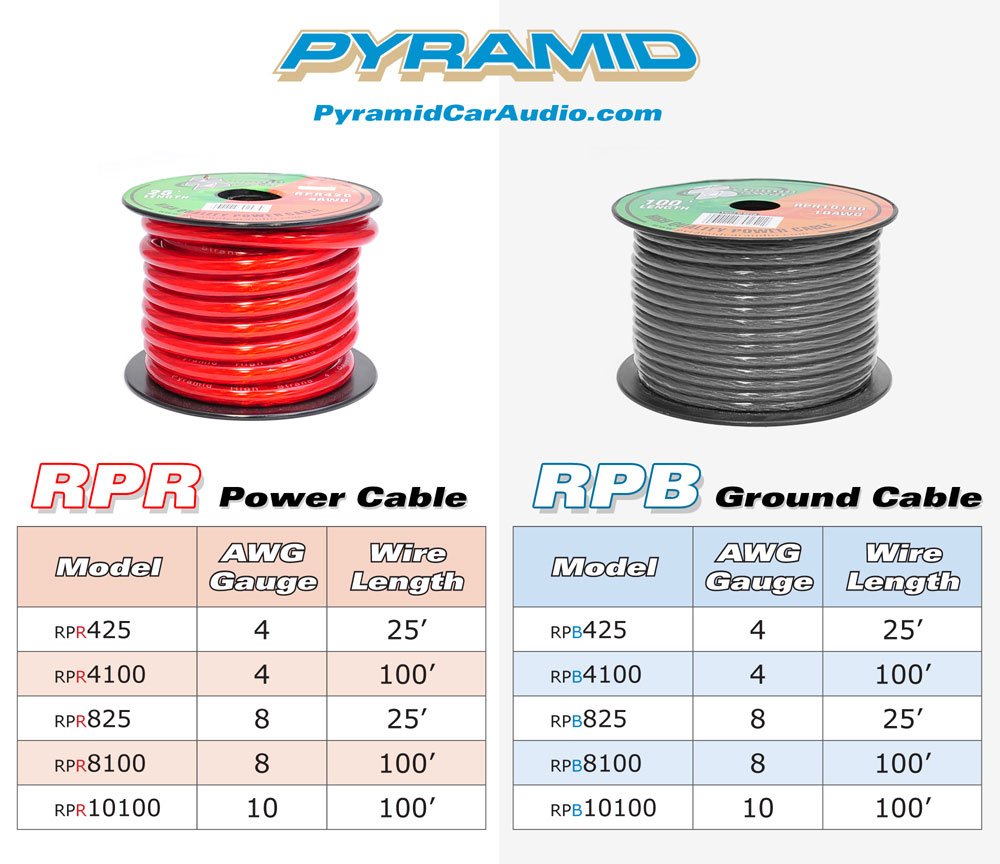
🔊 Power Up Your Sound Experience!
The Pyle 8 Gauge Clear Red Power Wire is a 25ft copper cable designed for connecting audio systems, amplifiers, and home theaters. Engineered for professionals, it combines durability with user-friendly features, ensuring high-quality sound performance.
D**R
Good legit 8 gague wire for the cost
First things first: when I bought this, it was not labeled OFC (oxygen-free copper), so I'm reviewing it with that in mind. I seriously doubt that they've switched to actual tinned copper wire at the same price, so keep in mind that, at this price, this is probably still copper-clad aluminum (CCA), not tinned or pure copper.There are several reviews up here which complain that this is not 8 gauge wire; one person actually claimed 16 gauge. I'm not sure what these people are reviewing (there is some indication that not everyone gets the same thing from all suppliers), but it's not the wire I got from Amazon. The wire I received measures 3.45mm inside the insulation at the widest point, and around 3.2 at the smallest. The standard for 8 gauge wire (using the AWG standard, which everyone in the USA uses) is 3.264mm. That's for solid wire, so if you figure that fine stranded wire will have minimal air space between the strands, you can see that this is within the reasonable range for being legitimate 8 gauge wire. I should have measured the individual strands and added them up to be positive, but I'm not *that* anal. I've added pictures showing the actual spool I received, and a caliper measuring the wire. The insulation is thick, and it's generally nice wire. I only gave 4 stars because it's copper-clad aluminum (called CCA) rather than tinned copper (or pure copper). You can tell the difference by cutting the wire and looking at the end; if it looks more silver, it's aluminum. If it looks like copper with a slight silver sparkle, it's tinned copper (which is slightly better, but costs a lot more). CCA is typically about 10% copper by volume, and copper costs more than aluminum right now.This wire is pretty lightweight. This is because aluminum is substantially lighter weight than copper, for one thing. That's why this doesn't weigh as much as a roll of household solid copper 8 gauge wire. This kind of wire is often used in airplanes and other applications that actually need lighter weight cabling. In an automotive power situation, copper is actually somewhat preferable, as copper-clad aluminum has a very slightly higher DC resistance than copper - but we're only talking about a difference of .002 ohms over a 25 foot run, which is trivial at the voltage levels in a car.How about some numbers? There's a nice calculator online to figure out the voltage drop for stranded wire over a given length at a given current. Amazon for some reason won't let me post a link to the calculator, so search Google for "stealth316 voltage drop calculator" to find the site. With a 14.4 volt car audio system, you want the voltage drop to be .28 volts (2%) or less over the length of your power wire in an ideal situation. Since the calculator is using copper as the reference value, you need to be closer to .21 volts dropped over the length for CCA (CCA will drop about 130% of what copper will drop if everything else is the same). So, say the wire from your battery to your amp is 15 feet long, and your amp has a 50 amp fuse (or two 25 amp fuses). That means your amplifier should never draw over 50 amps. To the calculator! 6 gauge copper would have a .3 volt drop, but 4 gauge would only drop .19 volt. So, 4 gauge copper or aluminum would be just fine for that load, because .19 is less than .28 (copper) or .21 (CCA). This 8 gauge wire would be a little small, dropping .48 volts over that 15 foot run.That last paragraph could be a little confusing, I think. So here's what I would feel comfortable recommending this wire for: - up to 12 feet @ up to 25 amps - up to 6 feet @ up to 50 amps - up to 3 feet @ up to 100 ampsIf you're in between, the values are inversely proportional. If you go up in distance by 2x, for example, go down in acceptable current by 1/2. This is because the resistance doubles, so to keep the voltage drop in the acceptable range, you have to reduce current by the same amount (due to the "V=I*R" relationship). So, for example, 4.5 feet is 1.5 x 3 feet, so acceptable current is 100/1.5 = 66 amps max.At those maximum lengths and current loads, you will not see any difference in performance (or safety) by going to a larger wire. If you're only over by a few amps (say, 30 amps @ 12 feet) you'll still be ok with this if you're on a budget, but I'd be seriously considering a larger wire in that case.
W**.
Insilation
I bought this wire to serve as power source for car aftermarket audio system installation. Upon receipt O didn’t think it was insulated properly to serve my purpose.
I**E
Decent quality cable, but not Pyle as advertised.
This cable seems to be of decent quality. It was advertised as Pyle branded, but is actually Pyramid (not that I see much difference between the two). It is flexible and installed nicely, including a couple solder joints.
R**.
Every bit as good as any speaker wire costing tens of thousand dollars.
Don't waste money on "audiophile" "high end" loudspeaker cables. The "engineers" who design "high end" cables have no physics or engineering training. For instance, they sell cables which are hollow or litz constructed to "correct" for skin effect at high frequencies. Skin effect attenuates an audio signal by 0.01 decibels at 20 kHz compared to the lowest frequency you can hear for two 5 foot lengths of this 8 gauge cable in series with a 4 Ohm planar magnetic speaker. Pure long grain copper does not emulate little diodes which must overcome threshold voltages and the insulator does not store static electricity that can introduce so much as a microvolt into speaker wires. Get thick enough cable which is easy to connect to banana plugs and cables costing hundreds or even thousands will not be any better. Look for the speaker cables in the attached photographs. The ruby red see-through insulation I think is far more beautiful and not eloquent in snake oil.
F**M
Great for what I needed it for
I used this wire as SPEAKER wire instead of POWER wire. This wire worked perfect for what I had planned and if I need to rewire my subs again, I will order more of this. Would I use it for power wire? No. Most people don't want to hear this but when your running power wire for an amp, you don't want to go cheap. You want to use quality, brand name, wire like STINGER, STREETWIRES or ROCKFORD FOSGATE. 8 gauge power wire is a joke anyway, 4 gauge is almost too small for power. I recently upgraded to a 0 gauge STREETWIRES power kit and the difference is amazing! Although I would never use this pyramid 8 gauge as power wire for any of my systems, it makes great speaker wire!
M**K
No hate here. It's a decent cable.
This cable has a serious amount of haters regarding the gauge of the actual cable. From what I can tell, the cable its self is 8 gauge, or at least very close. I think the rub is that often other higher quality cables will provide a thicker than specified gauge to set themselves apart from the rest. This cable only meets the minimum specification for the gauge, and thus might be smaller in comparison to others. For me it does the job, has a good look, and has an appearance of being very high quality. The cable is a very high strand count and is thus fairly flexible for the size.
J**E
I ordered 8 gauge high powered wire.
Burnt as soon as I installed a piece to my alternator. I specifically ordered 8 gauge heavy duty wire. This is like speaker wire
D**N
works as expected
no issues
M**F
great stuff ty
awesome thanks
A**R
good product
Definitely not 8 gauge, maybe 10awg but it is copper and the price is cheap.
B**.
Item arrived as described and in a timely manner
Item arrived as described, excellent power wire for whatever 12v projects you may have.
B**V
False Labelling. Not actually 8 ga wire.
The price may seem too good to be true... That’s because it is!The sheathing is clearly marked 8 ga wire, but the copper is much thinner than that. It’s smaller than every 10 ga wire I had in my shop to compare it to. You can fit two of these cables in an 8 ga terminal and still have room to spare. If you need 8 ga wire, look elsewhere.
A**U
Rien
Parfait
Trustpilot
1 week ago
2 months ago