
desertcart.com: Nietzsche: Anti-Christ, Ecce Homo: And Other Writings (Cambridge Texts in the History of Philosophy): 9780521016889: Friedrich Nietzsche, Aaron Ridley, Judith Norman: Books Review: I highly recommend this - Thank you, I have received the package in good condition. Review: good philosophy for our time also!!! - the nietzsche philosophy works well for our modern times and is not dated at all this is great views to all those who are their own persons not sheeplike clones who follow the rest of the boring flock think for yourself judge things for yourself that's how i feel think for yourself find your own views on life don't be a follower be a leader.
| Best Sellers Rank | #333,465 in Books ( See Top 100 in Books ) #228 in History of Philosophy #3,037 in History of Philosophy & Schools of Thought |
| Customer Reviews | 4.4 4.4 out of 5 stars (27) |
| Dimensions | 6 x 0.85 x 9 inches |
| ISBN-10 | 0521016886 |
| ISBN-13 | 978-0521016889 |
| Item Weight | 1.2 pounds |
| Language | English |
| Part of series | Cambridge Texts in the History of Philosophy |
| Print length | 340 pages |
| Publication date | October 27, 2005 |
| Publisher | Cambridge University Press |
Y**A
I highly recommend this
Thank you, I have received the package in good condition.
R**D
good philosophy for our time also!!!
the nietzsche philosophy works well for our modern times and is not dated at all this is great views to all those who are their own persons not sheeplike clones who follow the rest of the boring flock think for yourself judge things for yourself that's how i feel think for yourself find your own views on life don't be a follower be a leader.
P**L
Better Than Kaufmann For The Layman
Maybe you're an etymologist, a philologist, a grammarian. If so, you'll probably hate this translation because it doesn't capture the essence of whatever you think is the pure translation of the work of the man who slayed God to become a god. I have no use for people like you. Nietzsche said something to the effect of writing simply and plainly in order to be understood. People who write with ridiculous affectations do so in order to signal their status as an intellectual and hide the fact that their thoughts lack profundity. What am I getting at? Kaufmann's translations were done in the 1950s or so. In the brief period between then and now, American English has already evolved. Watch any black and white film and compare the actors' manner of speaking with those in a modern film. Obviously, they're very different. Language is not just style; it's contextual. Without capturing the context of meaning, it may as well be in a foreign language. Again, I'm speaking as a layman for the benefit of other laymen. I can't speak to this entire volume, but I'm reading Twilight of the Idols now in this Cambridge translation. It is far superior to Kaufmann's as far as readability is concerned. The critics will complain that this Ridley/Norman translation doesn't capture some original essence. If you want original, learn German and read it in German. I bet Germans would have a hard time reading the original texts. Bottom line: 1. languages change; modern translations are more readable. 2. pedants always proclaim that the old is better because they're aristocratic chalatans with too much free time who don't understand their status as reviewers means nothing. They intentionally or unintentionally trick people into taking unnecessarily difficult tasks. Here's an excerpt from Twilight for you to compare so you can make up your own mind. From Cambridge (Ridley/Norman) - Twilight of the Idols, p. 164-165 "I have shown how Socrates could be repulsive: which makes it even more important to explain the fact that he fascinated. -- That he discovered a new type of agon, that he was its first fencing master in the noble circles of Athens -- this is one thing." From Kaufmann, p. 476 (The Portable Nietzsche) "I have given to understand how it was that Socrates could repel: it is therefore all the more necessary to explain his fascination. That he discovered a new kind of agon, that he became its first fencing master for the noble circles of Athens, is one point." ---- If you're a layman that wants to read and understand Nietzsche without the added layer of obfuscation that comes about from reading awkward sentences, get this translation. I am speaking only about Twilight; I cannot vouch for the other translated books, which may or may not be good, as I have not read them. If you want to be an academic blowhard who wants to add an unnecessary layer of difficulty to Nietzsche's already difficult concepts, then by all means, get the Kaufmann translations.
R**E
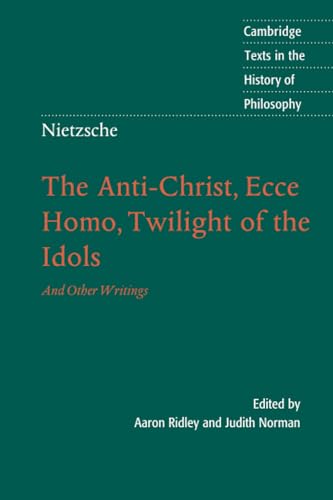
Nietzsche: The Anti-Christ, Ecce Homo, Twilight of the Idols
The Cambridge Texts in the History of Philosophy yet again struck gold, enshrining history's greatest thinkers in pre-eminently handsome texts, robust and readable translations, and scholarly and timely commentary and introductory exegesis. Despite Nietzsche's admonition greeting us in the very first prefatory page, this book belongs not to the few, but to all seeking meaning beyond society's regurgitated paradigms and ossified constrictions. A philosopher-bibliophile's "must have"!
G**.
Not in "very good" condition as described [Olivia-Products seller]
Extensive writing on several pages, cracked spine.
P**I
Not the best translations
The other translations of Nietzsche's works I have read from the _Cambridge Texts in the History of Philosophy_ series were all very good, but this particular volume is not the best available translation for the works included. To cite just one example, the translators have chosen on numerous occasions to translate "man" (the German word for "one") as "you." The subtitle of _Ecce Homo_, for example, "wie man wird, was man ist," means "how one becomes what one is" but in this translation it becomes "how to become what you are" (p. 69) or "how you become what you are" (p. 96). In addition to the lack of consistency, this rendering has two problems. It lacks both fidelity to the exact meaning of the original text, and fidelity to the style of the original text. My suspicion is that the translator (Judith Norman) has developed a timid habit of avoiding any form of expression that might be considered at all "elevated," since this might make her appear elitist and offend her democratic sensibility. But shouldn't a translator be faithful to the sensibility of the original text, rather than to his or her own political agenda? Nietzsche's style is nothing if not elevated. The sort of vernacular speech that substitutes "you" for "one" is entirely foreign to this style. All three of these posthumous works are available in far superior translations by Walter Kauffman. The translations of _Twilight of the Idols_ and _The Antichrist_ are published in _The Portable Nietzsche_ (1954). _Ecce Homo_ is published in _Basic Writings of Nietzsche_ (1966).
F**!
Affordable, but Uneloquent translation
Mainly because of its low price, I bought Judith Norman's translation of Nietzsche's The Antichrist, Ecce Homo, Twilight of the Idols, and Other Writings, thinking that the recent scholarship that has passed by must make this an excellent translation. To my dismay, however, the translator seems to make Nietzsche sound much more colloquial than the Nietzsche I am used to reading by Hollingdale and Kaufmann. Words are simplified and dumbed down; Nietzsche's concise tone is not as sophisticated; and the prose is not as enrapturing. Although, I will admit, this translation is probably (I don't read German.) highly accurate, it sacrifices a lot of eloquence in doing so, and making it worse, the occasional use of colloquial phrases unique to this translation ("for real" "bit of a break" and etc.) do not seem true to Nietzsche's "aristocratic radicalism." If you have the money, I would recommend you to buy better translations, but if you're on a tight budget like me, this, unfortunately, will have to do.
Trustpilot
2 weeks ago
3 days ago