
DOWNLOAD THE APP


Customer Services
Copyright © 2025 Desertcart Holdings Limited
DOWNLOAD THE APP

Full description not available
J**A
Full of options for your campaign
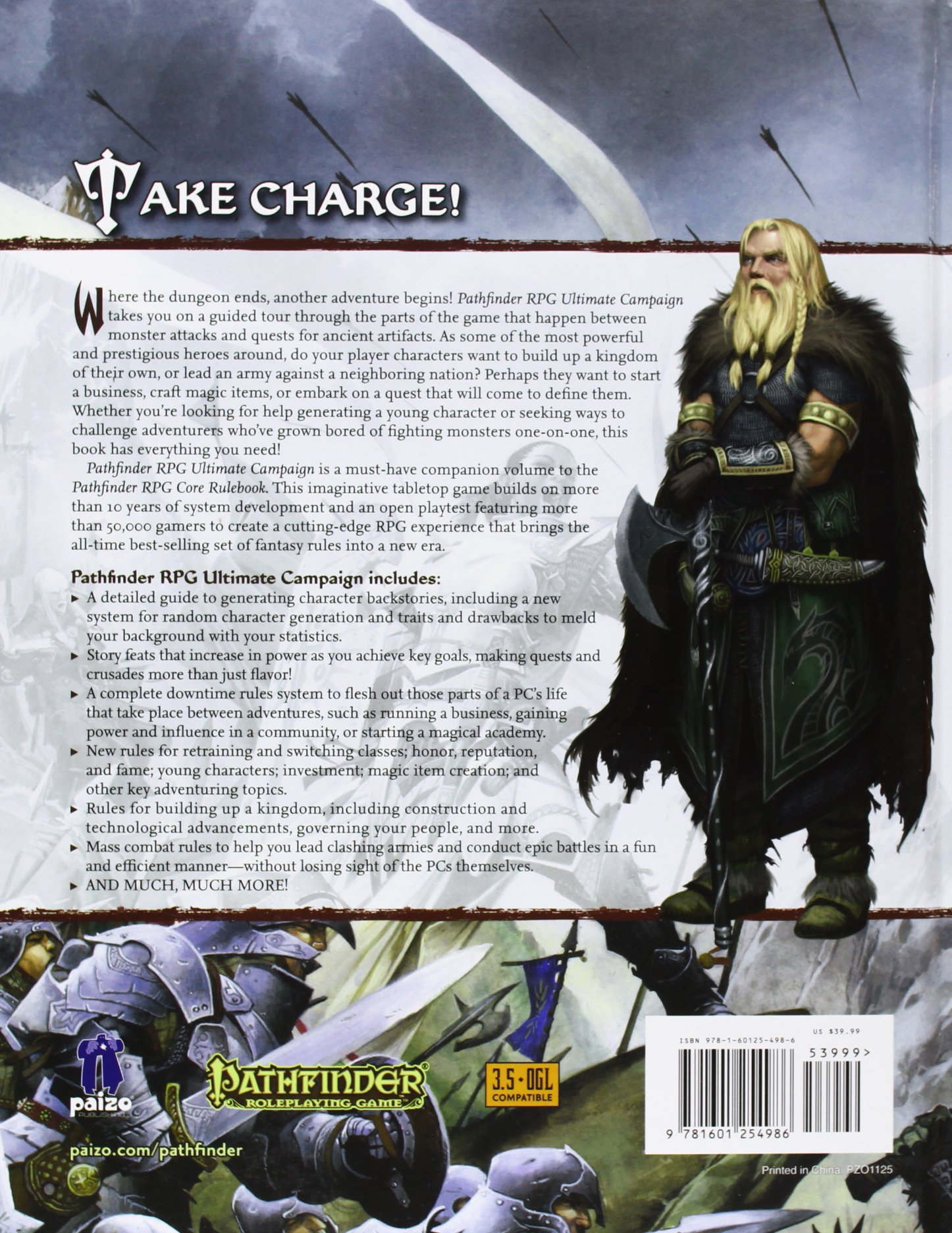
This supplement for the Pathfinder Roleplaying Game is full of campaign options for GM's, and many of these options could be used in other fantasy roleplaying games with little or no modification to the rules (I personally know of at least one GM who is using this book in her D&D 5th edition campaign). While I don't think I'll ever use some of the variant rules presented in this book, many of the other options presented here are fully-developed systems to cover things that I've spent years hand-waiving away or coming up with house rules on the fly to address, and I found a lot of value here for that reason alone.The first chapter of this book, "Character Background," is worth its weight in platinum pieces! There's some really, really solid advice in this chapter for GM's and players alike. Too often, players try to create unique characters by indulging in what I call 'special snowflake syndrome' by coming up with utterly implausible character backgrounds and epic character backstories; please understand that I have no objection to strong character concepts which call for an unusual character background, but for many players, this strong concept doesn't exist-- they're just cobbling together a number of disparate character elements in an effort to be "unique." Playing a Tiefling fey druid on the run from a cabal of deadly assassins who are hunting it across time and space doesn't necessarily make for a unique character; such a convoluted backstory only makes that character a novelty. What really makes a character UNIQUE are that character's personality traits and belief systems, and without developing these aspects, this 'special snowflake' character concept is no more remarkable at the gaming table than an otherwise unremarkable farm kid gone adventuring. This common misunderstanding about character development is essentially what the first chapter of "Ultimate Campaign" seeks to address, with a series of practical tips for developing character personality traits by really thinking about his or her background. What was the character's childhood like? Who were the character's family members? What life events shaped the character in adolescence and early adulthood? This section of the rules also presents an optional series of tables for random background generation, arranged by race and class, which rather reminded me of the classic 1980's roleplaying supplement, Central Casting . This chapter also reintroduces the concept of character traits, which first appeared in the Pathfinder Advanced Player's Guide .The next chapter, "Downtime," is also full of roleplaying goodness! This chapter is essentially a complete, balanced rules subsystem for managing the player's activities between adventures, covering things like alchemical research and crafting magic items, but also allowing characters to make investments, form a business or guild, hire employees, build their reputations, or even spread rumors throughout the land! Chapter two also includes several different random event tables to determine what sort of real-life problems or opportunities present themselves to the characters while they're at home.Chapter three, "Campaign Systems," includes a plethora of rules for any campaign. While the options presented here are uniformly good, they may not be applicable to every campaign or gaming style, and this is where the book's offerings might become a bit 'hit or miss.' This chapter provides advanced rules for character Alignment, a barter/bargaining system, rules for player companions (including animal companions), rules for building and maintaining NPC contacts within the game world, rules for hex exploration (similar to those presented in the Kingmaker adventure path), rules for character honor, rules for family and lineage, detailed magic item creation rules, guidelines on maintaining character relationships (friends, parents, siblings, spouses, rivals, etc.), rules for character and party fame and reputation, thoughts on character aging and retirement, rules for retraining characters (i.e., changing classes), a system for taxation (ugh!), and finally, rules for playing younger characters who haven't reached 1st level yet. This chapter covers a lot of terrain, and it does so uniformly well, but many of these options are more a matter of taste and personal choice than a matter of necessity for every game.The final chapter, "Kingdoms and War," totally makes this book worth owning! The 52 pages of this chapter are chock full of usable crunch. This chapter covers kingdom building, different leadership roles for players or NPC's to fill, building and construction rules, a system for determining how government laws and edicts effects the populace, and rules for founding new settlements; all of these rules are fully-compatible with the hex exploration system from the previous chapter. There are also tables for kingdom random events, so that the kingdom can experience an unexpected economic boom, or be plagued by slavers, or even be visited by a celebrity. This chapter also presents several optional subsystems for use with its kingdom rules, such as a system for things like diplomacy and trade. Finally, the book closes with rules for building, training, and leading armies in mass combat. Everything in this chapter is awesome-- as with the system for hex exploration, you'll want to use the rules in this book when running the Kingmaker adventure path, instead of the rules there.All in all, this is a solid addition to the Pathfinder roleplaying game. Not every gaming group will use every rule contained in "Ultimate Campaign," but there ought to at least be something for everyone here.
D**4
Ultimate Campaign delivers on the Options!
So there are a lot of reviews on this - and most are right on the money. The book is nearly 100% for the players - it presents a new background generator for those of you that have a hard time coming up with a character concept. The backgrounds are diverse enough to give you a head start in flushing a background out once you have chosen or randomly rolled one.There are new story feats for your characters that can enhance or change your PC over time. This requires help from your GM and possibly other players as well. I recommend discussing these options OUTSIDE a game session so as not to detract time away from actually gaming.There is a large chapter on Downtime. Downtime is exactly what it says - what is your PC doing between sessions? What is she doing while in town? Does she have a job? Is she lord and responsible for building something? Do you have employees? All this and more is laid out methodically so your PCs can have something to enhance their PC experience between adventure sessions. This is definitely the FIRST time I have seen something like this aside from the 2nd Edition Castle Guide years back - (I'll speak on that in a moment).Downtime covers professions, research, animal handling and familiars and more! Ask your GM regarding these options during or before your campaign begins to see how much of these rules and guidelines you can use to augment your PC experiences.I mentioned the Castle Guide. There is a large chapter on Kingdom building (taken mostly from the Pathfinder Adventure Path: Kingmaker) these rules have been fully flushed out, enhanced and updated. They include a system of Build Points that you use from everything from constructing buildings to exploration to researching spells or items. These rules favor GM involvement heavily, none the less another great set of options for those of you who love homebrew campaigns. This will fit right in!Finally there are Traits and Flaws - Ultimate Campaign updates the traits introduced in the Advanced Player's Guide and expands on them - updates a few and of course introduces loads more. I find this chapter helpful because it also takes traits from several Adventure Paths and places them in one sourcebook.Conclusion: All in all a great book. I dinged it a star though if there was a half-a-star option I would have done it, because though the rules and guidelines are awesome - they are not coherent. What I mean by that is - there is no real explanation on how best to adapt say the Downtime or the Kingdom building to your campaign. It's implied you just do so. I couldn't understand why the authors wouldn't just take a few pages explaining a few textbook scenarios on how best to use downtime A or build points in Kingdom Building B etc. Similar to what they did way back when the GameMastery Guide came out for Pathfinder. I would have liked something along that premise where they discuss ways to make this successful.However, their intent may have been to truly leave it up to you, the player, or you the GM. I found this book more useful than December's NPC Codex - and would consider this a nice addition to your Pathfinder RPG library! Happy Gaming!
B**Y
Kingdom building rules for the win
Fantastic rules if you want to make Pathfinder even more in-depth, but the true gem of the book is the amazingly fun Kingdom Building rules from the Kingmaker campaign path. Whilst a little unwieldy to use, it was an incredible experience building up a kingdom from scratch. This book is worth it for those rules alone.
D**N
Five Stars
Great Item.
S**S
Well presented and useful, functional rule sets for pcs assets and developing ...
Well presented and useful, functional rule sets for pcs assets and developing holdings. Improved version of Kingdom builder from kingmaker adv path.Army rules look workable.
B**O
Five Stars
Super
J**T
Awesome addition to the PF rules
I love this book, I Also loved the Gamemastery guideAnyone looking to flesh out a campaign world will find lots of useful stuff in here. I like the rules on kingdom building a lot and the down time rules for POCs building inns, shops, taverns, keeps, guilds, magic towers etc are great
Trustpilot
2 weeks ago
1 month ago