
DOWNLOAD THE APP


Customer Services
Copyright © 2025 Desertcart Holdings Limited
DOWNLOAD THE APP


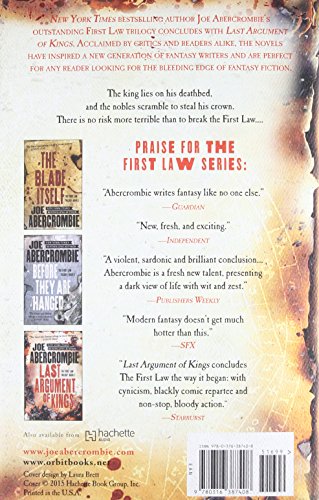


desertcart.com: Last Argument of Kings (The First Law Trilogy, 3): 9780316387408: Abercrombie, Joe: Books Review: A powerful - but crushing - end to a superb series draws everything together in shocking ways - I’ve been marathoning my way through the First Law trilogy now for a while, and with each new chapter, falling more and more under Joe Abercrombie’s spell. And yet, I couldn’t have been more wrong in some of my comments that I made about the first and second books in the series. Not in their quality, and not in their strengths – the rich character building, the black sense of humor, the complex plotting. No, what I misjudged – and what punched me in the gut as Last Argument of Kings finished – was its sense of hope. Because while I thought that Abercrombie was presenting deeply flawed characters who were doing their best to be good people, and that those good people might be capable of redemption, it turned out he had a whole secondary game waiting for me in the shadows – one that left me pretty stunned by the end of the series. In most ways, though, Last Argument of Kings continues the threads we’ve seen for the other books. The wars we’ve been setting up on both sides of the Aduan kingdom – that with Bethod to the north and the Gurkish to the south – finally break loose, in all of their horrific violence and cost. And as those wars play out, our various “heroes” (put in quotes because, as anyone who’s read these books knows, calling any of these men pure heroes is a stretch of the imagination) find themselves in positions of surprising power over the events unfolding. Logen Ninefingers – a.k.a., the “Bloody Nine” – reunites with his old group of men, and does his best to turn the tide in the North, while continuing his internal debate of whether he could ever undo the damage he’s done in his old life. Sand dan Glokta – cripple, torturer, cynic – finds himself torn between two very demanding masters, and with the power to quite possibly save the kingdom – or maybe destroy it. And Jezal dan Luthar finally realizes exactly why Bayuz, the First of the Magi, has been following him around for so long. More than anything else, though, this is the book where we finally see Abercrombie’s full design, and just how elegantly he’s been putting all of this together. I’ve commented about the previous books that one of their joys is the sense that we’re not quite sure what the endgame is – just what, exactly, is the common thread of this trilogy? By the time Last Argument of Kings ends, you’ll realize exactly what’s going on, and see that what we’ve been watching play out has been far more controlled, manipulated, and shaped than what we expected. And our assumptions about our characters are going to take some serious blows. What Abercrombie seems to be fascinated by, overall, is the blurred line between good and evil, and that’s something that gives the ending its brutal punch. Characters we like, and even admire, turn out to be something less than heroic. Cowardice turns out to have its benefits. The cruelest, in some ways, show themselves to be capable of the greatest kindnesses. And more than anything, the question of power and survival hang over everything. Exactly how far should we be willing to go in order to survive and succeed? These are thorny questions, and Abercrombie doesn’t give us easy answers. Nor does he make the book an easy read, as he displays a Martin-like willingness to butcher and maim characters, to turn them on their heads, and make us question their motives. It’s a bravura performance by Abercrombie, and while the end can be a painful, heartbreaking read at points – one character’s fate, in particular, is truly awful in ways that I never dreamed of – I’m also floored by what he accomplished here. Each character developed, changed, evolved, and shaped over the course of the series in incredible ways, giving you a complexity and depth that many authors just dream of, and setting up moral shades of gray without ever betraying our assumptions. More than that, by the time you finish Last Argument of Kings, it becomes evident just what a grand scope Abercrombie was working on, and just how intricately structured the entire series has been from the beginning. In short, it’s a fantasy trilogy that I absolutely loved. It’s darkly funny, shockingly violent, richly written, beautifully rendered, thoughtfully constructed, and brilliant. And I’m thrilled that there’s more stand-alone books to come – I don’t plan on waiting long to jump into them. If you like George R.R. Martin and haven’t read these, you’re missing out, plain and simple. Review: A Satisfying But Open-Ended Conclusion - The Last Argument of Kings is the third and final volume in Joe Abercrombie's First Law trilogy. The series follows a small but varied array of characters as they navigate treacherous wars on several fronts in a world resembling medieval Europe. It's a fairly standard fantasy plot: the dark, mysterious empire to the south holds a grudge against the "civilized" good guys who are also dealing with the barbarian hordes to the north. In fact, a lot of the series is pretty standard, but the First Law trilogy excels anyway, and the Last Argument of Kings is a fine conclusion. There is no one aspect of the novel that is particularly fantastic. Although two of the characters, Glokta the crippled Inquisitor and Logen the reluctant warrior-barbarian, are fascinating (particularly Glokta), the rest of the characters fit into pretty basic character tropes: the mysterious wizard, the cocky swordsman, the bumbling apprentice, the murderous barbarians, etc. The more prototypical characters, however, are developed pretty well and fit into the story nicely. Characters like Jezal (the swordsman) and Bayaz (the magician) likely won't stick with the reader years later, but they're passable. Abercrombie's writing is pretty solid. Each character's point of view chapter is written uniquely. That is, chapters from Logen the barbarian's point of view are written more gruffly, with slang words, short sentences, etc., while chapters from Jezal the noble's perspective are written more fluidly, with more proper wording and sentence structure. It's a neat little touch that adds some realism to an already realistic bit of writing. For the most part, Abercrombie doesn't write deep, thorough descriptive narrative, preferring, instead, to leave the reader to imagine what most of the characters and scenery look like. It's an effective strategy for Abercrombie as flowery narrative would surely undermine the gritty feel he intended. The strongest part of the writing, however, is the dialogue, which is snappy and realistic. Abercrombie manages to give each character a unique mode of speech without relying on cheesy accents or catchphrases. As a final point on the writing style, Abercrombie writes some very good, very realistic action scenes. A lot of fantasy authors are a little high minded with their fight scenes, portraying them as little more than glorified fencing sessions, but Abercrombie's fights are brutal, dirty and painful - truly a pleasure to read. Although they all share a lot of the same strengths and weaknesses, the Last Argument of Kings is probably the best book in the series. As much as I enjoyed the Blade Itself, it was basically one long, extended introduction. The plot barely advanced at all. Things really started to move in Before They Are Hanged, but the novel served primarily to get the characters into position for the conclusion. Outside of the fact that you wouldn't understand the characters or the plot, you could probably read the Last Argument of Kings on its own and not miss a whole lot (aside from an enjoyable reading experience). The First Law Trilogy is by no means perfect. As I said, the plot is nothing special. In fact, it's fairly predictable at times. I don't recall a single moment of real surprise in any of the three books, even the conclusion. The book is a quick read with a decent plot, great action scenes and some really interesting characters. If you didn't like the Blade Itself, you likely won't like Before They Are Hanged. But if you did enjoy the Blade Itself and Before They Are Hanged, or you are looking for an entertaining, exciting fantasy read, pick up the Last Argument of Kings and the First Law trilogy. As a final note, there are two side novels currently that build on the plot and characters of the First Law trilogy, which means that there is a lot more to read. And the best thing I can say about the series is that, even after three volumes, I am still eager to read more about Abercrombie's world and characters. The First Law trilogy is well worth your time.
| Best Sellers Rank | #23,756 in Books ( See Top 100 in Books ) #23 in Historical Fantasy (Books) #112 in Epic Fantasy (Books) #1,143 in Fantasy Action & Adventure |
| Book 3 of 3 | The First Law Trilogy |
| Customer Reviews | 4.5 4.5 out of 5 stars (17,861) |
| Dimensions | 6.05 x 2.2 x 9.15 inches |
| ISBN-10 | 0316387401 |
| ISBN-13 | 978-0316387408 |
| Item Weight | 1.6 pounds |
| Language | English |
| Print length | 656 pages |
| Publication date | September 8, 2015 |
| Publisher | Orbit |
J**E
A powerful - but crushing - end to a superb series draws everything together in shocking ways
I’ve been marathoning my way through the First Law trilogy now for a while, and with each new chapter, falling more and more under Joe Abercrombie’s spell. And yet, I couldn’t have been more wrong in some of my comments that I made about the first and second books in the series. Not in their quality, and not in their strengths – the rich character building, the black sense of humor, the complex plotting. No, what I misjudged – and what punched me in the gut as Last Argument of Kings finished – was its sense of hope. Because while I thought that Abercrombie was presenting deeply flawed characters who were doing their best to be good people, and that those good people might be capable of redemption, it turned out he had a whole secondary game waiting for me in the shadows – one that left me pretty stunned by the end of the series. In most ways, though, Last Argument of Kings continues the threads we’ve seen for the other books. The wars we’ve been setting up on both sides of the Aduan kingdom – that with Bethod to the north and the Gurkish to the south – finally break loose, in all of their horrific violence and cost. And as those wars play out, our various “heroes” (put in quotes because, as anyone who’s read these books knows, calling any of these men pure heroes is a stretch of the imagination) find themselves in positions of surprising power over the events unfolding. Logen Ninefingers – a.k.a., the “Bloody Nine” – reunites with his old group of men, and does his best to turn the tide in the North, while continuing his internal debate of whether he could ever undo the damage he’s done in his old life. Sand dan Glokta – cripple, torturer, cynic – finds himself torn between two very demanding masters, and with the power to quite possibly save the kingdom – or maybe destroy it. And Jezal dan Luthar finally realizes exactly why Bayuz, the First of the Magi, has been following him around for so long. More than anything else, though, this is the book where we finally see Abercrombie’s full design, and just how elegantly he’s been putting all of this together. I’ve commented about the previous books that one of their joys is the sense that we’re not quite sure what the endgame is – just what, exactly, is the common thread of this trilogy? By the time Last Argument of Kings ends, you’ll realize exactly what’s going on, and see that what we’ve been watching play out has been far more controlled, manipulated, and shaped than what we expected. And our assumptions about our characters are going to take some serious blows. What Abercrombie seems to be fascinated by, overall, is the blurred line between good and evil, and that’s something that gives the ending its brutal punch. Characters we like, and even admire, turn out to be something less than heroic. Cowardice turns out to have its benefits. The cruelest, in some ways, show themselves to be capable of the greatest kindnesses. And more than anything, the question of power and survival hang over everything. Exactly how far should we be willing to go in order to survive and succeed? These are thorny questions, and Abercrombie doesn’t give us easy answers. Nor does he make the book an easy read, as he displays a Martin-like willingness to butcher and maim characters, to turn them on their heads, and make us question their motives. It’s a bravura performance by Abercrombie, and while the end can be a painful, heartbreaking read at points – one character’s fate, in particular, is truly awful in ways that I never dreamed of – I’m also floored by what he accomplished here. Each character developed, changed, evolved, and shaped over the course of the series in incredible ways, giving you a complexity and depth that many authors just dream of, and setting up moral shades of gray without ever betraying our assumptions. More than that, by the time you finish Last Argument of Kings, it becomes evident just what a grand scope Abercrombie was working on, and just how intricately structured the entire series has been from the beginning. In short, it’s a fantasy trilogy that I absolutely loved. It’s darkly funny, shockingly violent, richly written, beautifully rendered, thoughtfully constructed, and brilliant. And I’m thrilled that there’s more stand-alone books to come – I don’t plan on waiting long to jump into them. If you like George R.R. Martin and haven’t read these, you’re missing out, plain and simple.
J**N
A Satisfying But Open-Ended Conclusion
The Last Argument of Kings is the third and final volume in Joe Abercrombie's First Law trilogy. The series follows a small but varied array of characters as they navigate treacherous wars on several fronts in a world resembling medieval Europe. It's a fairly standard fantasy plot: the dark, mysterious empire to the south holds a grudge against the "civilized" good guys who are also dealing with the barbarian hordes to the north. In fact, a lot of the series is pretty standard, but the First Law trilogy excels anyway, and the Last Argument of Kings is a fine conclusion. There is no one aspect of the novel that is particularly fantastic. Although two of the characters, Glokta the crippled Inquisitor and Logen the reluctant warrior-barbarian, are fascinating (particularly Glokta), the rest of the characters fit into pretty basic character tropes: the mysterious wizard, the cocky swordsman, the bumbling apprentice, the murderous barbarians, etc. The more prototypical characters, however, are developed pretty well and fit into the story nicely. Characters like Jezal (the swordsman) and Bayaz (the magician) likely won't stick with the reader years later, but they're passable. Abercrombie's writing is pretty solid. Each character's point of view chapter is written uniquely. That is, chapters from Logen the barbarian's point of view are written more gruffly, with slang words, short sentences, etc., while chapters from Jezal the noble's perspective are written more fluidly, with more proper wording and sentence structure. It's a neat little touch that adds some realism to an already realistic bit of writing. For the most part, Abercrombie doesn't write deep, thorough descriptive narrative, preferring, instead, to leave the reader to imagine what most of the characters and scenery look like. It's an effective strategy for Abercrombie as flowery narrative would surely undermine the gritty feel he intended. The strongest part of the writing, however, is the dialogue, which is snappy and realistic. Abercrombie manages to give each character a unique mode of speech without relying on cheesy accents or catchphrases. As a final point on the writing style, Abercrombie writes some very good, very realistic action scenes. A lot of fantasy authors are a little high minded with their fight scenes, portraying them as little more than glorified fencing sessions, but Abercrombie's fights are brutal, dirty and painful - truly a pleasure to read. Although they all share a lot of the same strengths and weaknesses, the Last Argument of Kings is probably the best book in the series. As much as I enjoyed the Blade Itself, it was basically one long, extended introduction. The plot barely advanced at all. Things really started to move in Before They Are Hanged, but the novel served primarily to get the characters into position for the conclusion. Outside of the fact that you wouldn't understand the characters or the plot, you could probably read the Last Argument of Kings on its own and not miss a whole lot (aside from an enjoyable reading experience). The First Law Trilogy is by no means perfect. As I said, the plot is nothing special. In fact, it's fairly predictable at times. I don't recall a single moment of real surprise in any of the three books, even the conclusion. The book is a quick read with a decent plot, great action scenes and some really interesting characters. If you didn't like the Blade Itself, you likely won't like Before They Are Hanged. But if you did enjoy the Blade Itself and Before They Are Hanged, or you are looking for an entertaining, exciting fantasy read, pick up the Last Argument of Kings and the First Law trilogy. As a final note, there are two side novels currently that build on the plot and characters of the First Law trilogy, which means that there is a lot more to read. And the best thing I can say about the series is that, even after three volumes, I am still eager to read more about Abercrombie's world and characters. The First Law trilogy is well worth your time.
P**N
L'Union est en guerre avec le Royaume du Nord. La menace de l'Empire du Sud se fait plus précise chaque jour... Le dernier volet de la trilogie comporte son lot de batailles, d'action et de violence. Mais plus que les scènes de combats, ce sont les parcours des différents personnages qui passionnent. L'auteur leur réserve - ainsi qu'au lecteur - nombre de surprises. J'ai beaucoup apprécié toute la trilogie, notamment pour ses personnages (chacun avec son lot de défauts et de qualités), et les différents niveaux d'intrigues. L'histoire ne connait pas de temps mort et l'on en suit avec intérêt les différents fils. Pour ma part, j'aurais préféré un peu plus de magie et un peu moins de combats, mais cela n'enlève rien au plaisir que j'ai eu à lire l'ensemble.
A**H
Good
A**N
What a great finish to this trilogy. I really hope we'll hear more of the Bloody Nine. Say one thing for Logen Ninefingers, say he's still kicking! I feel like this'd be a great end to the series, or a great start for another trilogy. Either way I've thoroughly enjoyed the 1st 3books, & also Sharp Ends was an awesome read of short stories, providing some cool back stories of some of my favorite characters in the series. I'm about to start Best Served Cold now, & I suspect it'll be just as fun a read as these others from the world of the 1st Law. I certainly don't know about Abercrombie being the "king of grimdark", but I do know that I've really enjoyed what I've read so far, & have no doubt that he'll provide us more great fantasy in the future. He's definitely one of my favorite authors now👍
R**N
Wow! With an exception to book 2, not since I read George Martin's Song of Ice and Fire have I thoroughly enjoyed a fantasy series like this one. Abercrombie's characters are extremely well developed and consistent. As you progress through the series, so do the characters. Each book reveals a different aspect of their personalities, and these are indeed affected by different factors that happen on their life journeys. Events are exciting and believable. Machinations are intriguing. Battles and fights are bloody and fast paced. I stumbled across this series through using the kindle. I was sceptical about the hype of the book. However, the first book, The Blade Itself, was an excellent read and I was swept along, thoroughly engrossed by the characters and multiple diverging plots. Unfortunately, I found the second book, Best Served Cold, had a much slower pace. The ending was a disappointment and it had a meandering plot that seemed unfocused and almost unplanned. Although it was not painful to read, it did not capture my imagination or draw me back to its pages like the first did. The only good story line followed Glotka in Dagoska. I nearly didn't continue with the series after that book. I am REALLY glad that I did. The third book is a masterpiece. Each chapter carries the plot forward at an irresistible pace. I found this time I was reading whenever I could. If you've persevered with the second book, I HIGHLY recommend that you carry on with the series. It is a truly special read.
S**R
I bought two books as a gift, expecting new condition. Unfortunately they arrived with clearly visible wear: damaged and rounded corners, scuffed cover edges, and marked page edges. This does not look like shipping damage but prior handling. Because of the condition, the books are not suitable to be given as a gift. If items are not new, this should be clearly stated.
Trustpilot
2 days ago
2 months ago