

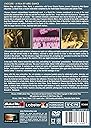
J'Accuse
Product ID: 21031189
Buy anything from 5,000+ international stores. One checkout price. No surprise fees. Join 2M+ shoppers on Desertcart.
Desertcart purchases this item on your behalf and handles shipping, customs, and support to Finland.
Romuald JoubT, STverin-Mars, Maryse Dauvray. One of cinema's silent masterpieces by French film pioneer Abel Gance was done in the vein of an anti-war statement. This post-WWI epic dramatizes the tale of two men and one woman whose lives are tragically complicated by the horrors of the world's first global conflict. In French with English subtitles. Silent. 2 DVDs. 1919/b&w/166 min/NR/fullscreen. Review: INNOVATIVE TRUE WORK OF GENIUS FROM THE HEAVYWEIGHT SILENT FILM MASTER - Magnificent and Innovative early WWI film from one of the undisputed absolute TRUE GENIUSES of the film medium of 1919, Now, or ANY OTHER ERA this beautiful artfom has Ever existed in! Review: j'Accuse - It was a very good movie. A must see for any silent movie fan or a fan of Abel Gance. It is about two men who are enemies who become allies and friends to one another, when they were drafted into world war one. the scenes are beautifully filmed and the actors are great. I reccomend this movie to anyone.j'Accuse deserves a 5 stars for great tremendous acting and great directing.
| Customer Reviews | 4.1 out of 5 stars 75 Reviews |
T**D
INNOVATIVE TRUE WORK OF GENIUS FROM THE HEAVYWEIGHT SILENT FILM MASTER
Magnificent and Innovative early WWI film from one of the undisputed absolute TRUE GENIUSES of the film medium of 1919, Now, or ANY OTHER ERA this beautiful artfom has Ever existed in!
T**S
j'Accuse
It was a very good movie. A must see for any silent movie fan or a fan of Abel Gance. It is about two men who are enemies who become allies and friends to one another, when they were drafted into world war one. the scenes are beautifully filmed and the actors are great. I reccomend this movie to anyone.j'Accuse deserves a 5 stars for great tremendous acting and great directing.
A**R
The Toll of War
December 15, 2008 J'Accuse - France, 1919 It's a somber fact that many of those who have perished in war throughout history have greeted the start of armed conflict with thunderous applause and overwhelming enthusiasm. Perhaps every generation of men longs for its opportunity to make a difference, to prove its mettle on the battlefield. On Sunday, August 2, 1914, many of the young men in France became instantaneously overjoyed when news of France's declaration of war became known. This moment is perfectly captured in Abel Gance's impressive 1919 film J'Accuse. As word of the start of the First World War spreads, crowds form and make their way toward local government offices. As the crowd moves, children hear adults spreading the news and wonder aloud, "What's war?" Reaching its destination, the crowd feasts its collective eyes on an official notice, an order of general mobilization. Young men cheer and begin singing the national anthem, the elderly are mostly shocked, and tears fall from women's eyes, as their minds most likely turn to the fates of their sons, husbands, and brothers. These are sentiments lost on a drunkard named Francois Laurin (M. Severin-Mars). "At last!" he proclaims. Meanwhile a young poet named Jean Diaz (Romuald Joube) has a different reaction. Stunned, he stumbles back a little, shaken by the magnitude of the announcement and its potential ramifications. By this point in the film, these divergent reactions come as no surprise to viewers. After all, we have seen ample evidence of Francois' belligerence. This is a man who sees nothing wrong with physically striking his wife Edith (Marise Dauvray), trying to force his dog to lick blood dripping from a dead deer, and firing warning shots in Jean's direction when he thinks he is getting too close to Edith. We have also seen that Jean views the world very differently that Francois. A pacifist who writes poems about nature and a utopian world, Jean is the kind of person who mourns the death of a bird and empathizes with those who suffer in their daily lives. Edith Lauren is one of these people. And because of that, it would be easy for viewers to initially confuse J'Accuse with other cinematic love stories involving a love triangle. Yet J'Accuse is not your average love story, for at its heart, J'Accuse is about the horrors of war. In one of the most interesting and affective scenes that I can recall, Gance shows us a series of interlocked hands on the eve of deployment to the frontlines, a husband and a wife, a mother and a son, a father and his child, a man and his girlfriend. The effect is quite powerful, for in each of these tender moments there is a story that we will never know, one that has a high probability of ending in heartbreak and sorrow. Later in the film a character disobeys a direct order and undertakes a potentially deadly mission not because he believes he is the better soldier for the job but because he has learned that the person he was supposed to send loves Edith as much as he does. This discovery leads one of them to seek the other's forgiveness for loving Edith, and the two of them promise to talk about her often. This is all the more amazing given the fact that at this point in the film neither of them knows Edith's whereabouts, for Edith was captured by the Germans after Francois forced her to go to his parents' house so that she would be far away from Jean. J'Accuse has one of the most interesting structures of any film I've ever seen, for what would normally be the climactic moment of the film is in reality just the end of the second act. The third act is as unexpected as it is stunning, as confusing as it is revealing. In it, the reasons for war itself are questioned, the actions of those whom soldiers leave behind are exposed, and war takes its tragic toll on optimism and sanity. In an amazing reversal of fortune, four years of sacrifice have turned a brute into a man and a man of conscience into a man of conspiracy and rage. In the end, war's toll is completely devastating, robbing the deceased of second chances, families of desired moments with loved ones, and little girls of potential fathers. The movie forces us to ask if these sacrifices are worth it. (on DVD) 4 stars *J'Accuse is in French with English subtitles. While the subtitles are boxed, they are white. Because of that, there are a few moments in which they are difficult to read. From [...]
I**N
Best preserved of all Gance's silent film's
Abel Gance's J'Accuse is, in my opinion, the best preserved silent film because the Flicker Alley DVD includes the orignal French language intertitles with the adition of new English subtitles. Neither Napoleon nor La Roue contain the original intertitles. I am fortunate to have seen both the silent 1919 version on DVD and the 1939 sound version on VHS.
A**R
Blu-Ray not region free?? No picture on my Panasonic Blu-Ray player, disc plays, have music
I knew the DVD would not work but the seller describes the Blu-Ray as being compatible with region A. B, and C. Instead I appear to have received a Region B only Blu-ray. Just got around to watching it well after the return window closed. Do NOT buy if you don't have a region free player.
E**.
Excellent movie on war consequences
This silent movie features superb film transfers of this silent film classic. The technology advances with lighting and scene composition are common in today's films. The graphic nature of the consequences of war to those who actively participate and those who are innocent but forced into participating are well developed. The physical living conditions of men in combat is well demonstrated. The question "what has my death contributed to benefit my loved ones" is broached and an answer is suggested.
C**X
Five Stars
WOW!
B**D
French WWI silent cinema at its best!
Having been deeply impressed by French director Abel Gance's other two silent epics, "La Roue" and "Napoleon", I had high expectations of this film which he directed a few years earlier, and was not one bit disappointed. Even the opening credits of soldiers forming the film's title "J'Accuse" was a great first impression, and Gance's famous use of sophisticated imagery and fast editing technique is apparent from the outset to the dramatic climax. Although the editing is somewhat less smooth than in his famous later films, "J'Accuse" is still outstanding for its production year, 1919, although filming had begun earlier, during the WWI years about which this film is meant as a protest, hence the title meaning "I accuse". Gance's message is that of accusing those who caused, supported and profited from the war, but rather than being a war movie per se, it is in fact very much a human story about lives in turmoil and the unnecessary suffering caused by the war. There are only a few main players in this film, all connected and touching each other's lives dramatically as the `Great War' shatters the innocent peace of an idyllic village in Provence. The story revolves around a woman, Edith, whose abusive husband and her caring lover both end up in the same trench when the war breaks out. Tension and rivalry between the two men turn into comradeship in the face of death and slaughter on the battlefield, and when Edith is abducted by German soldiers, they feel united in their love for her. Parents and a small child - the result of gang rape perpetrated by the German soldiers upon Edith - also become involved in the four-year ordeal of the war, all of which leads to a stunning climax which reinforces Gance's message. It is an issue later heard in our day as well, asking whether the war was worth all the lives it destroyed, and did the families left behind honour the sacrifice their men made for them by their conduct during the war. These soul-searching issues are challenged in unforgettable images depicting the fallen soldiers awakened from their graves, played by real soldiers on leave from the war. Other authentic images from the war were also used in this film, but actual battle scenes are short and not the main focus of this film. The majority of the 2 ½ hours running time depicts the lives of the main characters and their feelings, making "J'Accuse" a very emotionally-charged experience, as well as a milestone in early silent film development. Perfectly restored and given an outstanding, beautiful musical score by Robert Israel who excels in such projects, this is a very important DVD for film historians, early cinema and even World War I enthusiasts. Besides its historic significance and `social commentary' which was common in silent films in the early decades of the century, "J'Accuse" is a highly artistic and very impressive work of cinematography which is rarely seen in our day. Also included in this 2-disc set is are two bonus short films, one of which is an actual documentary of WWI battles in France in 1916, and a top quality 20-page booklet with two essays about "J'Accuse" with insight into Abel Gance's thoughts add further to the high standard of this set.
Trustpilot
1 week ago
1 week ago