
DOWNLOAD THE APP


Customer Services
Copyright © 2025 Desertcart Holdings Limited
DOWNLOAD THE APP


Full description not available
J**N
Very useful comparison between different ministry models
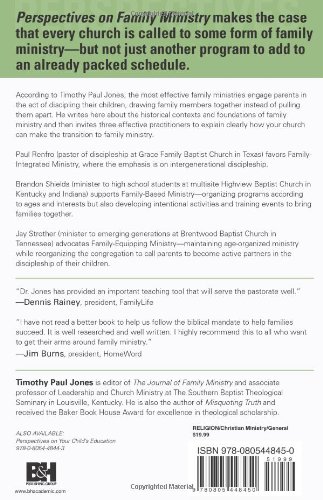
CONTENT "Perspectives on Family Ministry," by Paul Renfro, Brandon Shields, and Jay Strother, is a cordial debate contrasting three models of ministry - family-intergrated, family-based, and family-equipping. The Perspectives series mirrors the format of the similar Counterpoint series by Zondervan, but with a Baptist publisher and Baptist contributors. Part one, "Why Every Church Needs Family Ministry," addresses the importance of parenting, a brief review of the development of the history of youth ministry, a definition of family ministry, and an overview of the methodological distinctives of the three views. It defines family ministry as "the process of intentionally and persistently realigning a congregation's proclamation and practices so that parents are acknowledged, trained, and held accountable as the person primarily responsible for the discipleship of their children" (Jones 40). Some of their stated assumptions are that "Scripture is the supreme and sufficient standard for how to do ministry," "God has called parents-and especially fathers - to take personal responsibility for the Christian formation of their children," and "The generations need one another." Part two, "How Churches are Doing Family Ministry," describes in detail what each model looks like and explains its theological or practical basis. Each contributor has about 25 pages to define and defend his model, which is followed by a 10-15 page response section by the other contributors, which is followed by an 8 page final defense by the original contributor. Family-integrated ministry is defined by its integration of all age groups in worship and teaching and its rejection of age-segregated ministry. Its secondary focus is that of the home as the primary location of discipleship and evangelism. Using the cultural background of Hebrew life, Biblical mandates to "train your children" are used to support the idea that God wants the training of children and family worship to happen in the home (as opposed to the church or synagogue or a school). The most significant critiques against the model are that the emphasis on parents' roles makes it difficult to reach children in non-Christian homes, it is overly separatist from culture, and it is only embraced by one demographic - the two-parent, Christian, home schooling family. Family-based ministry maintains age-segregated ministry, such as youth group or children's church, but they also include intergenerational activities and family events. In this way, it attempts to keep the benefits to targeting specific age-groups with developmentally-appropriate training while still addressing the Biblical need to equip families and promote unity amongst the generations. Using the tools relevant to contemporary culture, it attempts to be evangelistic in reaching the unchurched and those outside of Christian culture or influence. The most significant critiques against this model are that it does not go far enough to systematically and regularly equip parents, it simply adds more events to families' busy schedules, and it is too focused on cultural relevance and event-based ministry. "Family-equipping churches retain some age-organized ministries but restructure the congregation to partner with parents at every level of ministry..." (144). In doing so, this model attempts to systematically equip and train parents to disciple their children at home. The responsibility of the church is to develop a comprehensive plan for a child's spiritual formation and to encourage parents to take up this responsibility. The most significant critiques against this model are that age-organized events still demand more time away from the parents and that there is no proven need to change from the professional, programmatic way of doing ministry.CRITIQUE I found part one to a very informative part of this volume. In contrast with many introduction to the argument, this section was in-depth, thoughtful, and useful. Having only read part one, I was able to understand the big picture for why this was even a significant issue for the church today. Without the historical component, for instance, I would never have thought about the "invention of adolescence" as a relatively new part of society. Without the definitions or assumptions clearly stated, it would have been difficult for the contributors to communicate without unfairly attacking each other. Part two was very useful as it requires the reader to think through the different positions. Reading the chapter on family-integration was an important start, because it is the only position to attempt to create a Biblical theology that supports its model. Doing so made me think through the contexts for Deut 6, Ps 78, and Eph 6. What the method what God was commanding, or was it the end result? Was the edict given to fathers because teachers should not have that role or because mothers were not equipped? It would be unfair to conclude that the only divinely-sanctioned method of passing on the history of what God has done is for dads to tell their kids. But it would also be unfair to conclude that God did not intend for the primary place of spiritual training to be the home, not the temple.The chapter on family-based churches was a useful contrast reminding me of why age-segmented ministries were formed in the first place - to reach the unreached youth of America on their turf. It also reminded me to challenge given statistics, as they can be misrepresented. But this model failed to answer its critiques and was found lacking in its claims that 1) there is no need to change from program-driven, age-segmented ministries and 2) that random parenting classes or intergenerational events are sufficient to fulfill the Biblical mandates.The chapter of family-equipping ministry was the most balanced model in terms of implementation and Biblical value, and the critiques against it were the weakest. (This author was also the most gracious in critiquing his peers.) The family-equipping models seems to be the one that would work within the context of most current church set ups while gradually transforming the values of the church to be more home-based and parent-based. This chapter includes a useful example from the author's home church as to how the purposes of the church and values of family ministry are integrated into age-segmented ministries. Clearly, this specific church model would not work for every church, but it serves as a framework for adaptation.I would recommend that Perspectives on Family Ministry, by Paul Renfro, Brandon Shields, and Jay Strother, be read by children's ministers, youth ministers, and senior pastors. "Family ministry" is becoming a bit faddish, and the term is being used by different groups without clarifying their purpose or intention. Pastors must be aware of the different uses of the term by different groups so that they can understand the appeal of D6, Think Orange, and other conferences or ministry models. Even though "Perspectives on Family Ministry" is a Baptist publication, there is no current parallel resource on the market, even from Zondervan. To engage in a thoughtful debate between different models of family ministry, one must think through the positions represented by the contributors here.- J. Foster
J**H
the first part of the book alone is worth the price
Perspectives on Family Ministry is a great introductory book to read on family ministry. In part one there is a clear introduction, historical context, and foundations for family ministry. In part two the three contributors lay out their arguments, critique and respond to the other views. In the beginning Timothy Paul Jones suggests that, “The ministry models that many ministers have studied in seminaries and inherited in local churches are fundamentally flawed. As a result, well-intended ministers have attempted to pursue task in the sole context of the church that God designed to occur first and foremost in another context. That other context is the family.” This ministry model that he speaks of is one in which parents are not seen as the primary disciple maker of their children, but rather a professionally trained minister is seen as the one who is responsible for making disciples of all the children/youth. In chapter 2 we see from Scripture that the home is to be the primary context for discipleship and the parents are expected to serve as the primary disciple-makers. In chapter 3, a clear historical context for family ministry is given in which we learn about the recent invention of the teenager and how high school and age segregation are both a recent phenomenon in America as of the 40’s and 50’s. In chapter 4 foundations are laid for family ministry in which all the contributors agree on. The definition that is given for family ministry is, “the process of intentionally and persistently realigning a congregations proclamation and practice so that parents are acknowledged, trained, and held accountable as the persons primary responsible for the discipleship of their children.” There are many other foundations for family ministry on which all three perspectives given in this book agree on. In part 2, the three perspectives, Family-Integrated Ministry, Family-Based Ministry, and Family-Equipping Ministry are represented, critiqued, and responded to.This book was very useful when I was serving at a church working with middle school students. After reading the book I decided to recommend it to a couple of the pastors that I worked with. One of the pastors, after reading it, recommended the entire pastoral team read the book and said that the first part of the book alone is worth the price. I agree with my pastor and want to say at the outset that the fact that people are discussing how to do family ministry is a very good thing. I believe that all three perspectives represented in this book are good and helpful. Each perspective does have strengths and weaknesses, and none of the three perspectives alone will make disciples of your children.As a young parent I remember reading these words and being freshly convicted and feeling the weight of my role as a parent like never before: “…such a vast and serious undertaking as a child’s discipleship is too significant to be relinquished completely to professionals. God has selected specific, ordinary people for this assignment, and these people are know as “Dad” and “Mom.” The primary formation of a child’s faith is not a job for specialist. It is a job for parents.” The reality of this sunk in, and I was and continue to be eager and grateful to be able to take on this weighty and noble task. I was convinced not just from reading this book but also from Scripture that this is indeed true. It is amazing how culture and tradition (or neo-tradition) affect how we have thought about the discipleship of our children. Being raised in a church where a clear pragmatic model for ministry was practiced, I really had no category for family ministry. I believe all of the models that are given in this book are a great alternative to the neo-traditional model of pragmatic/age segregated family ministry that we have seen practiced in many modern day churches.One critique that I have of the definition given for family ministry on page 40 in the book is the potential for a neglect of reaching and discipling the unconventional family in our church. For instance what do you do with the widow, single mom, or the spiritual orphan who comes to or visits your church? If everything in the congregation’s proclamation and practice is focused on parents being acknowledged, trained, and held accountable as the persons primary responsible for the discipleship of their children, will these people in this category not feel awkward at best? While this definition is helpful and biblical, I believe that in the messiness of real life ministry we must strive to reach those that have been and are affected by sin and the fallenness of the world we live in. My fear is that in response to the pragmatic model some would respond by placing an over emphasis on family ministry and neglect to include those that may not have a conventional family. This critique would play into my critique for the Family-Integrated model. I know this model does not seek to neglect the unconventional family (Single-Parents, etc.) The reality is that of all the models, this one is the most extreme eliminating any age segregation. In having family ministry integrated into everything couldn't this be an unnecessary stumbling block or turn off to the single mom that visits your church? For instance if you are clearly calling fathers to disciple their kids every week wouldn't a single mom unnecessarily be made uncomfortable and or reminded of the fact that she is a single mom every week? I am not saying that churches should neglect to teach clear biblical teaching (Fathers are to lead their families and disciple their kids) but I don’t see it as necessary to make that a main point in every aspect of the churches life.
S**T
I really enjoyed this book
I really enjoyed this book. It is good to read about three very different perspective to family ministry without being told one way is best. Each perspective is presented, the other perspectives way in on the one that is not their own and then each have their turn to answer the questions posed to their one.
Trustpilot
1 week ago
3 days ago