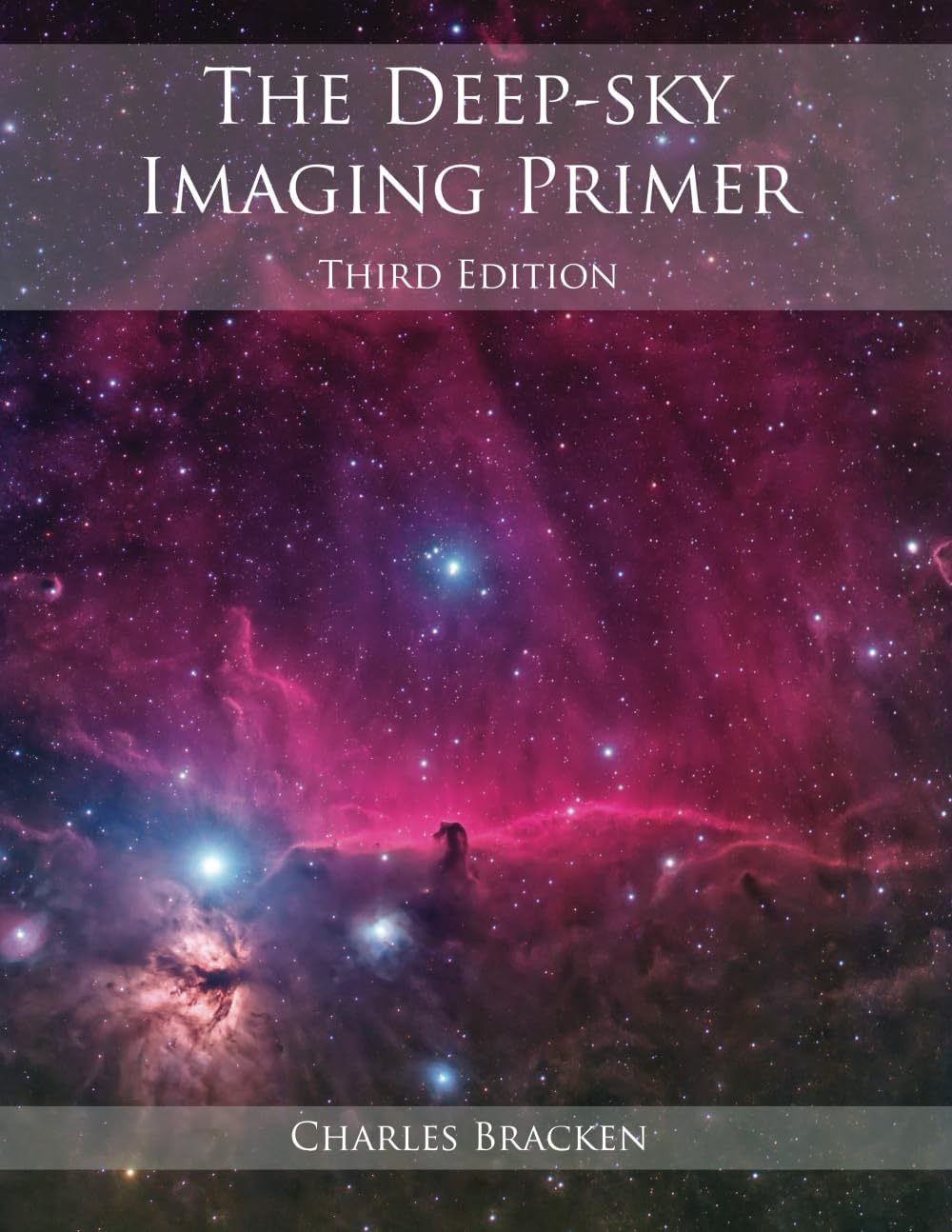
The Deep-sky Imaging Primer, Third Edition
Product ID: 435153419
Buy anything from 5,000+ international stores. One checkout price. No surprise fees. Join 2M+ shoppers on Desertcart.
Desertcart purchases this item on your behalf and handles shipping, customs, and support to Finland.
Thousands of people learned astrophotography from the first two editions, now The Deep-sky Imaging Primer has been fully revised and expanded in this third edition. It has been updated to include the latest cameras, technology, and software. Everything you need to know about capturing and processing stunning images of deep-sky objects is covered. You’ll learn about: The fundamental principles of electronic cameras, optics, and mounts How to choose the best camera and telescope for you How to set up, choose exposure parameters, and take the images Where and when to find the best deep-sky objects How to process images. In addition to PixInsight® and Adobe Photoshop®, Affinity Photo® and AstroPixelProcessor® are now fully covered. Start-to-finish examples of image processing are included, with a focus on PixInsight. Full-color throughout with 372 illustrations. Review: Hands-down the most comprehensive and practical guide to astrophotography - This is the book I wish had existed when I was getting started with astrophotography. The author has modestly entitled this book a “Primer”, and it is that. But it is also a comprehensive tutorial and reference work. This book stands out from the others in the field in several regards: • It is truly all-inclusive, covering every aspect of imaging from A to Z. Section 1, Understanding Images, starts off by explaining the unique challenges of deep-sky imaging, and then proceeds to lay out what you need to understand about sensors, dynamic range, signal/noise, and other detailed, foundational topics. Section 2, Acquiring Images, is a how-to guide through every aspect of actually capturing images: Choosing a telescope, camera, filters, mount; focusing, guiding, and exposures. Section 3, Processing Images, is an in-depth how-to for turning your raw, grainy, monochrome images into those beautiful, detailed, full-color deep sky photos you see in magazines. There are plenty of books that cover equipment and how to acquire images, but treat processing images as an afterthought; and there are plenty of books that focus on (one) post-processing tool, but none others as far as I know that cover the whole field so thoroughly • Although much of the material is technical, as it has to be (if you If you are daunted by technical detail, then maybe deep sky imaging isn’t for you), the explanations are crisp and lucid, supplemented every step of the way with clarifying illustrations. I wish explanations of this quality had been in my college physics textbooks. And the ultimate focus of the topics is, always, WHY you need to know this: How it affects the manifold decisions and tradeoffs you need to make about equipment, location, exposures, targets, processing, and so forth. • Section 3, Processing Images, is worth the price of admission alone. Most books cover a single processing platform, such as Photoshop, and then throw a blizzard of techniques at you, often with little direction as to why you’re doing what you’re doing, or what to do in what order. This book, by contrast, after introducing the principles, goals, and tools of post-processing, systematically guides you through the rationale and expected results of each step, pausing along the way to show you specifically how the step can be accomplished in different popular programs: PixInsight, Photoshop, AstroPixelProcessor, and Affinity Photo. These programs can be overwhelming, with slews of menus and tools and choices and options and different ways of doing things. This book cuts through the chaff and explains which ones are actually of practical use in imaging, and why and how to use them at various stages. Not all of these programs support a full astro processing toolset, so you are shown how you can do end-to-end processing using a mix of programs if you prefer. For example, if you are already proficient in Photoshop, you may want to cut your teeth on deep sky imaging by using a relatively turnkey program like AstroPixelProcessor for pre-processing, then use Photoshop for post-processing. This book will guide you through that. Then, when you’re ready to climb the mountain of PixInsight, you can follow the same processing logic in the PixInsight chapters. That is a big leg up, and leverages what you already know. • The book is loaded with what are clearly experienced-based best practices and suggestions: Tips on composition, how to annotate your images, how to make the best use of your time in imaging sessions, how to choose the right subs to take, and countless other dos and don’ts. As I said at the beginning, I wish I had this book when I was getting started, as I had to painfully learn a lot of these lessons myself; and in reading this book I was very, very grateful to discover numerous valuable practices and suggestions new to me, especially in the post-processing chapters. In summary, if you’re going to buy one book on how to do astro imaging, then this is the one. And I’ll bet you won’t want or need any other for a long, long time. Review: Great reference, great for starters and advanced AP - Its a great reference book if you are interested in the basic mechanism of astrophotography - and you should because it makes a big difference, saving you time, cost, frustration The individual chapters read well and have a good balance between covering best practices and some basic math. It is very helpful to have this all together in a book than scattered across internet fora, highly recommend this to anyone. The chapter ordering is somewhat illogical if you compare it to your typical workflow ; concept of plate solving, composition in the back? Another item I was missing was the basics of what we are imaging; emission lines from Nebulae, or broad band galaxies? It is mentioned in the filter section, but not really clear from a workflow perspective. At the time of writing there were several competing software packages for processing, and these different software products are all covered - I hope in the next edition (which I will surely buy) the author has been able to make a choice for one platform that our hobby is converging on. It is very light on target selection and planning - that is however covered very well in another book from the same author that I would recommend.
| Best Sellers Rank | #107,939 in Books ( See Top 100 in Books ) #12 in Astrophotography (Books) #53 in Digital Photography (Books) #147 in Astronomy (Books) |
| Customer Reviews | 4.8 out of 5 stars 186 Reviews |
U**C
Hands-down the most comprehensive and practical guide to astrophotography
This is the book I wish had existed when I was getting started with astrophotography. The author has modestly entitled this book a “Primer”, and it is that. But it is also a comprehensive tutorial and reference work. This book stands out from the others in the field in several regards: • It is truly all-inclusive, covering every aspect of imaging from A to Z. Section 1, Understanding Images, starts off by explaining the unique challenges of deep-sky imaging, and then proceeds to lay out what you need to understand about sensors, dynamic range, signal/noise, and other detailed, foundational topics. Section 2, Acquiring Images, is a how-to guide through every aspect of actually capturing images: Choosing a telescope, camera, filters, mount; focusing, guiding, and exposures. Section 3, Processing Images, is an in-depth how-to for turning your raw, grainy, monochrome images into those beautiful, detailed, full-color deep sky photos you see in magazines. There are plenty of books that cover equipment and how to acquire images, but treat processing images as an afterthought; and there are plenty of books that focus on (one) post-processing tool, but none others as far as I know that cover the whole field so thoroughly • Although much of the material is technical, as it has to be (if you If you are daunted by technical detail, then maybe deep sky imaging isn’t for you), the explanations are crisp and lucid, supplemented every step of the way with clarifying illustrations. I wish explanations of this quality had been in my college physics textbooks. And the ultimate focus of the topics is, always, WHY you need to know this: How it affects the manifold decisions and tradeoffs you need to make about equipment, location, exposures, targets, processing, and so forth. • Section 3, Processing Images, is worth the price of admission alone. Most books cover a single processing platform, such as Photoshop, and then throw a blizzard of techniques at you, often with little direction as to why you’re doing what you’re doing, or what to do in what order. This book, by contrast, after introducing the principles, goals, and tools of post-processing, systematically guides you through the rationale and expected results of each step, pausing along the way to show you specifically how the step can be accomplished in different popular programs: PixInsight, Photoshop, AstroPixelProcessor, and Affinity Photo. These programs can be overwhelming, with slews of menus and tools and choices and options and different ways of doing things. This book cuts through the chaff and explains which ones are actually of practical use in imaging, and why and how to use them at various stages. Not all of these programs support a full astro processing toolset, so you are shown how you can do end-to-end processing using a mix of programs if you prefer. For example, if you are already proficient in Photoshop, you may want to cut your teeth on deep sky imaging by using a relatively turnkey program like AstroPixelProcessor for pre-processing, then use Photoshop for post-processing. This book will guide you through that. Then, when you’re ready to climb the mountain of PixInsight, you can follow the same processing logic in the PixInsight chapters. That is a big leg up, and leverages what you already know. • The book is loaded with what are clearly experienced-based best practices and suggestions: Tips on composition, how to annotate your images, how to make the best use of your time in imaging sessions, how to choose the right subs to take, and countless other dos and don’ts. As I said at the beginning, I wish I had this book when I was getting started, as I had to painfully learn a lot of these lessons myself; and in reading this book I was very, very grateful to discover numerous valuable practices and suggestions new to me, especially in the post-processing chapters. In summary, if you’re going to buy one book on how to do astro imaging, then this is the one. And I’ll bet you won’t want or need any other for a long, long time.
B**R
Great reference, great for starters and advanced AP
Its a great reference book if you are interested in the basic mechanism of astrophotography - and you should because it makes a big difference, saving you time, cost, frustration The individual chapters read well and have a good balance between covering best practices and some basic math. It is very helpful to have this all together in a book than scattered across internet fora, highly recommend this to anyone. The chapter ordering is somewhat illogical if you compare it to your typical workflow ; concept of plate solving, composition in the back? Another item I was missing was the basics of what we are imaging; emission lines from Nebulae, or broad band galaxies? It is mentioned in the filter section, but not really clear from a workflow perspective. At the time of writing there were several competing software packages for processing, and these different software products are all covered - I hope in the next edition (which I will surely buy) the author has been able to make a choice for one platform that our hobby is converging on. It is very light on target selection and planning - that is however covered very well in another book from the same author that I would recommend.
L**7
Newbies MUST read this book BEFORE buying anything related to astrophotography!
More valuable to me than my OTA! This reference guide has been the best investment in astrophotography I've ever made. I strongly recommend any new astrophotographers to start with this book! Do not buy any astro-equipment (like I did) before reading this book. STUDY first! I wish I had done this first because it would have saved me literally at several thousand dollars from the beginning, from the selection of my OTA (would have bought an EdgeHD instead of an XLT OTA then eventually bought a very expensive coma corrector to help fix the problems with the XLT SCT), would have started with an APS-C instead of a stock IMX533, would have bought a CGX mount instead of the VX, would have bought 2" filters and a seven position filter wheel instead of starting with 1.25" LRGB filters, and don't get me started on the money I wasted on guide scope/camera combos....If you are new to this hobby then you most likely do not know what I'm talking about yet which is why I hope you see the importance of studying first, buying later is the best strategy for astrophotography. I've learned that this hobby, while AMAZING, is very, very expensive and our time is even more precious so taking 100 hours out of your life to invest in studying this book BEFORE you start buying gear will save you more than I can tell you. This book helps you plan just as much as it teaches the fundamentals so it is a worthy investment. OK, I'm done evangelizing this book!
L**L
The best handbook on Astrophotography
Altough I am only a novice in AF, just started about a year ago, to me this is the best standard text book that money can buy. Comprehensive, very clearly written, with both mathematical theory, as well as very practical examples, pictures, advice and infographics. A joy to carefully read and learn from and a brilliant piece of meticulous work from years of experience and deep knowledge and understanding.
A**G
Excellent book, but can improve
Astrophotography imaging technology has been changing very fast, from film cameras to imaging sensors (first CCD and then CMOS), although the basic principles of long exposure low-light/dark-sky photography (signal and noise) remain the same. The new technology has reduced the amount of trouble (but not the cost) needed for successful deep-sky astrophotography. This book covers both the theory and practice of deep-sky astrophotography using the latest sensor technology and software, and covers them quite well. I also like the writing style and clarity of exposition. There is a lot of room for improvements. Some suggestions: (1) Typos remain (was it proofread thoroughly?). (2) The index is pretty meager (a technical book's usefulness depends on the quality of the index). (3) The formatting of math formulas is very poor and look unprofessional/old-fashioned (given that in today's age TeX/MathJax is standard even in basic websites such as wikipedia and Stack Overflow). (4) This is the 2022 edition. In the four years before that, there has been a growing interest in "EAA" or Electronically Assisted Astronomy, which may be described as "quick and rough astrophotography" (useful in outreach events, although EAA cannot have the superb fidelity of astrophotography). It would have been nice if the author included a section on EAA. (5) The author lists most major software for deep sky imaging (although not all, e.g. the very popular Sharpcap is not properly mentioned), and selects some of them for detailed coverage (e.g. PixInsight). Some of these software cost significant amounts of money. It would be nice if the author also guides the reader through a clear work path (from auto-guiding/acquisition/capture to post-processing) that uses only free software. Still, I highly recommend the book. If you have basic familiarity with classical prime-focus astrophotography, then this book can bring you up to date with the latest technology.
C**R
Best Resource for beginning astrophotographery
Simply excellent! Rich source of information. Learn how your cmos sensor works, the how of gain setting and image exposure settings. And on and on. This is a one stop information rich textbook on astrophotography. Stop wasting your time on YouTube and the web. All you need to know is in this book. If you’re serious about astrophotography, this book is for you.
M**R
A great guide
This is a must book to understand all the aspects of astrophotography. I had been doing astrophotography for about a year before purchasing this book. Even the topics that I thought I knew, this book extended my knowledge even further. At first I thought that the author may have went too far in some topics but found myself going back and really wanting to know those details. If you really want to get the best images possible, read this book.
S**H
A Deep Dive into the Basics of Astrophotography
I have found this book to be a great resource, both as a step by step guide to image processing and as a good primer into understanding the science, engineering and software processes that are involved in astrophotography.
G**.
Ottimo libro di astrofotografia
Libro stupendo e davvero pieno di informazioni! Consigliatissimo
コ**ー
天体写真の良書
天体写真を撮るかたにお勧めします。ただし初心者向けではありません。 英文ですが、著者のサイトでPDF版を購入すればGoogle翻訳を使って日本語で読めます。 日本で出版されている他の書籍は撮影のための手順やノウハウですが、本書は撮影の理論的な裏付けを与えてくれます。また、体系的にまとめられていますのでネット情報をどれだけ行なってもこれにはかないません。 Google翻訳はこのような専門書の場合、精度に難がありますがflatをアパートと訳すのはしょうがないですね。flatは天体写真ではフラットフレームのことですが一般的ではありませんので。それでも天体写真の経験があれば おかしい和訳は英文を見て推測することは難しくないと思います。本気で取り組もうとするかたにとって障害にはならないのではないでしょうか。
E**A
Easy reading, well structured
The book has pedagogically and clearly structured content. Each new section is preceded by an introduction to the basics. That's why the book is also suitable for a beginner astrophotographer. However, the amount of information the book offers is respectable, so it is well suited reading even for those already familiar with the field. The author's writing style is nice and easy to read. I felt that the content was a nice mix of the author's knowledge and his own experiences. There were a few instances where the proofreader has failed (and English isn't even my second language).
F**O
3 estrellas porque nunca me llegó, pero…
Nunca llegó el libro, sin embargo ya pude conseguirlo por otros medios y la verdad que el contenido es de lo mejor, incluye los elementos teóricos y científicos de la astro fotografía así como temas acerca del procesado, el uso de las cámaras, sus tipos, lo referente a las monturas y telescopios, para que sirve cada una, que tamaño de telescopio o distancia focal es recomendada, etc… todas las bases y mucho más para aprender y dominar este gran e interesante pasatiempo. Recomendado.
A**R
Must have for astrophotographers
This is a must have for astrophotography. It covers all the aspects of how to collect and process data to create great deep sky photos.
Trustpilot
5 days ago
2 weeks ago