Desert Online General Trading LLC
Dubai, United Arab Emirates
Desert Online General Trading LLC
Dubai, United Arab Emirates


🔐 Secure your sanctuary with smart, sleek protection.
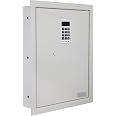
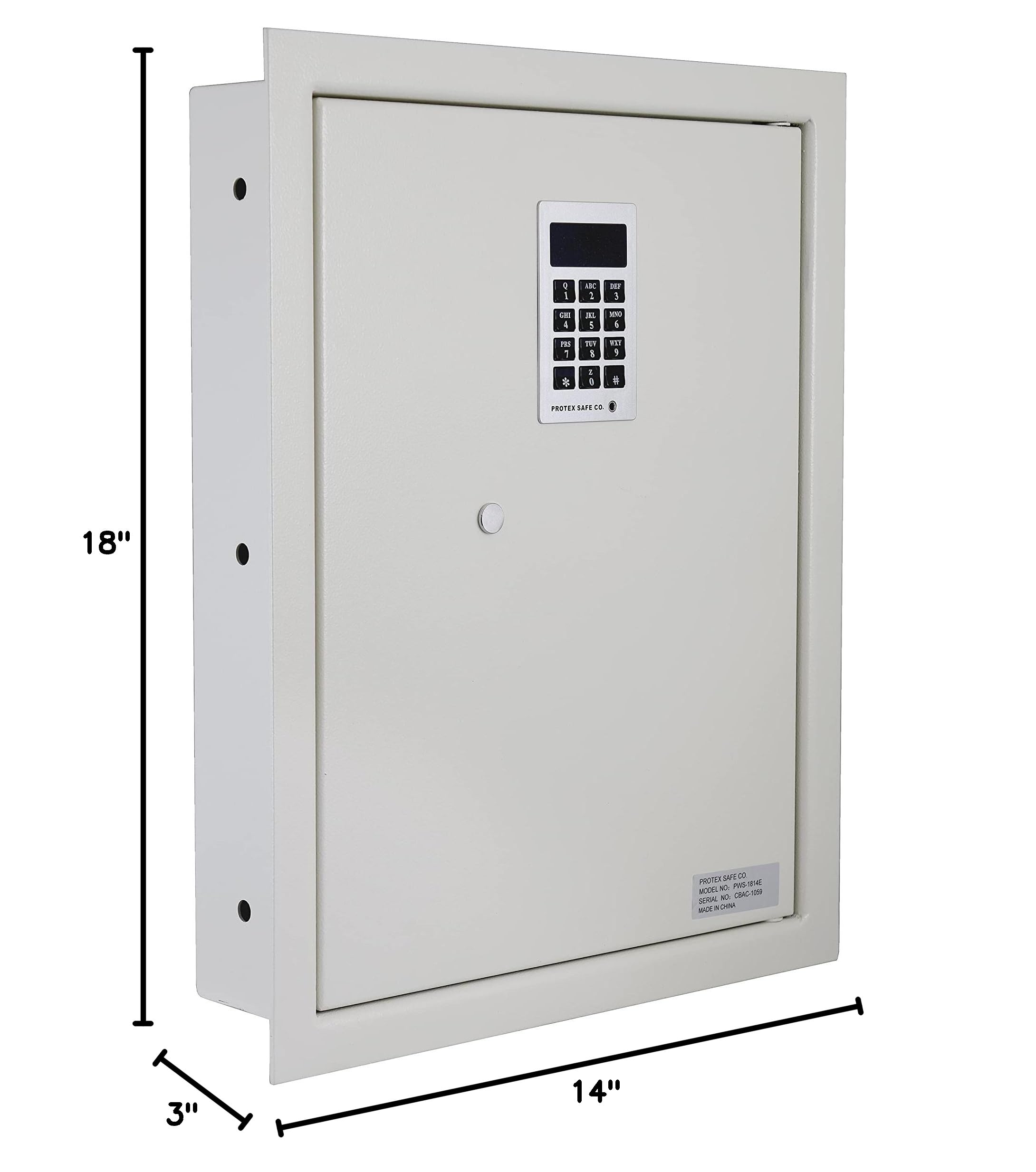
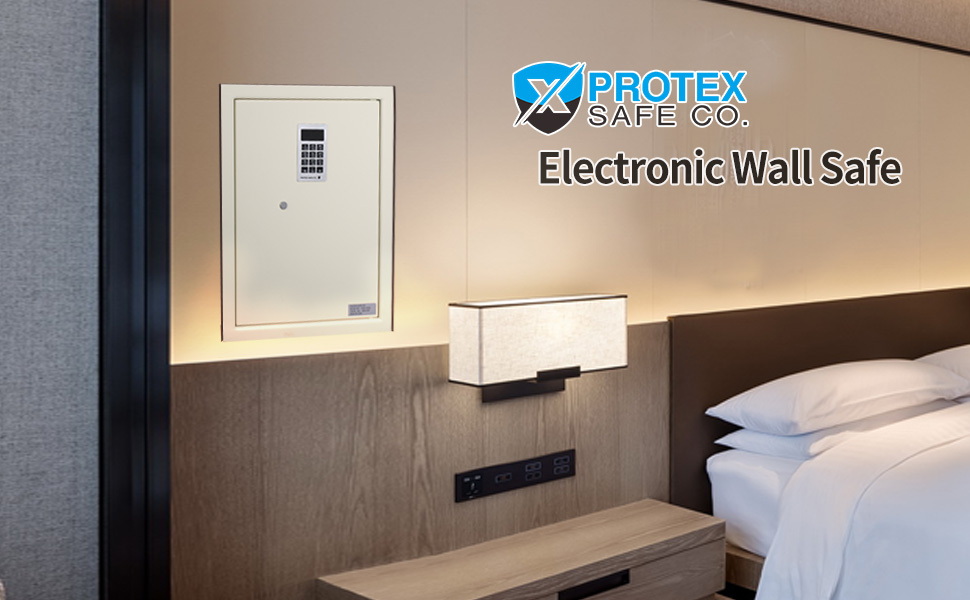
The Protex Safe Electronic Keypad Wall Safe (PWS-1814E) is a burglary-resistant, wall-mountable safe featuring a digital electronic locking system with dual motorized chrome bolts. Designed to fit between standard 16" wall studs, it offers 0.44 cubic feet of velvet-lined storage space with two removable shelves. The safe includes a touchpad control, LCD display, and automatic door opening for quick, secure access, all housed in heavy-duty gauge steel.


| Brand | Protex Safe Co. |
| Product Dimensions | 3"D x 14"W x 18"H |
| Lock Type | Electronic |
| Color | BEIGE |
| Capacity | 0.44 Cubic Feet |
| Material | heavy duty gauge steel |
| Special Feature | Anti-Theft |
| Mounting Type | Wall Mount |
| Control Type | Touchpad Control |
| Included Components | Keys |
| Item Weight | 28 Pounds |
| Alarm | Lock |
| Water Resistance Level | Not Water Resistant |
| Chamber Width | 16 Inches |
| UPC | 799198285428 837654461310 |
| Global Trade Identification Number | 00837654461310 |
| Manufacturer | Protex Safe Co., LLC |
| Part Number | PWS-1814E |
| Item Weight | 28 pounds |
| Country of Origin | China |
| Item model number | PWS-1814E |
| Batteries | 4 AA batteries required. (included) |
| Is Discontinued By Manufacturer | No |
| Style | Modern |
| Item Package Quantity | 1 |
| Display Style | LCD |
| Special Features | Anti-Theft |
| Batteries Included? | Yes |
| Batteries Required? | Yes |
| Battery Cell Type | Alkaline |
| Warranty Description | Parts |
R**S
Great product, but beware of installation work required
I just spent the entire day installing this safe and am not quite done with covering all tracks of the construction surgery due to all the suitable wall spaces in my old house having studs at considerably less than standard 16"o.c. distance.That little contretemps aside, this product is first rate. Sturdy, easy to use (and to install, if you live in a modern house), this heavy safe looks and feels sturdy and crowbar-proof, yet has a pleasing interior thanks to a velvety interior cladding. Punch in your personal 4-digit code and the door springs open on its own and illuminates the safe interior through a hidden LED light. The effect is almost magic and very inviting. There is also a 6-digit override code in case you forget the 4-digit code. Both are easy to reprogram from their factory settings. While the locking mechanism requires 4 AA batteries to work, there is a secondary exterior battery compartment that can be used in the unlikely case that the interior batteries run out. You would have to ignore the low-battery warnings or not use the safe for a long time for that to happen. Finally, there is a set of rather odd-looking keys to open the safe the old-fashioned way if all of the above were to fail. My biggest worry at this minute is where to store these keys so I would find and identify them if ever needed, but in a place a burglar would not bother to look... I am thinking my safe at the bank.Now to some practical installation hints, as the instructions are very sparse in this respect. First, you need to find a suitable placement from a comfort point of view. The door hinges are on the right and cannot be switched. The safe requires a rectangular opening in the wall, 18-1/8 by 14-1/8 inches. 14 1/8 inches is the surface-to-surface distance between studs in standard construction, and you *will* need side studs to bolt the safe into.Next, you need to identify where the studs are in your preferred spot. A studfinder works best, but knocking the wall with your knuckles can also work if you have an ear for hollow vs. solid sounds. Once you ascertain the proper space, explore the supposedly hollow space between the two studs for any firebreaks (horizontal spacer studs), again with a studfinder or your knuckles and your ear. If you find one, you will likely want to place the safe immediately above it.Once you have a rough idea of the safe's location, make a small pilot hole with a drill, then stick a wire (or disassembled coathanger) into it to plumb the depth. The safe requires 3 3/4 " unobstructed depth, measured from the wall surface facing the room. Assuming all is good so far, draw the outline of the required opening with light pencil on the wall. Next, drill pilot holes at 1 to 2 inches apart along the outline. You want to insure that there are no hidden obstacles anywhere. Small drill holes are a lot easier to patch up then a large hole. The pilot holes will also help you identify the exact location of stud edges and firebreak edge, if any. As you draw the final, verified outline of the opening, make sure that the angles are square! Ideally you have a helper hold the (heavy) safe against the wall you you run a pencil around its outline. A heavy, strong person might be able to do so without help in a pinch.Finally you are ready to cut. For regular sheetrock (gypsum board) used starting in the 1950s, a handsaw is best. Ideally you hold the business end of a household vacuum hose (without attachment) immediately below the saw blade as it works through the sheetrock, as this dust will otherwise have a way of coating every square inch of surface within sight. If, however, you have lath and plaster as I did in my old house, you will need an electric reciprocating saw ("sawz-all") with a short, "bimetal" blade to cut cleanly through the hard gypsum and the wood slats. Err on the side to make the hole about 1/8" wider and taller than the outline of the safe. One more hint: Make a 3 x 3 hole in the center first, then peer around inside for any pipes or wires you may have missed. Flexible romex wire may likely and safely fit behind the safe, but pipes my force you to retreat and find an alternate location.Once you are done with the cutting, if you are lucky, the safe will pop in cleanly into your opening. If you are like me and made the opening too tight, you'll have to cut a little more. With the open safe fitting snug against the wall, mark the 3 drill holes on the left side against the left stud, and repeat the same with the 3 holes against the right stud. Drill holes smaller than the supplied bolts -- you can always re-drill with a larger bit if needed. Don't forget to add the supplied washers as you insert the bolts into the holes you drilled. You will need a socket wrench (I used 17 mm -- 5/8 or 11/16 *might* work, also) with a ratchet arm to do these bolts justice. Remove the velvet shelves while you do this.Once you are done and the safe is installed, vacuum it out and paint any damaged wall surface surrounding it though, if you were very careful, that may not be necessary. Enjoy!
K**D
We're very happy with the quality of this safe
We're very happy with the quality of this safe, it feels very sturdy and is very easy to use. The steel is sturdy, and the keypad doesn't feel cheap at all. The buttons are actually plastic, and don't feel flimsy or cheap at all. I also like the digital readout of the keypad digits as they're pressed. The "user code" works like a hotel safe where you enter a code while the door is open then press * to close. The user code will open it the next time, but must be re-entered to close it. It also comes with a "master code" that will always open and close the safe, and it is re-programmable. I read some reviews that the keypad is loud, and I would agree it is moderately loud. Not loud enough to be annoying, but loud enough that anyone could hear it in the house when its dead quiet. I put mine in our master closet, so with my setup, it's less audible outside of my bedroom.The door actually swings out nicely when you open the lock, about a couple inches. Enough to comfortably grab the door and open it the rest of the way. The felt lined interior is nice, and there's even a little LED light in there. It's almost luxurious. Real nice to open and use. I was also surprised how little it comes out of the wall. I didn't measure, but it can't be more that 1/4-1/2". It feels like it's just part of the wall!Installing this was a bit of a pain, but that's only because my studs were 16" apart from the edges, not the center. I had to get a 2x4, cut a 2' section off, then cut off another 1/4" to get it to fit in place. Overall, it probably took me 2-3 hours to install, but again that's because I needed to cut a filler piece. I was also using a hand saw to cut the 2x4 and a utility knife to cut the sheetrock, I'm sure if I used the more appropriate tools it would have taken significantly less time. But if your studs are 16" on center, its a cinch. Just measure out where you want it on your wall, use a level to draw your lines, cut, insert, drill some pilot holes, then screw it in. If you're handy at all, I would recommend that you install this yourself and save yourself the $200+ to have amazon get a professional to install it. You'll probably do a better job anyway.
D**.
No Customer Service available.
The safe worked great for awhile. Now the solenoid won't operate. I tried for the last couple of months to get ahold of Protex. It just rings. And eventually disconnects. No one ever answers. Poor customer service.
Trustpilot
1 week ago
2 months ago