We remain fully operational. Our teams are working around the clock to ensure your deliveries continue safely.

DOWNLOAD THE APP


Customer Services
Copyright © 2025 Desertcart Holdings Limited
DOWNLOAD THE APP
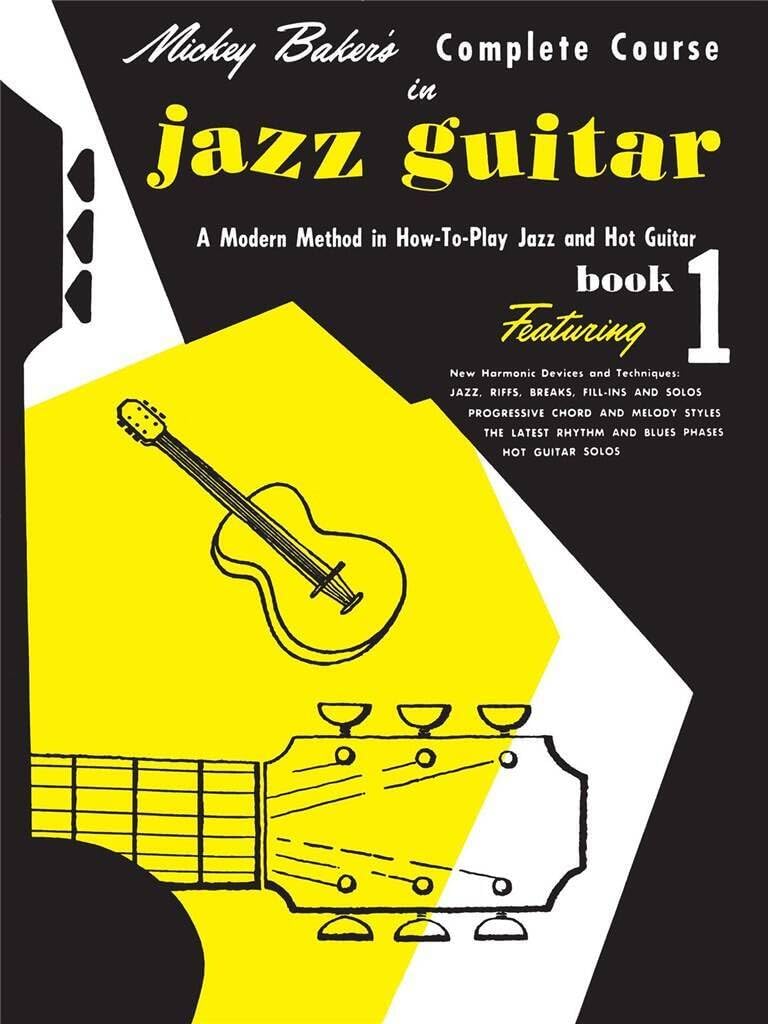



desertcart.com: Mickey Baker's Complete Course in Jazz Guitar Book 1 | Jazz Guitar Instructional Method for Beginners and Intermediate Players | Learn Jazz Chords Riffs Solos and Harmonic Techniques: 8601404406447: Baker, Mickey: Books Review: Deceptively Simple - Almost every pro guitarist, and a lot of amateur ones, know the Mickey Baker books. A number of jazzers and rockers started out with them- Pete Townsend has said that he learned his chords from Mickey. This was the only specifically jazz oriented guitar method available back in the 50s when Mickey wrote it, and it's been in print pretty much continuously since then. That by itself should should tell you a lot. A lot of guitarists looking for a good jazz self-study course have looked at this book, and wondered if there was really much to be learned from few simple chord exercises and a few dozen riffs. Sure, there were a lot of good chords to be learned from it, but beyond that...? Actually, there is a tremendous amount of information to be found in this book, but only if you follow Mickey's directions. He doesn't give you a lot of why- just "do this until you have it down." But if you do that, you'll find yourself internalizing a lot of important rules and skills that other teachers spell out. Those hokey sounding chord progressions that Mickey wants you to memorize and transpose to other keys are actually teaching you all the standard jazz substitutions. Mickey does spell out some of these rules in the second half of the book, but if you've done your homework you'll find that it's much easier to apply these rules to soloing if you've actually internalized them than if he had just told you that you could use a Lydian or Aeolian sub for a dominant chord in a 12 bar blues. The second half of this book is all about learning to solo, and a lot of non-readers have looked at it, and been put off by the lack of tab. But you don't need reading skills beyond that absolute minimum to use this book. Mickey has provided all the fingerings below the staff for each exercise. It may be a little unfamiliar at first, but by the time you finish this book- and it'll take a year to really do it right- you'll find that you have some pretty good reading skills, too. Even though it was written back in the 1950s, the riffs and chords Mickey teaches sound just as hip today. Some guitarists will quibble with some of Mickey's choices, or his chord names, but it's more a matter of opinion than a fault in the book. For example, a lot of contemporary guitarists would play something like Bm7-Bb7-Am7... rather than Mickey's straight descending m7ths (Bm7-Bbm7-Am7..) today, but that's something the student will learn just by listening to guitarists today. In short, if you have some basic guitar skills- you know a few dozen chords, and you can strum along- and you're confused by all the different jazz guitar books out there- this is the one you should start with. If you follow his directions, practice every exercise until you've memorized it, and written out and practiced all the transpositions, too, by the time you finish the book you'll be able to comp and put together a simple solo over most any jazz tune. [n.b.- this edition is the original book as printed in the 1950s. There's another edition with a blue cover that was edited and re-typeset in the 70s, but that edition contained a number of errors that were introduced in the editing. This is the one you want.] Review: Get out of the rut with this one--but there are significant problems - This book gets you out of the rut of memorizing chords, reading tabs (which you shouldn't anyway if you really want to learn), and cycling thru what you already know. The chord groupings, and the exercises that put those to use, are invaluable for guitarists who want to learn accompaniment (esp. to standards) in all the keys. Not a book on music theory but rather a practical course of study and practice. Learning his chord forms can be difficult--and several can be made more simply--but that preliminary work is well worth the time. That being said, the major drawback to the book is the author's failure to explain anything. Students don't need to be coddled, but they do need to be helped to understand what they're being asked to do! For example, the author in lesson 4 says you are to transpose the material in the previous lesson into different keys. When you look back at the previous lesson, unless you are already well versed in music theory, you won't understand either the layout of the previous lesson or what is being asked in the new lesson. Each example in the previous lesson begins in "G" and ends in "Gma7." What is this supposed to tell us about the key of the example? I imagine this book is great when used by the student along with a good teacher. On its own, it is difficult to follow and, as some reviewers have noted, discouraging.


| Best Sellers Rank | #199,417 in Books ( See Top 100 in Books ) #59 in Jazz Songbooks #195 in Guitar Songbooks #1,155 in Music Instruction & Study (Books) |
| Customer Reviews | 4.7 4.7 out of 5 stars (882) |
| Dimensions | 9 x 0.16 x 12 inches |
| Edition | First Edition |
| ISBN-10 | 0825652804 |
| ISBN-13 | 978-0825652806 |
| Item Weight | 2.31 pounds |
| Language | English |
| Print length | 64 pages |
| Publication date | September 1, 1996 |
| Publisher | Ashley Publications Inc./Lewis Music Publishing Co. |
M**J
Deceptively Simple
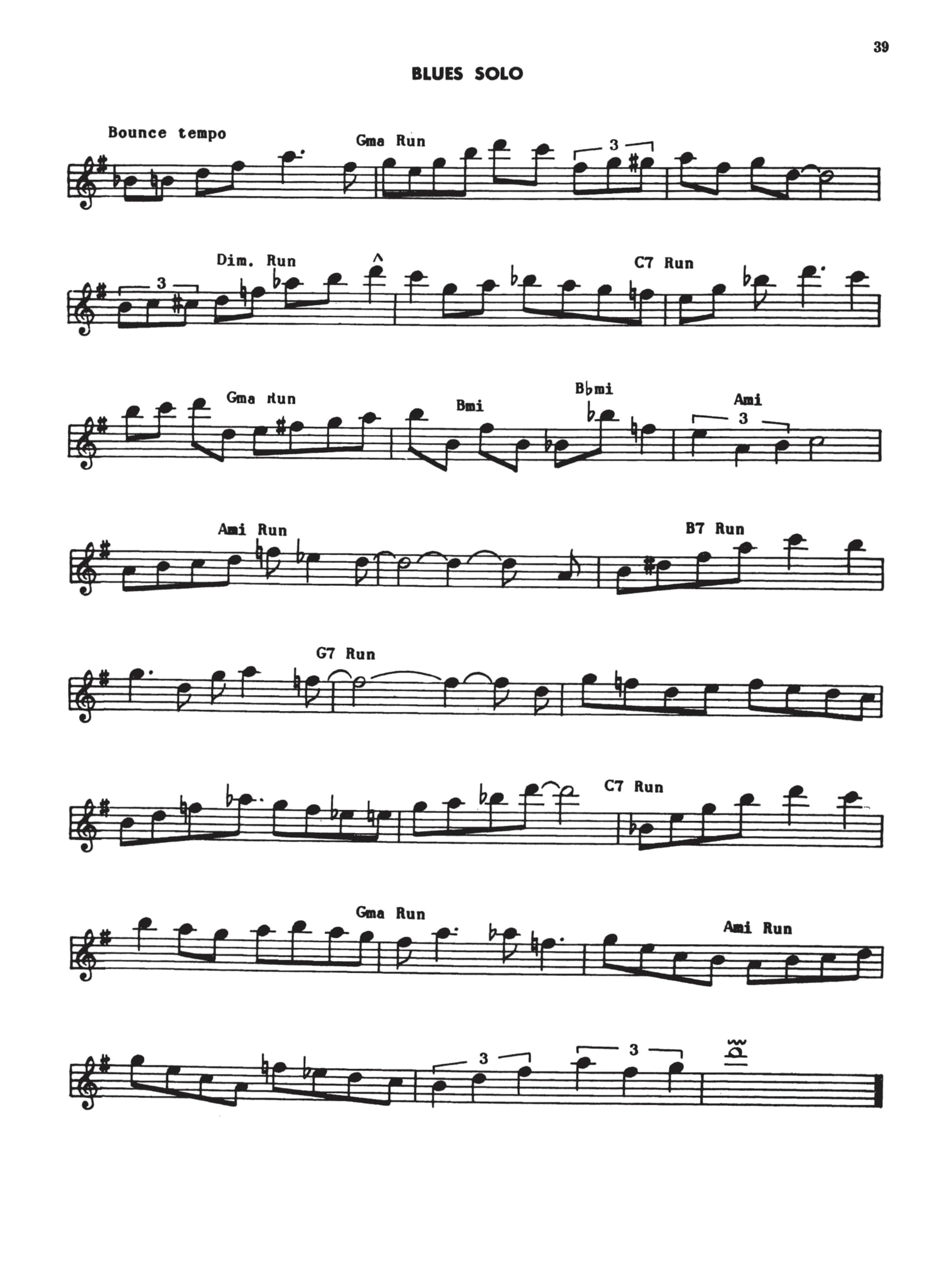
Almost every pro guitarist, and a lot of amateur ones, know the Mickey Baker books. A number of jazzers and rockers started out with them- Pete Townsend has said that he learned his chords from Mickey. This was the only specifically jazz oriented guitar method available back in the 50s when Mickey wrote it, and it's been in print pretty much continuously since then. That by itself should should tell you a lot. A lot of guitarists looking for a good jazz self-study course have looked at this book, and wondered if there was really much to be learned from few simple chord exercises and a few dozen riffs. Sure, there were a lot of good chords to be learned from it, but beyond that...? Actually, there is a tremendous amount of information to be found in this book, but only if you follow Mickey's directions. He doesn't give you a lot of why- just "do this until you have it down." But if you do that, you'll find yourself internalizing a lot of important rules and skills that other teachers spell out. Those hokey sounding chord progressions that Mickey wants you to memorize and transpose to other keys are actually teaching you all the standard jazz substitutions. Mickey does spell out some of these rules in the second half of the book, but if you've done your homework you'll find that it's much easier to apply these rules to soloing if you've actually internalized them than if he had just told you that you could use a Lydian or Aeolian sub for a dominant chord in a 12 bar blues. The second half of this book is all about learning to solo, and a lot of non-readers have looked at it, and been put off by the lack of tab. But you don't need reading skills beyond that absolute minimum to use this book. Mickey has provided all the fingerings below the staff for each exercise. It may be a little unfamiliar at first, but by the time you finish this book- and it'll take a year to really do it right- you'll find that you have some pretty good reading skills, too. Even though it was written back in the 1950s, the riffs and chords Mickey teaches sound just as hip today. Some guitarists will quibble with some of Mickey's choices, or his chord names, but it's more a matter of opinion than a fault in the book. For example, a lot of contemporary guitarists would play something like Bm7-Bb7-Am7... rather than Mickey's straight descending m7ths (Bm7-Bbm7-Am7..) today, but that's something the student will learn just by listening to guitarists today. In short, if you have some basic guitar skills- you know a few dozen chords, and you can strum along- and you're confused by all the different jazz guitar books out there- this is the one you should start with. If you follow his directions, practice every exercise until you've memorized it, and written out and practiced all the transpositions, too, by the time you finish the book you'll be able to comp and put together a simple solo over most any jazz tune. [n.b.- this edition is the original book as printed in the 1950s. There's another edition with a blue cover that was edited and re-typeset in the 70s, but that edition contained a number of errors that were introduced in the editing. This is the one you want.]
D**.
Get out of the rut with this one--but there are significant problems
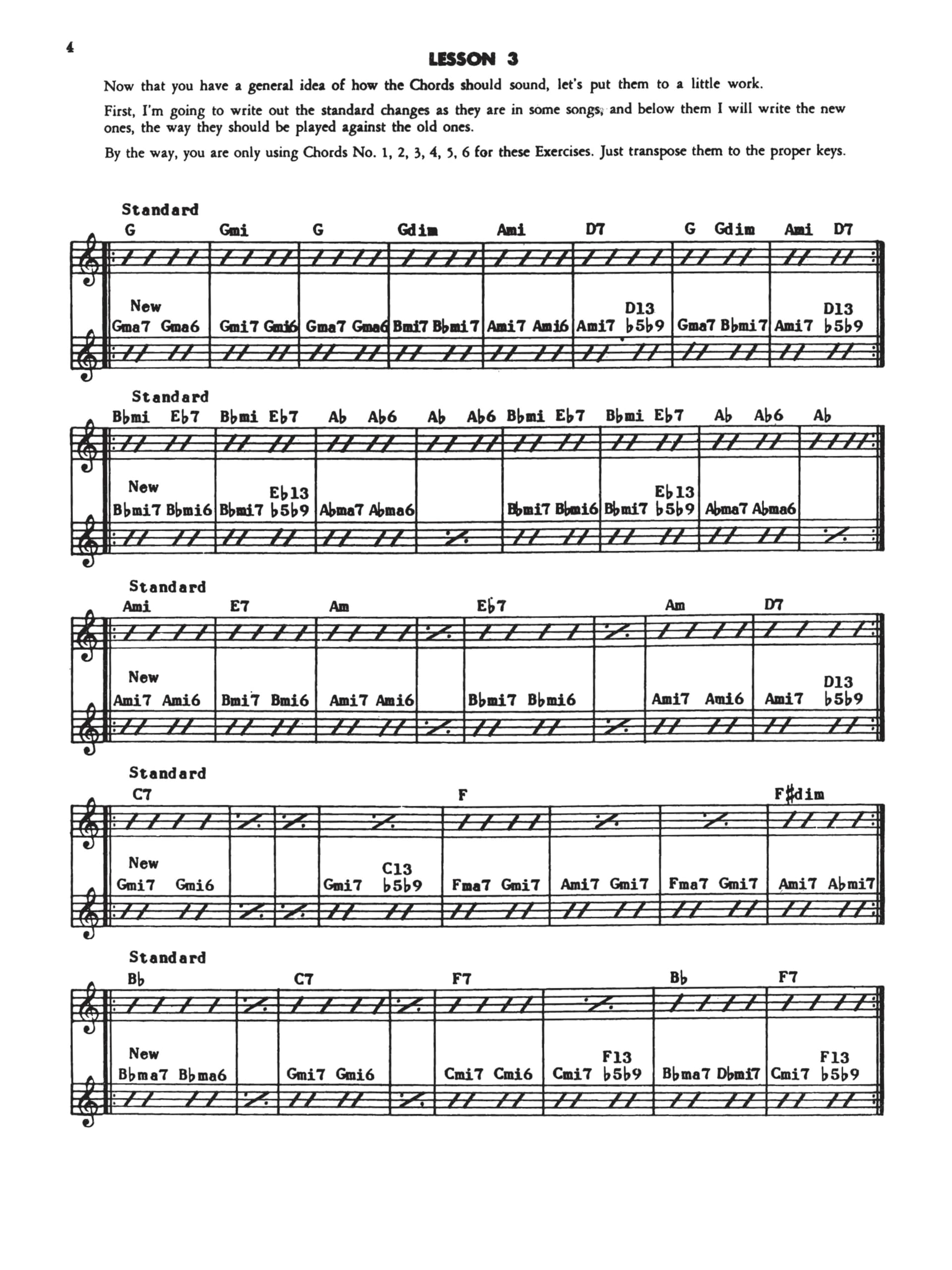
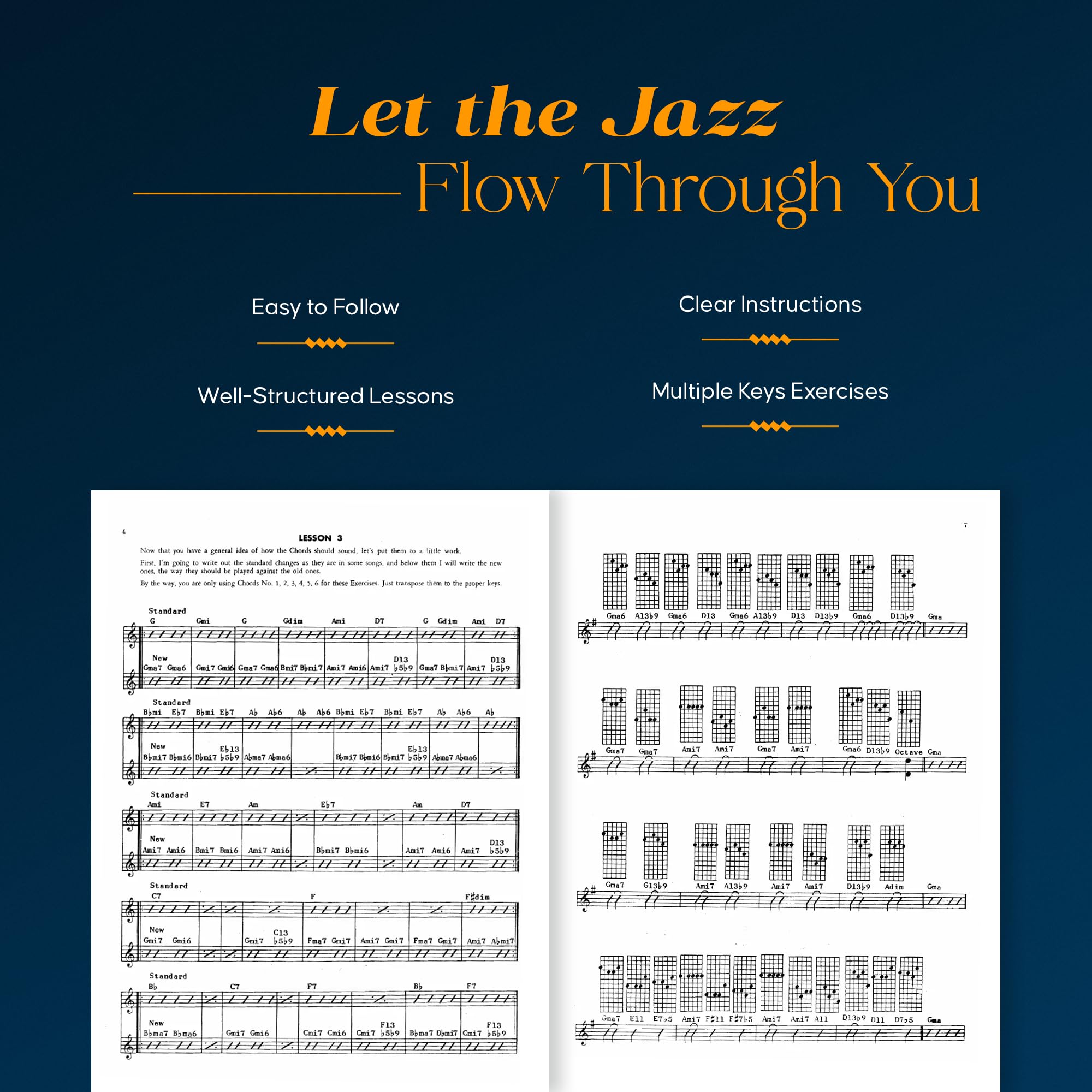
This book gets you out of the rut of memorizing chords, reading tabs (which you shouldn't anyway if you really want to learn), and cycling thru what you already know. The chord groupings, and the exercises that put those to use, are invaluable for guitarists who want to learn accompaniment (esp. to standards) in all the keys. Not a book on music theory but rather a practical course of study and practice. Learning his chord forms can be difficult--and several can be made more simply--but that preliminary work is well worth the time. That being said, the major drawback to the book is the author's failure to explain anything. Students don't need to be coddled, but they do need to be helped to understand what they're being asked to do! For example, the author in lesson 4 says you are to transpose the material in the previous lesson into different keys. When you look back at the previous lesson, unless you are already well versed in music theory, you won't understand either the layout of the previous lesson or what is being asked in the new lesson. Each example in the previous lesson begins in "G" and ends in "Gma7." What is this supposed to tell us about the key of the example? I imagine this book is great when used by the student along with a good teacher. On its own, it is difficult to follow and, as some reviewers have noted, discouraging.
C**S
You need to buy this book!
This book has been the standard for all guitar players since the 1980s. Don’t hesitate. Buy this book! Take it one step at a time. Everything you need to know as a guitar player is in this book. As I said, take your time and play through all the cords and related Stuff. It will make you a better guitar player!
G**R
Excellent jazz chord primer for guitar...
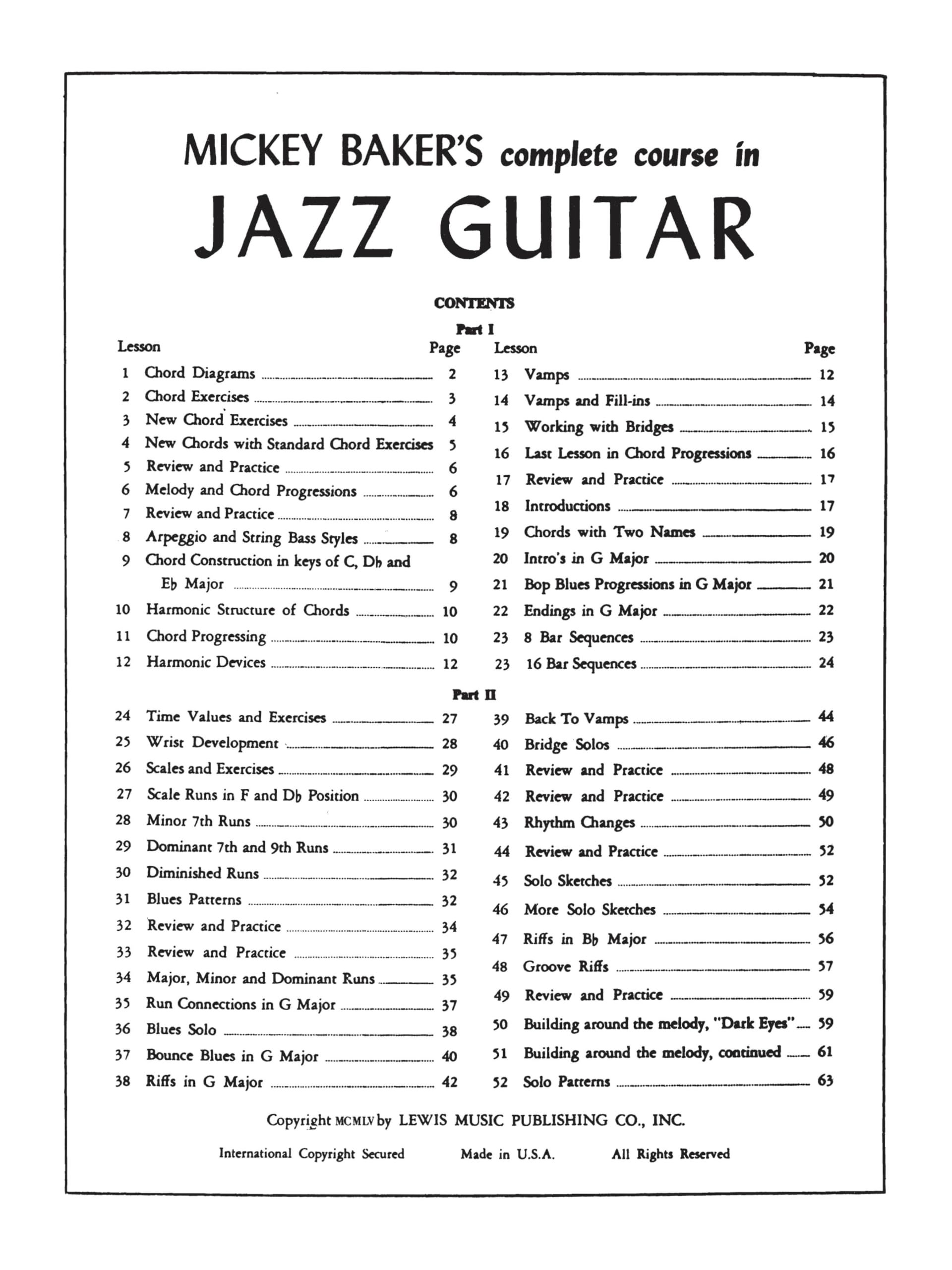
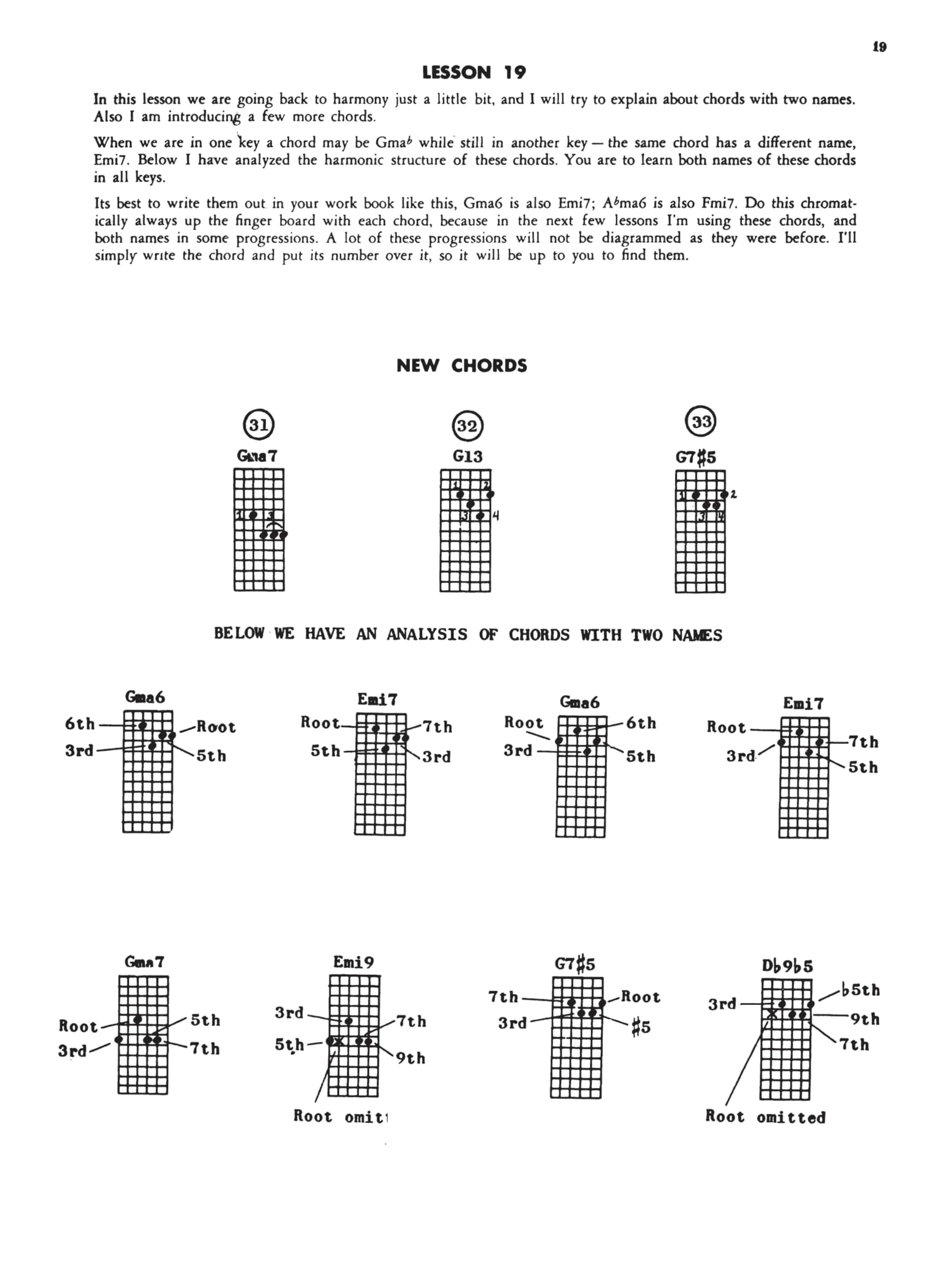
I purchased this volume (and volume 2) 6 months ago or so and have been steadily working through the lessons. As for my skill, I'm an intermediate player with a solid chord vocabulary and a fair understanding of jazz harmony. Like most jazz guitar players, I want to know more. Aside from the low cost ($7.95), what most inspired me to consider these books was the "subtle" endorsement given them by Robben Ford in his "Art of Blues Solos" instructional video (which I enjoyed too). Ford stated that he worked through Mickey Baker's book when he first started playing guitar and... well, Ford is an awesome player! Lesson 1 starts with Baker diagramming 26 chord forms and telling the reading to get familiar with them. The book does not use tab for showing chords, but the chord diagrams Baker provides are straight-forward. I suspect beginning players should want to break the chord forms down, by note, to learn which dotted fret is the root, 3rd, 5th, 7th, etc., for any given chord. The lessons that follow ask the reader to play melodies using specific groups of the 26 chords. Also, for some lessons, Baker asks the reader to transpose progressions from previous lessons into new keys and then practice playing them. As the lessons progress, Baker methodically introduces the reader to more chord forms, to single-note lines, chord vamps, progressions, and more... and more... and more. As other reviewers have pointed out, there are 52 lessons in volume 1, and so there is lots to learn. The Baker books are simply designed for the reader to work at a comfortable yet steady pace, not become overwhelmed by discussions of theory, and to lean to play some cool sounding jazz melodies on the guitar. Beginning guitarists will likely have more difficulty but that would be due to a lack of mechanics than with anything else. With sufficient finger and chord exercises, playing troubles will diminish. Bob
C**N
Bon livre complet pour travailler les différents aspects du jazz, en revanche je regrette l'absence de cd audio reprenant les exemple du livre
D**L
es bueno, sirve muy bien como apoyo de otros materiales didactos de jazz, hace falta el contenido de audio para poder seguir bien las lecciones
L**L
Validissimo, da praticare con cura meglio se con la guida di un maestro per capire il senso degli esercizi. Gli accordi e le progressioni devono entrare nelle mani e gli studi cromatici aiutano a memorizzare note e posizioni jazz sul manico. Tipografia vintage con personalità.
A**.
I need help from some one more experienced for understanding these book. I keep it in my shelf. Material given in the book is excellent
A**ー
おすすめ出来る本です
Trustpilot
1 month ago
2 days ago