Desert Online General Trading LLC
Dubai, United Arab Emirates
Desert Online General Trading LLC
Dubai, United Arab Emirates


🎧 Elevate your sound game—because your ears deserve the best.
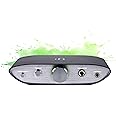
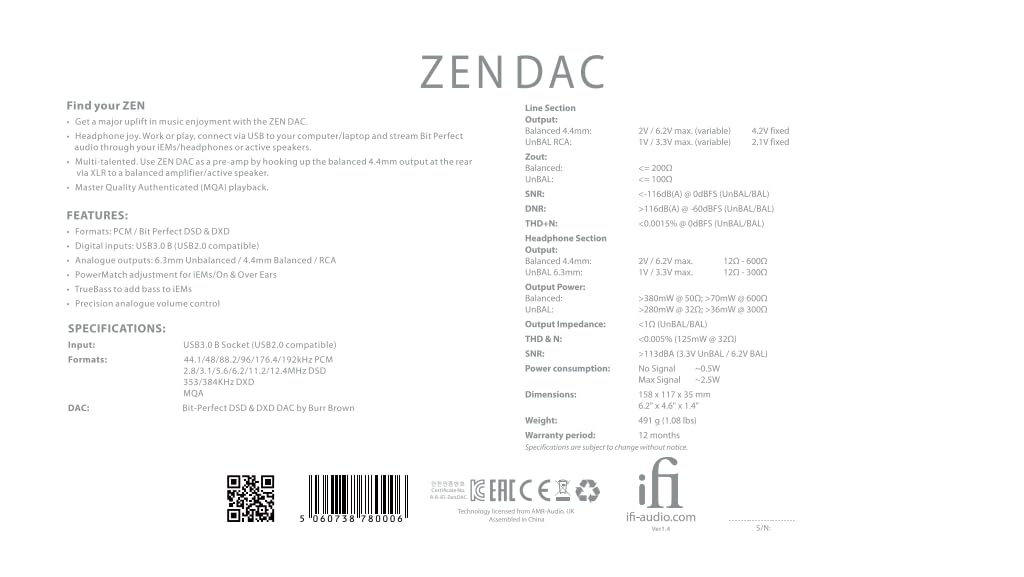
The iFi Zen DAC is a compact, high-resolution digital-to-analog converter and headphone amplifier designed for discerning listeners. Featuring Burr Brown True Native architecture, it supports PCM up to 24-bit/384kHz, DSD256, and MQA formats. With versatile USB 3.0 input and multiple output options (6.3mm, 4.4mm balanced, RCA), plus advanced features like PowerMatch and TrueBass, it delivers customizable, studio-quality audio. Its military-grade aluminum build combines durability with sleek style, making it an essential upgrade for home or office audio systems.
| Brand | IFI |
| Mounting Type | Tabletop |
| Interface Type | USB |
| Number of Channels | 2 |
| Material | Aluminum |
| Manufacturer | Abbingdon Music Research |
| Global Trade Identification Number | 05081313082483 |
| Model | ZEN-DAC |
| Product Dimensions | 27.69 x 15.75 x 6.1 cm; 491 g |
| Item model number | ZEN-DAC |
| Colour Screen | No |
| Batteries Included | No |
| Batteries Required | No |
| Connector Type | RCA, USB |
| Item Weight | 491 g |
K**R
Guter und wertiger DAC / Kopfhörerverstärker für den Schreibtisch mit kleinen Macken.
Ich habe den ifi Zen DAC erst seit zwei Tagen (praktischerweise zum Wochenende bekommen) und schreibe dennoch jetzt schon eine Rezension v.a. um den Interessenten hier ein paar Infos zu liefern, die ich selbst im Netz vor dem Kauf nicht - oder nicht eindeutig - finden konnte.Ich habe mir den ifi Zen DAC u.a. wegen meiner guten Erfahrungen mit den älteren akkubetriebenen DAC/Amps "ifi iDSD Micro" und "ifi iDSD Nano" (beide sind nicht im entferntesten Micro oder Nano) geholt. Und war insbesondere an den symmetrischen Kopfhörer- und Line-Out Ausgängen des Zen interessiert. Die Firma ifi audio ist aber nicht unbedingt mein Favorit; sie verkaufen viele Strom-"Reiniger", USB-"Purifier", sündhaft teure Digital(!)-Kabel usw. und für einen derartigen Kabel-Klang-Esoterik-Voodoo bin ich als Physiker eher nicht empfänglich.Zunächst das "Unboxing":Das Teil ist schwer - richtig schwer für seine Größe (für uns Ältere; hat ungefähr den Fussabdruck einer CD-Hülle) und fühlt sich ausgesprochen wertig an. Man hat Metall in der Hand. Die Steckbuchsen und LED-Bohrungen sind passgenau und die Knöpfe sowie der Lautstärkenregler klicken und drehen ohne viel Spiel. Ausgezeichnete Verarbeitungsqualität. Das Design sieht man ja auf den Fotos - ist halt gewöhnungsbedürftig.Eine Frage die praktisch seit der Ankündigung unklar war: Es ist kein 5V-Netzteil dabei. Im Manual (=eine Doppelseitige Pappe wie von ifi audio üblich ) steht was von Originalnetzteil für die 5V-Rundbuchse benutzen usw. Ein anderer Beipackzettel behauptet übrigens, dies sei der ifi xDSD... Der Lieferumfang beschränkt sich aber auf ein USB-A-zu-USB-B-3.0 Kabel und ein Chinch/RCA-Kabel (ebenfalls typisch ifi audio).Damit kommen auch schon erste Teilpunktabzüge:Das Netzteil braucht man nicht wirklich, da der DAC/Amp ja nur per USB-Eingang betrieben wird und somit immer per Strom versorgt wird (s.u.) - allerdings gibt es ja auch Quellen, die nicht viel USB-power liefern. Eine Netzteil-Beigabe wäre sicher nicht zu aufwändig gewesen bei dem Preis. Ärgerlicher ist aber, dass das USB-B-Kabel nicht richtig funktionierte! Ich hatte erstmal einige Frustmomente mit Linux- und Windows10-PCs und dachte eben an fehlenden Extra-Strom oder USB-2/3 Inkompatibilitäten. bis ich einfach mal andere USB-3.0-B und USB-2.0-B Kabel probierte. Das mitgelieferte Kabel war einfach nicht "datendurchlässig".Sobald der Zen DAC per USB verbunden ist, ist er auch ON. Es gibt keinen On/Off-Schalter oder Switch im Lautstärkenregler. Das Signal-Licht hinter dem Regler (recht dezent) geht allerdings erst an wenn ein USB-Audio-Signal anliegt - es geht aber nicht aus, wenn die Quelle schon aus ist, solange noch Strom anliegt. Das ist natürlich von Vor- und Nachteil. Bei mir von Nachteil , da ich den DAC letztlich an einem powered USB-Hub/Switch betreibe, der zwischen verschiedenen Computern schaltet. Der Zen ist dann bei mir also immer an. Direkt an PCs angeschlossen ist das natürlich wiederum praktisch. Wenn man ein 5V-Netzteil mit Rundstecker anschliesst, signalisiert eine grüne LED, dass jetzt die externe Stromversorgung übernimmt und dem USB-Host wird kein Strom mehr entzogen.Anschlüsse und Nutzung:Das ist eigentlich das Highlight (für mich). Der Zen ist mit 6.3mm KH-Buchse und symmetrischem KH-Anschluss per 4.4mm-Pentaconn-Buchse sowie symmetrischem Line-Out ebenfalls per 4.4mm-Pentaconn auf der Rückseite ausgestattet. Daneben gibt es hinten noch die zwei Chinch-Buchsen. Der sym. und der single-ended-Line-Out sind beide aktiv und können per Schalter zwischen fixed Volume auf Line-Level direkt vom DAC oder eben Pre-Out vom Amp geschaltet werden. Im letzteren Fall wirken neben Volume auch Gain (="power match") und auch die recht dezente Bass-Anhebung auf die beiden Ausgänge. Die Line/Pre-Ausgänge werden NICHT inaktiv, wenn man Kopfhörer einsteckt (auch eine Frage die ich nicht beantwortet fand).Während der 4.4.mm-KH-Anschluss ja wohl klar in seiner Funktion ist (alle meine KHs und IEMs, die balanced Anschlüsse unterstützen haben bei mir auch symmetrische Kabel (meist 2.5mm 4-Pol)), ist das beim 4.4mm Line-Out evtl. eher schwerer nachzuvollziehen. Der 5-polige Pentaconn 4.4mm-Anschluss hat einen großen Vorteil gegenüber zB 2.5mm 4-pol Buchsen: der 5.Ring ist Masse/Shielding. Es können also aktive Komponenten zB per 4.4mm-zu-2mal3-Pol-XLR-Kabeladapter mit korrekter Erdung angeschlossen werden. In meinem Fall hängt ein einfacher aber symmetrischer Röhren-Kopfhörerverstärker (Loxji P20) so an diesem Ausgang. Leider ist es auf dem Markt üblich, solche 4.4mm-2XLR-Adapter mit nur den 4 symmetrischen Signalen belegt (ohne Verbindung des 5. Rings/1. XLR-Pins) anzubieten. Voll belegte Adapter habe ich zB nur auf der amerikanischen Mutterseite von amazon gefunden: "4.4mm to Dual XLR Male Balanced Audio Headphone Adapter Silver Plated Cable 1 FT 0.3M by Youkamoo".Man kann gerne über die Sinnhaftigkeit von symmetrischen Anschlüssen diskutieren, aber der Röhrenamp braucht nunmal 2-XLR-Input um vernünftig zu funktionieren. Damit ist für mich der primäre Kaufgrund für den ZEN DAC erfüllt.Die üblichere Nutzung ist sicherlich der Anschluss von Aktivboxen (über Chinch). Allerdings werden die - wie erwähnt - nicht stumm geschaltet bei KH-Nutzung (und umgekehrt), sodass man weitere Regler braucht.USB-Audio:Tja da kommt der zweite Punktteilabzug; Der Zen wird am win10 PC treiberlos als USB-Audio-Device mit Samplingraten von 44.1 bis zu 384 kHz erkannt - allerdings alles nur in 32bit. Klingt erstmal nicht schlecht, aber ich habe Android-basierte Geräte, die mit den Bittiefen nicht zurechtkommen. Ich hätte mir ein bisschen Abwärtskompatibilität mit USB-Audio1 gewünscht (geht bei anderen ifi-Geräten ja auch). An einem Linux-PC unter Ubuntu 18.04 funktioniert er ebenfalls. Am win-PC wird der Zen unter Audirvana als MQA-fähig erkannt und Tidal-Tracks auch entsprechend abgespielt. MQA ist für mich zwar ebenso fragwürdiger Voodoo wie das esoterische Kabelgedöns... aber wer's mag. Ich selbst habe nur ein Tidal-Probeabo und nutze eigentlich Qobuz(Studio) oder Spotify(Premium).Aber auch ansonsten ist er eigentlich erstaunlich anschlussfreudig:An Apple iPod/iPhone(SE und 5c)/IPad-mini läuft er mit dem Apple CCK problemlos - sogar ohne Extra-Strom ?!?!? ... zumindest zeitweise. Ich habe aber das CCK eigentlich immer unter Strom damit die Apple-Geräte nicht anfangen zu meckern.An meinem eigentlichen Android-Smartphone (LG v30) ging er ebenfalls problemlos und ohne Zusatz-Strom (das LG ist aber auch ein sehr guter Strom-Versorger) mit einem USB-C(OTG)-zu-USB-B-Kabel. Genauso gut funktioniert er an deinem Fiio M9-Android-DAP per USB-C. Diese mobilen Lösungen sind aber wohl eher nicht die klassischen Nutzungszenarien für das Gerät (erwähnte ich schon wie schwer das Teil ist/bzw. wirkt ?).An einem Nvidia-Shield-TV funktioniert er auch super als USB-Audio-Device (mit fest 192kHz als Hi-Res-Gerät). Auch ein Chromebook mit ChromeOS unterstützt ihn als usb-2-audio-device.Das wichtigste... der Klang:Tja, ... ich bin etwas verwöhnt. Ich höre eigentlich primär über recht gute DAC/Amp-Kombis wie zB einem RME ADI-2 DAC + THX 789-Amp und mit einer Ehefrau-verärgernden Vielzahl von recht hochwertigen Kopfhörern wie Beyer T1, T5p(2), DT1990pro oder Sennheiser HD660s, Neumann NDH20, Sendy Aiva usw. Der Zen-DAC ist eigentlich für einen anderen Arbeitsplatz vorgesehen. Ich schwanke noch etwas (wie gesagt ... erst zwei Tage) und will ihn nicht mit wesentlich teureren Geräten vergleichen. Bei den ifi iDSDs war die Auflösung zwar super, aber die Höhen manchmal etwas zu harsch und unangenehm. Das ist hier eher nicht so... aber besonders toll klingt er nicht; etwas schlecht aufgelöst ist er zB. Aber das kann man natürlich auch als entspannend empfinden... mal relativierend: er ist ganz gut für den Preis. Sehr gerne höre ich an dem Zen-DAC zB die Tin P1 planaren IEMs, den HD660s oder den Thieaudio Phantom Magnetostaten. Auch der DAC-direkt-Ausgang ist ziemlich gut.Leistung: An dem symmetrischen Ausgang treibt er recht problemlos die meisten KHs auch mittlerer Sensitivität/ höheren Ohmzahlen (zB. eben jenen HD660s). Aber auch mit "power match" = high gain ist er nicht wirklich kraftvoll. Der Gain-Sprung ist auch nicht wirklich enorm. Der Beyer T1 (der ganz ausgezeichnet am ifi iDSD Micro läuft) geht hier gar nicht - ist aber auch kein Wunder bei 600 Ohm (der ZenDAC ist empfohlen bis max. 300 Ohm).Insgesamt muss ich aber nochmal sagen, dass ein symmetrischer KH-Verstärker/DAC mit wertigem Äusseren und edeln Innereien von einer renommierten Audio-Firma für den Preis wirklich ein Schnäppchen und somit zu empfehlen ist ... wenn das Nutzungsszenario stimmt. Als kleine Schreibtisch-Lösung durchaus zu empfehlen.P.S. (28.10.): Ich habe von 4 auf 5 Sterne aufgewertet. Nicht weil ich nicht weiterhin ein paar Mängel sehen würde, sondern nur aus Fairness, weil eine andere Rezension auftauchte, die völlig unqualifiziert 2 Sterne vergibt.Wenn das hier bei einer Kauf-/Nichtkauf-Entscheidung hilft, gerne den "Hilfreich"-Knopf drücken, dann weiß ich wenigstens, ob es sich lohnt, das hier nach längerem Einsatz des Zen DACs auch mal upzudaten...Update 01.11.: Ok, es gibt scheinbar Interesse an Updates... ifi empfiehlt den Zen DAC für 12-300 Ohm KH, Wenn ich aber sehr(!) sensitive IEMs einstecke (zB TFZ Galaxy T2;16 ohm), höre ich deutliches Grundrauschen und Interferenzen sobald ein USB-Audio-Signal anliegt (auch wenn nichts gespielt wird, die Lautstärke auf Null ist und auch bei Verwendung externen Stroms). Das ist nur in der Amp-Stufe, der DAC-Line-Out ist sehr "sauber". Da ich natürlich nur "böse" Billig-USB-Kabel nutze und nicht zB das "iFi Audio Gemini3.0 Audiophiles USB-Kabel" für nur 589 EUR liegt das wohl an meinem Equipment :) ... und da der ZenDAC definitiv nicht für den mobilen Einsatz mit empfindlichen IEMs gedacht ist, sehe ich das nicht als Mangel - aber wissen sollte man es.
R**V
What can I really say...
First time I've actually ever taken out the time to go back and bother to leave a review on a product, that in itself should say something...Really nice, cool looking piece of kit, from the general aesthetic to the sturdy metallic finish! Would look great amongst any electronics enthusiasts set up/ collection.Looks only get you so far in this world though... so how good is it?Well, I've previously owned a Chord Mojo and an iFi Audio iDSD Micro (silver version) and sure enough, after extensive, critical, to the point of half going nuts back and forth testing between the Chord, iFi, my laptop and my phone, I ended up returning both.Ultimately, i just couldn't justify spending that much money on something that, to my ears, made very little difference in a few select songs (honestly, probably just placebo) to no difference at all in most songs, in comparison to just playing music right out of my laptop/Galaxy S10.For reference, all this was tested on Tidal MQA with a wide range of genres, going all the way from Classical to Hip Hop, using a pair of Senn HD600s, HD58X Jubilees, Philips Fidelio X2's & Audioquest Nightowl Carbons.You couldn't imagine my disappointment after having read and watched so many reviews online praising these products to no end. Touting and holding them up on a pedestal as the best portable DAC/AMPs on the market, even beating out some well regarded desktop options for performance and sound."Pfff... WTF are these people talking about!!? This sh*t don't make a lick of difference!", I thought to myself as I just sat there in silence, arms crossed feeling cheated, feeling swindled, headphones on, music playing, all the while looking over at both devices realising I had really just thrown away close to a grand on something that, (again - to MY ears), made no difference, AT... ALL!So... after this whole, both physically, emotionally and certainly financially draining experience, it's fair to say that I was a little, just somewhat, you know, just a smidge skeptical about trying this whole external DAC & AMP thing again.Originally, I was considering a JDS Labs Atom AMP to get some more much needed juice out of my HP's, no DACs, since we already know how that whole ordeal went. But then I stumbled across this little guy in the Amazon search results and thought, "why not?!", "I mean, it's a DAC/AMP by iFi and it's cheaper than the Atom, sounds like a solid little deal to be honest", and indeed it was.I've been here listening to Tidal MQA through this thing for over 2hrs now, and whether there's a difference in sound quality between it and my laptops sound card, I couldn't tell you, since I havent stopped the music to test it yet, and I probably won't.All I know is, I like what I hear, it's doing it's job well... and It wasn't bloody half a grand like it's old compatriot that i had the pleasure (or displeasure) of getting acquainted with.Side note: Also the bass boost on the Zen actually works, as apposed to the previous £500 model I had. Although, on some songs it can be too much and the bass can get slightly muddy and bleed into the mids quite a bit. At least it works though...All in all, the iFi Zen sounds clean, think that's the word I'm going with. Clean! Not crisp, just clean. Transparent.Clean and transparent sounding, whatever that means, but it makes sense to me as I'm using it.Sorry I can't go into more detail as I wouldn't know how to.Conclusion:Look, it's good.Looks good, feels good, sounds good. And at this price point, I think it's pretty much a no brainer.
G**
Turned my IPad into a Hi-Res audio player for my Hi-Fi
Music streaming services such as Tidal are now offering “Masters” quality Hi-Res versions of albums. The tracks on these albums have been digitally sampled at 24-bit/96kHz which promises to offer a superior audio experience to CD versions of the album which are always digitally sampled at a lower 16-bit/44kHz frequency. The great news is that “Masters” albums are not just limited to recent releases by the likes of Ed Sheeran, Stormzy, Justin Bieber and Drake. The entire back catalogue of musical icons such as the Beatles, Bowie and Led Zeppelin have been resampled at this higher bit rate and frequency from the original Master tapes.I initially expected that it would be relatively easy to enjoy the full Hi-Res audio experience from MQA (Masters Quality Authenticated) files played from the Tidal app on my iOS devices. After a little bit of research I soon learned that MQA files require two stages of unpackaging and processing to unlock the Hi-Res sound. The first stage of the unpackaging is done by the Tidal App on your iOS device. The data is then passed on to the DAC (Digital to Audio Convertor), which is responsible for completing the final unpack and processing of the MQA audio file.The removal of the 3.5 mm headphone jack from recent iOS devices resulted in the loss of the onboard DAC. You are therefore left with one of three choices to transfer your music from your iOS device. The first option is Bluetooth streaming but iOS devices automatically downsample the Hi-Res audio files to AAC format before transferring them, which naturally leads to a reduction in quality. The second option is to use the included Apple lightning to 3.5 mm dongle, which has an inbuilt DAC. This DAC however lacks the ability to reproduce Hi-Res audio. Attaching an External DAC is therefore the only option that will allow you to reproduce Hi-Res audio from an iOS device. If your choice of provider of Hi-Res “Masters” audio files is Tidal you are going to need a DAC that is MQA certified. Unfortunately most DACs on the market are not MQA certified and lack the capability to complete the final unpack and processing of the MQA audio file which is required to deliver true Hi-Res audio.My initial research left me seriously doubting whether there would be any solution within my price range to enable me to deliver Hi-Res audio from my my iOS devices to my Hi-Fi. I therefore couldn’t believe my luck when an internet search brought up the recently released iFi Zen DAC for less than £130. It is such a beautifully designed DAC, with a full metal chassis that gives the Zen such a premium feel. The absolute killer feature of this DAC is that it is MQA certified. This means it can complete the unpacking process and output the Tidal “Masters” files in full Hi-Res audio to the device of your choice. RCA connections allow you to output to your Hi-Fi and there are also two 4.4 mm outputs to hook up a pair of headphones.I connected my iPad Pro by purchasing a £7 USB-C to USB-B 3.0 cable (not to be confused with a USB-C to USB-B 2.0 cable, which won’t fit the USB-B 3.0 port on the Zen). To connect my iPhone I require a Lightning to USB-A dongle (Apple call it the Lightning to USB 3 Camera adapter) along with the supplied USB-A to USB-B 3.0 cable. A slightly less elegant solution but still incredibly simple.I’d initially used my award winning Cyrus Soundkey DAC/Headphone amp (not MQA certified) to deliver audio from my Tidal app on my iPad to my amplifier, via its 3.5mm headphone output. The device has done an admirable job when coupled to my Senheisser Momentum headphones. However to say I was disappointed with the experience through my Hi-Fi was an understatement. Even at low to moderate volume my system really exposed the flaws in the outputted audio, which suffered from very audible distortion.With the iFi Zen DAC I can use a vastly superior, balanced RCA connection to my Hi-Fi’s amplifier, instead of a sub-optimal unbalanced 3.5 mm connection. As soon as I play a “Masters” quality track on my iPad Tidal app the light on the front of the iFi Zen DAC goes purple (technically Magenta) to indicate it is receiving and processing an MQA authenticated file. As soon as I switch to playing one of the more usual standard “Hi-Fi” quality tracks on the Tidal app, the light on the front of the unit switches to green to indicate it’s receiving a lower bit rate file. It is really satisfying to be able to see as well as hear that the DAC is performing its magic on those Hi-Res MQA tracks.In reality however by far the most important part of this review comes down to the sound quality. The iFi Zen DAC delivers were it really matters. I tested it with a wide variety of source material and really “cranked up” the volume and still the music remained absolutely crystal clear. I then cross referenced a “Masters”quality album streamed from the Tidal app on my iPad through the DAC with the CD version I owned, played through my £300 CD deck. The audio reproduction from the DAC was at least as good as that from my CD player.The big difference however comes from the fact that I have unlimited access to millions of songs through the Tidal app. The iFi Zen DAC costs less than £130 and can reproduce these tracks to a level that is at least on par with my CD player. I bought the CD version of an album to experience the ultimate sound quality but thanks to the iFi Zen DAC I can now experience the best quality through a music streaming service.It’s rare to find such a clever, elegant and technically sound product that perfectly matches your requirement. It’s even rarer to find it at such an affordable price!
P**L
Beautifully built and high quality DAC that needed some sound tweaking to get the best out of it.
Update 25 June 2020: so I’ve been using this daily for the last 2 months and I love this DAC. I have compared this to a Chord mojo and Soundblaster Zx and i believe this is well worth it’s £129 price tag. I’ve tried many different headphones on it including AKG’s, Beyers, Sennheisers, HiFiman and phillips ranging from 32 to 600 Ohm and they all sound great on it. I actually prefer it over the mojo and those go for £400 new.There are a tonne of YouTube review videos you can watch and I think I about watched them all before buying this. I’m glad I did and you should too.Now I would consider myself as pretty picky about listening to music but not audiophile territory (at least i can’t afford to be 😂) and like my highs to be crystal clear, my lows to be punchy and deep but not overwhelming and my mid to be just enough to fill the music out but not too much. I listen to a tonne of different music styles but mainly rock and metal but also love a bit of classical, dance and a few other genres so whatever i listen to my music through needs to perform across a wide range of styles.I break the cardinal sin (according to hardcore audiophiles) of using EQs where I think they are required but I listen to my music through reference/studio kit as I think it’s a perfect baseline to build your tone from. I use studio monitors (yamaha HS-5 and KRK Rokit 8’s through studio kit incl a EQ and sonic exciter to restore some of the quality lost by streamed music and I love my sound. For headphones I use AKG K702’s and love them.Anyway enough about my preferences, I love the iFi Zen. It is one of the only ones I’ve found with a good bass boost feature (needed for the AKGs) and it is beautifully built and feels and looks very premium. However, what people describe as “warm” I would describe as dull and lacking in upper clarity. However don’t despair, using the app “Equalify” in conjunction with Spotify on my PC I have restored these lost frequencies and now it sounds awesome. You may not be fussed by this but I like those cymbals to be crystal so the EQ was a must for me.I would definitely recommend this DAC period. It’s great and with a bit of EQ I have got all my music to sound fantastic.Edit: today (18/04/2020) I decided to plug in a 5V power supply I had lying around from a USB hub I’m not using (as opposed to spending over £40 on an iFi one) to see if there is any improvement and I have noticed a pretty considerable widening of the soundstage and more clarity in the music. I’m even happier with the Zen DAC now so I would recommend digging out a 5V power supply or buying a half decent one to get the absolute most out of this great Unit.Edit: 18 May 2020 - I’ve now run this DAC with phillips fidelioX2HRs, senn HDxx’s, AKG K7xx’s and Beyer DT990’s and they all sound amazing. The balanced port helps drive the HD6xx’s really well. I’ve also bought a little magni 3 heresy to help power the beyers and using the rca outs it sounds great. Important point I couldn’t see written anywhere was that if you leave the RCA outs to be variable (I.e) you can control the volume (pre-out as opposed to line out) the gain and Truebass functions are still available through the RCA’s and front ports which is awesome.I really Love this DAC, I really can’t see me spending money on an upgrade any time soon!!
R**Y
iFantastic!
I’m a self-confessed iFi fan. So please pardon the stream-of-consciousness review.Also, I live in South Africa - and this unit was purchased via Amazon in the UK and swiftly delivered to me in Johannesburg in the new year, well before the world started locking-down due to the Coronavirus.So, first some context. The love-affair with iFi started last year as I started to emerge from the false-premise that all digital music could not live up to the mesmerising sounds that I used to get from my vinyl & CD days. This was before I even knew such a thing as a dac or headphone amp existed. I’m 47 years old, and now I feel like a kid in a candy shop as I’m re-living and re-loving my music collection all over again.It started with a birthday gift to myself last year. I splurged out on my first hi-end pair of headphones in almost 2 decades - the Beyerdynamic DT770 Pro 80 Ohm, which I bought from a South African distributor. This was huge for me, as they were not cheap for me, and they were the most ‘fancy’ set of cans I’ve had since I wore out my pair of Sennheiser HD 497s well over 10 years ago. The Sennheisers were eventually replaced by the Klipsch Image One, and then the Grado SR80e headphones - which were good, but I wasn’t in love.Then one day, a colleague of mine, who happens to be quite the established audiophile, saw my disillusionment as I plugged my DT770s into my headphone jack socket on my MacBook Pro and was underwhelmed by what I was hearing. He suggested two things: “Try a headphone amp or dac, and stop using iTunes.” So I stopped using iTunes and upgraded to Amarra Luxe Pro (which is phenomenal, but buggy as hell). And then he said he would loan me his dac to try out. The next day he presented me with his iFi Nano iDSD dac (which I believe has been discontinued - please correct me if I am wrong people from iFi).After connecting it to my MacBook and listening to Miles Davis's & Cannonball Adderley's "Autumn Leaves", my ears melted into audio heaven. I couldn't believe it! It certainly made the music sound awesome like I'd never heard it before, but still struggled to drive my DT770s to a loud enough volume. Even my Grados took on a new lease on life through that little iFi. I begrudgingly had to return the Nano iDSD a few days later, and longed to return to that sound. But I couldn't just go out and purchase a dac - as I am a budget audiophile virgin, and I have a family to feed. So I waited some time before I could splurge again. I then got an impressive little Sabaj PHA3 tube headphone amplifier, which definitely improved the volume of my DT770s, but yet still something was missing. And then iFi released their Zen Dac. And, it seemed like a gigantic upgrade on the Nano iDSD for less money, and I bit the bait.So, I've been living with the iFi Zen Dac for almost 5 months now, and I can honestly say that it has been one of my best friends during lockdown.It's permanently plugged into my MacBook Pro's USB socket, which is great as it doesn't need external power - although it comes equipped with a 5 volt DC power input, but alas no power adapter. This may be a dealbreaker for some, but I plugged in my Sabaj power adapter into the unit and heard no noticeable difference in sound quality as opposed to using just the USB connection. Which is fine for me as my wall-socket already looks likes Medusa's hairdo with all the wires and things. I have connected the iFi's RCA outputs to the Sabaj amp (where the iFi becomes a pure dac), and sometimes switch between the plugging my headphones into the iFi or Sabaj just to hear the sound differences. Not too sure why, but my Hifiman HE4XX planar magnetic headphones sound a little better powered through the Sabaj, but for everything else the iFi is unbeatable. I have not tried any of my headphones on the balance output that the iFi Zen Dac comes standard with, opting to use the 6.3mm unbalanced port with a quarter-inch adapter that most headphones include as an accessory. Some say that the balanced output might be better for the planar magnetic headphones, but alas I will have to wait till I get a 4.4mm pentaconn adapter to verify this.I'm not going to get into any of the fancy technical details of the iFi Zen Dac, mainly because I do not understand most of it. But it seems to be extremely high-specced and hi-tech for a dac costing under £130, and the build quality is truly astounding. Most other dac/amps in this price-range are made of plastic, but this is solid metal, and a nice hefty metal at that. They say it's military-grade aluminium - and it feels like it's built like a tank. I also love the retro look of the design - it's got soul.I guess I should get into how the iFi Zen Dac sounds. Well, to my ears, utterly magical. I can only imagine how iFi's more expensive dacs sound if this little wonder already makes my ears joyous. Some say it has to do with iFi's love-affair with using the Burr-Brown Dac chip in their circuitry. And I love the TrueBass function, which really rounds of the bass nicely. If you're a reggae and dub lover, then you need the TrueBass button in your life. But it's not just the bass that is buttery, so too are the mids and highs. And as an amp it gets loud. My DT770s are already extremely loud at the 1 'o clock position on the volume knob (and what a lovely knob it is).Currently I'm mostly streaming music from Deezer HiFi and Spotify Premium on my MacBook Pro, played through the Zen Dac, and I'm loving my music all over again. It really is that good. I'd love to get a second one so I can have one at home and one at the office, but my wife might divorce me if I buy any more audio toys LOL.
Trustpilot
4 days ago
2 months ago