Desert Online General Trading LLC
Dubai, United Arab Emirates
Desert Online General Trading LLC
Dubai, United Arab Emirates

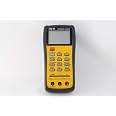
it comes only DE-5000 the LCR meter.
| Brand | IET Labs |
| Power Source | Battery Powered |
| Style | Classic |
| Color | Yellow |
| Item Weight | 12 ounces |
| Item dimensions L x W x H | 7.4 x 2 x 3.74 inches |
| Measurement Type | LCR Meter |
| Part Number | CECOMINOD083425 |
| Product Dimensions | 7.4 x 2 x 3.74 inches |
| Item model number | DE-5000 LCR Meter (Replaced DE-6000) |
| Batteries | 1 9V batteries required. (included) |
| Is Discontinued By Manufacturer | Yes |
| Item Package Quantity | 1 |
| Batteries Included? | Yes |
| Batteries Required? | No |
| Battery Cell Type | Alkaline |
P**.
Incredible capabilities and specs for a portable meter!
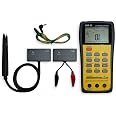
Edited to add: Beware of units sold by vendors other than IET or Amazon, as a similar unit exists which is an older instrument branded "Der EE." This is not the same instrument as the IET-branded one. IET Labs worked with an OEM to created their version, using their design input and internal software. I would suspect that the older unit might not meet the specifications and repeatability of the IET unit. Caveat emptor!After leaving a career in metrology, standards and calibration lasting over 30 years, I thought I wouldn't miss it. As it turns out, I had collected lots of my own equipment over the years and have been rounding out some of the missing elements I was so accustomed to having access to in an accredited, broad-capability lab environment. I've been needing a reliable LCR meter to replace my antique HP which needs unobtanium part galore and didn't want to take on yet another needy antique. Looking around at the various handheld portables I find so many of them with limited capabilities or dismal specs, with reliability a huge unknown. Agilent and B&K Precision had a couple models that piqued my interest, but I wasn't sold. I had found the OEM version of this meter before and didn't give it any thought, it seemed a huge unknown with little published information. I ran across this IET-branded version and had to take a look. I am very familiar with IET, Quad-Tech, ESI and old & new General Radio/GenRad equipment as many of these brands made up the core of my working and primary resistance/impedance (L-C) standards and more. IET is the umbrella company of all these brands these days and seeing their name applied to this particular instrument made me believe there was something more to it. I read the rather impressive specs and did some research with the DE-5000 held against other units I was considering. I came away completely impressed with the unit on paper, and figured if this meter had IET's considerable backing and support, it had to be a top contender. Weighing all the available options I had, I pulled the trigger and ordered one. I'm very happy I did.The unit arrived securely packed and undamaged. I was pleased to find the kit box of a higher quality that I expected, the OEM version apparently not shipping with the box. Inside was a tidy, well laid-out package consisting of the DE-5000 itself, the alligator clip test adapter TL-21, TL-23 guard/ground lead, the DE-5000-AC 120-240VAC adapter (I had expected this to be optional) and a genuine Duracell 9V alkaline battery, plus the well-written user's manual tucked in the kit box lid. The unit itself is solid, substantial and extremely well made. There is no soft-shell holster or rubber overmold, and in my opinion, none is needed given the typical environment the meter will be used in. A cursory internal inspection shows me the unit is very overbuilt and rugged. It's far from fragile! Excellent "out of box experience."I put the DE-5000 through its paces on my collection of "check standards", a set of measured, high-precision resistors, capacitors and inductors I keep as my personal standards lab to verify my own gear. The DE-5000 measured all of these well within its already impressive specs. The TL-21 adapter actually brings a true Kelvin 4-terminal guarded (shielded) measurement connection right to the alligator clips. This makes reading low-to-milliohm resistance far more repeatable and accurate than the typical pair of test leads. Very unexpected to find the four-wire model applying to the two banana jacks, which are internally split and make a separate source/sense connection to each side of an inserted banana plug. Impressive! This calls for the use of high quality test leads for two-wire measurements. Using either the included test fixture/leads or other test leads, a simple automated open/short calibration process can be made using a single key to offset stray L/C/R effects and ensure accurate measurements. The included guard terminal and lead ensure that low L/C and high resistance readings can be taken by enclosing the DUT in a shield, or using the device frame or shell like those found with IF cans or variable capacitors, without introducing errors due to stray EMF and the like. The unit also has slots that accept wire- or tab-leaded components right at the front panel, perfect for small component testing. Just plug the leads in. As a bonus, these clips apply a Kelvin 4-terminal measurement directly to the leads, as the lead opens the clips, each half of the clip is a separate source and sense terminal. This makes for accurate and repeatable measurements every time.The breadth of measured parameters the meter presents are practically perfect. Along with the direct autoranging values of resistance in ohms, capacitance in farads and inductance in henries, the unit measures selectable series and parallel inductance and capacitance for each component type, ESR in series and parallel, Q, dissipation factor and phase angle. Five test frequencies are available (100Hz, 120Hz (think AC line filtering here), 1kHz, 10kHz and 100kHz) making multi-ranged measurements of individual components possible. I like to design & build amplifiers and crossover networks in addition to making repairs to them plus lots of other electronic gear, the DE-5000 makes selecting and matching passives very easy already. A "Sort" function is included to allow the user to enter a specific component value then choose from a number of industry standard tolerances, then test a batch of components with the DE-5000 indicating when a DUT falls outside the spec range. This is a fantastic add-on for those needing to match component tolerances for precision, or just make sure an unknown pile of parts fall within acceptable limits. Wonderful addition for a hand-held meter.The dual display is easy to read, has blue backlighting and has separate 20,000 and 2,000 count simultaneous readouts of primary and secondary parameters. There is also an analog bar graph provided as well, great for testing variable devices or sensing intermittents. You can let the DE-5000 automatically select the appropriate set of readings automatically regardless of what device you connect, or manually select the main function as well as the secondary reading as you need. With a capacitor connected, you can select the inductance measurement to read internal series inductance, for example. Since the meter uses either AC or DC excitation to measure resistance, you can take a typical DC resistance reading and compare it to the reading given at different test frequencies. This is fantastic to find out if a component becomes reactive when in circuit. A handheld or bench DMM can't do this. Useful to find out if a wirewound resistor is appropriate for a particular design or for replacement. If it's reactive, you can measure its inductance or capacitance as well. For critical testing, Q, D and ESR parameters are available. Find out if that replacement electrolytic cap you are considering for a switching supply is adequate. Create high-quality filters and crossovers. For the engineer, technician or serious electronics hobbyist, this unit is a practical must.My list of "cons" is short. I wished the TL-21 leads were a tad longer, there are some components (large, small-value HV capacitors for one) that I'd like to measure using the shielded leads. The TL-22 SMD tweezers for me are a must, and those, along with the other available option, the DE-5000-DTK USB data transfer interface and software are not sold on Amazon by IET and these are worthy, must-have (especially the SMD tweezers) additions. These, along with the standard TL-21 should be easily available. I'd like to have a spare TL-21 adapter to modify with longer shielded two conductor cable to make the aforementioned test connection for bigger components. IET can make either a "deluxe" version of the kit available here and/or provide an easy link for purchasing the accessories to round out an already impressive setup.To sum it up, I am impressed with this unit and its specs and capabilities. Having it backed by a company at the forefront of impedance measuring technology made the purchasing decision swift and easy.Edited to add: Thanks to the attention of Mr. Sheena from IET, I now have the TL22 SMD tweezers to complete my LCR test kit. The tweezers are well constructed and have excellent shielding all the way to the tips. As long as the tweezers are gripped behind the molded-in ridges near the tips, there is absolutely no added stray capacitance or other artifacts added to the readings even on the lowest cap ranges. I was able to test the values of a small pile of unknown value SMD resistors and caps without chasing them around with probes all over the bench or launching them across the room by accident. Anyone considering this meter and plans on doing any SMD or fine-pitch leaded component testing or troubleshooting should order up these SMD tweezers to complete the set.
A**Y
Buyer Beware!!
Please be careful with these meters, if I could give no stars I would, they have good reviews but the 2 I ordered had a serious flaw. The first meter I purchased was used but in good condition, I opened up the battery compartment, put in a fresh 9 volt battery and the battery heated up instantly, the battery compartment pins have a 9 volt cradle that only allows the battery to go in one way, as soon as I put the battery in, the battery itself immediately heated up. I sent it back, my money was refunded, so I decided to purchase a second DE-5000 because I thought maybe I had received a defective one. The 2nd one I purchased was brand new, this too did the very same thing, they even included a battery and the battery heats up so fast that I had a hard time removing it from it's cradle. I tested the battery pins and found that they are shorted in both cases. If I were to close the battery compartment, well lets just say the meter might have been a charred mess or my home may not be have been here anymore, extremely disappointed. Buyer Beware!!!
G**N
An excellent value.
Is sturdy and well made. Readings agree with the stated values of several precision resistors and capacitors. Agrees also for capacitance with my BK Precision 810C and for resistance with my Fluke meter. I have no other inductance meter with which to compare its readings, nor any precision inductors so-labeled. But as the first two are correct, I am presuming also the third, this being an automatic impedance bridge. I am well pleased.
C**.
Measure Inductors and Caps Accurately for a Reasonable Cost
There are three common types of LCR meters available to the home or small business user - There is this type which is essentially an automatic impedance bridge and measures not just inductance or capacitance at a single frequency but measures it at a selectable frequency (100Hz, 120Hz, 1kHz, 10kHz, or 100kHz) plus it measures The Q of inductors or dissipation factor of caps at the same time (it can be set up to give the equivalent series or parallel loss resistance). This type is the very best approach because it gives you an accurate measurement of the part at a specific frequency which allows you to know not just the value to good accuracy but also an indication of the loss or quality factor which affects how the part will work in your circuit. The other low cost types are either DVM's with an inductance and capacitance range or a meter that measures capacitance or inductance by resonating or balancing the part against an internally known capacitance or inductance by automatically sweeping the test frequency. The DVM type units are only good for relatively high values of inductors of capacitors such as might be used in a power supply or some audio work - they are useless for most RF work because the measurement frequency is low and measurements in the microHenries or picoFarads are impractical. The frequency sweeping units that resonate or balance against an internal cap or inductor reference can give large errors in value reading if the test frequency turns out to be equal to or greater than 1/10 of the part's self resonance frequency - And in the case of iron core or ferrite core inductors, their inductance is also a factor of frequency and the test frequency may be outside the intended use frequency giving significant errors.The good (for me):This is an automatic bridge type measuring tool and can be set measure at the desired test frequency matching your use or the parts specs.Very wide range of measurements - It works for both RF type parts and audio or power supply type parts.Has calibration (open and short) to zero out the test leads or test fixture influence, calibration is stored internally so you only have to do it when you change test leads or fixture.Displays not just the inductance or resistance but also the Q or D (cap loss factor).Self contained with internal 9 Volt battery (plug in external 9 Volt supply option available) - no USB power cube and DC cable required.Fairly easy to use - plug in your test leads; run open short calibration, store calibration; select Auto and test away (change test frequency as desired).Has advanced modes for go/no testing and sorting, displaying loss resistance, connecting with computer - I did not try any of this.Tremendous value for what it is - does the job of testers selling for over three times this cost.Could use improvement:Included manual is printed in Chinese - Just google "DE-5000 manual" and download and print the English version.Other Notes:This is available as a kit with plug in test leads and a tweezer probe for measuring SMD chips. If you deal with SMD chips you really, really need to buy this kit or the tweezer probe. If you do not use SMD chips you can make roughly 6 inch long test leads with clips that plug in with a dual banana plug and save the cost of the kit if you can solder and have a dual banana plug and wires and alligator clips. Small leaded parts can just be plugged into the test slots on the tester.I am a retired electronic engineer. I have no relationship with the seller or manufacturer of this instrument or with Amazon.
R**D
Non english instructions, false advertising, there is no 6000 available.
Not sure which unit this is since Amazon add says the 5000 was discontinued but still says 5000 on the case. No English instructions for the price, false advertising(see below) - 3 stars.Seller advised me that the 5000 has not been replaced, add on Amazon was incorrect.
Trustpilot
2 weeks ago
2 weeks ago
2 weeks ago
3 weeks ago